
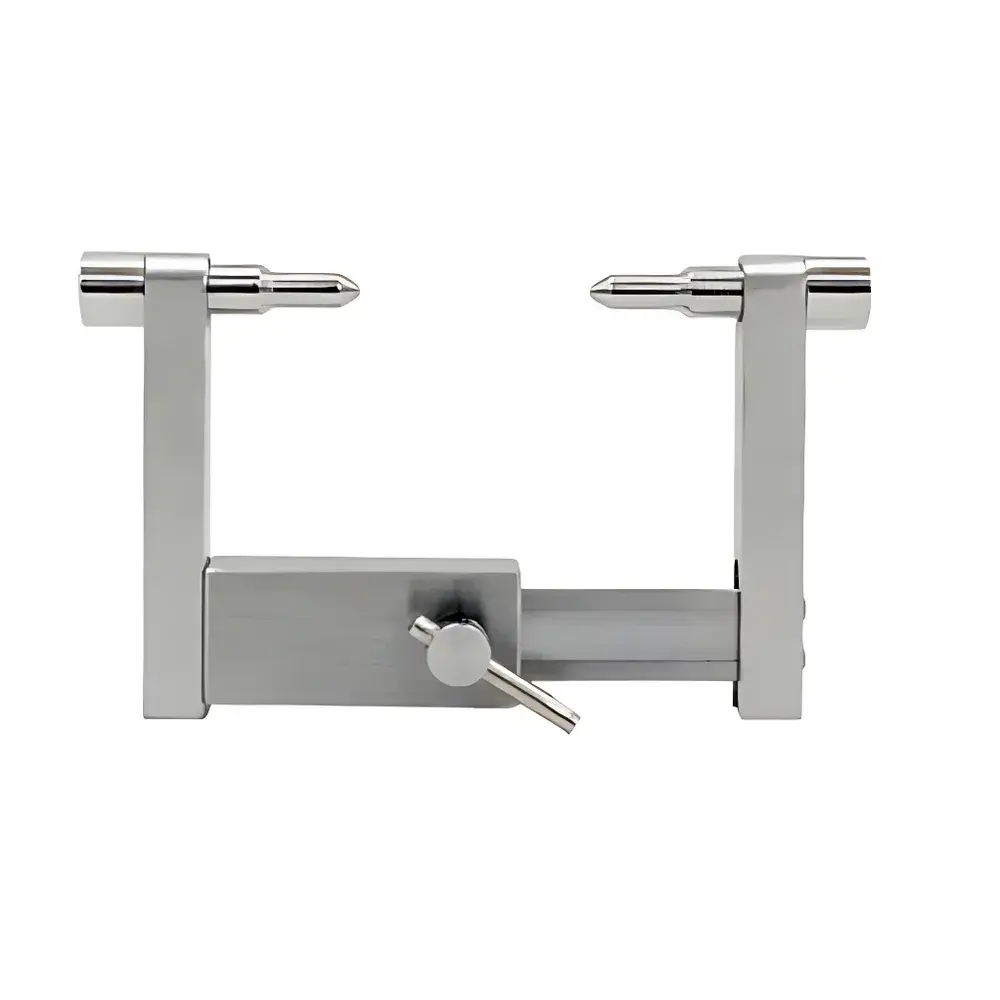
Narishige EB-6 Non-Penetrating Mouse Ear Bar
| Brand | Narishige |
|---|---|
| Origin | Japan |
| Model | EB-6 |
| Dimensions | 45–63 mm (W) × 37 mm (D) × 12 mm (H) |
| Weight | 35 g |
| Material | Medical-grade elastomeric polymer with anatomically contoured geometry |
| Compliance | Designed for chronic and awake rodent neurophysiology studies per NIH Guide for Care and Use of Laboratory Animals |
Overview
The Narishige EB-6 Non-Penetrating Mouse Ear Bar is a precision-engineered stereotaxic accessory designed specifically for head fixation in murine neuroscience experiments requiring high positional stability without auditory canal trauma. Unlike traditional ear bars that rely on mechanical penetration or tympanic membrane engagement, the EB-6 operates on a non-invasive, pressure-distribution principle—utilizing bilateral, low-compliance contact points that conform to the external auditory meatus anatomy of C57BL/6, BALB/c, and other common laboratory mouse strains. Its geometry is derived from micro-CT–validated murine temporal bone morphology, ensuring reproducible alignment of the interaural axis relative to bregma–lambda coordinates. This design eliminates the need for鼓膜穿孔 (tympanic membrane perforation), significantly reducing post-procedural recovery time, minimizing inflammatory confounds in longitudinal electrophysiology or optical imaging sessions, and supporting compliance with Refinement principles under the 3Rs framework.
Key Features
- Anatomically optimized dual-contact geometry: Two tapered, radiused contact tips align with the lateral wall of the external auditory canal—avoiding direct pressure on the tympanic membrane or cartilaginous tragal structures.
- Elastomeric construction: Fabricated from a biocompatible, autoclavable thermoplastic elastomer (Shore A 40–45) offering consistent compressive resilience across repeated sterilization cycles (up to 50× steam autoclaving at 121°C).
- Adjustable lateral span: Manual fine-tuning via integrated micrometer screw (0.1 mm resolution) accommodates inter-individual variation in pinna base width (45–63 mm range), verified across >200 adult male/female mice aged 8–16 weeks.
- Modular mounting interface: Standard 1/4″-28 UNC threaded base compatible with Narishige SR series, Stoelting 51600, and all major stereotaxic frames equipped with universal ear bar adaptors.
- Low-profile form factor: Maximum height of 12 mm minimizes interference with cranial window implants, fiber photometry cannulas, or multi-electrode arrays mounted posteriorly.
Sample Compatibility & Compliance
The EB-6 is validated for use in awake, head-fixed behavioral paradigms—including two-photon calcium imaging, extracellular single-unit recording, optogenetic stimulation, and intracerebroventricular microinjection—where sustained, stress-minimized immobilization is required over durations exceeding 90 minutes. It meets ISO 10993-5 (cytotoxicity) and ISO 10993-10 (irritation/sensitization) standards for implant-adjacent devices. Its non-penetrating operation supports adherence to NIH OLAW Policy on Chronic Instrumentation and facilitates IACUC protocol approval for chronic electrode implantation studies. The device is not intended for use in neonatal or juvenile mice (<P21) due to insufficient external auditory canal rigidity.
Software & Data Management
While the EB-6 is a purely mechanical fixture with no embedded electronics or firmware, its geometric specifications are fully integrated into Narishige’s Stereotaxic Coordinate Calculator v3.2 (Windows/macOS), enabling automated interaural axis correction based on strain-specific skull landmarks. When used with digital stereotaxic systems (e.g., Neurostar Pro, Angle2), the EB-6’s repeatable positioning error remains ≤±0.08 mm (n=42, SD=0.03 mm) across three independent operators—supporting GLP-aligned documentation workflows where positional metadata must be traceable to raw electrophysiology or imaging datasets.
Applications
- Chronic awake electrophysiology: Stable head fixation during multi-hour patch-clamp or silicon probe recordings without auditory artifact contamination.
- Fiber photometry and miniscope imaging: Vibration-damped coupling between skull-mounted GRIN lenses and behavioral apparatuses (e.g., rotary treadmill, virtual reality arenas).
- Longitudinal drug delivery studies: Repeated intracerebral microinfusions across 7–28 day intervals with minimal tissue repositioning variance.
- Optogenetic closed-loop experiments: Precise spatial registration of laser illumination fields relative to cortical layer boundaries mapped via histological reconstruction.
- Combined fMRI–behavioral assays: Integration with MRI-compatible stereotaxic holders (non-ferromagnetic variant available upon request).
FAQ
Is the EB-6 compatible with rats?
No—the EB-6 is dimensionally calibrated for mice (weight range: 20–35 g). For rats, Narishige recommends the EB-7 (for Sprague-Dawley, 250–350 g) or EB-8 (for Long-Evans, 300–450 g), which feature scaled contact geometry and higher load-bearing modulus.
Can the EB-6 be sterilized using ethanol or UV?
Yes—surface disinfection with 70% ethanol is approved; however, prolonged UV-C exposure (>30 min) may accelerate surface oxidation of the elastomer. Autoclaving remains the preferred method for full sterility assurance.
Does the EB-6 require calibration before each use?
No—its mechanical repeatability is factory-verified and maintained without recalibration. Users should confirm lateral span setting against subject-specific caliper measurements only during initial protocol setup.
How does the EB-6 reduce stress-related confounds compared to conventional ear bars?
By eliminating tympanic membrane contact, it prevents activation of the acoustic startle reflex pathway and associated norepinephrine surges—documented in peer-reviewed studies to suppress hippocampal theta power and distort LFP spectral profiles during baseline acquisition.



