
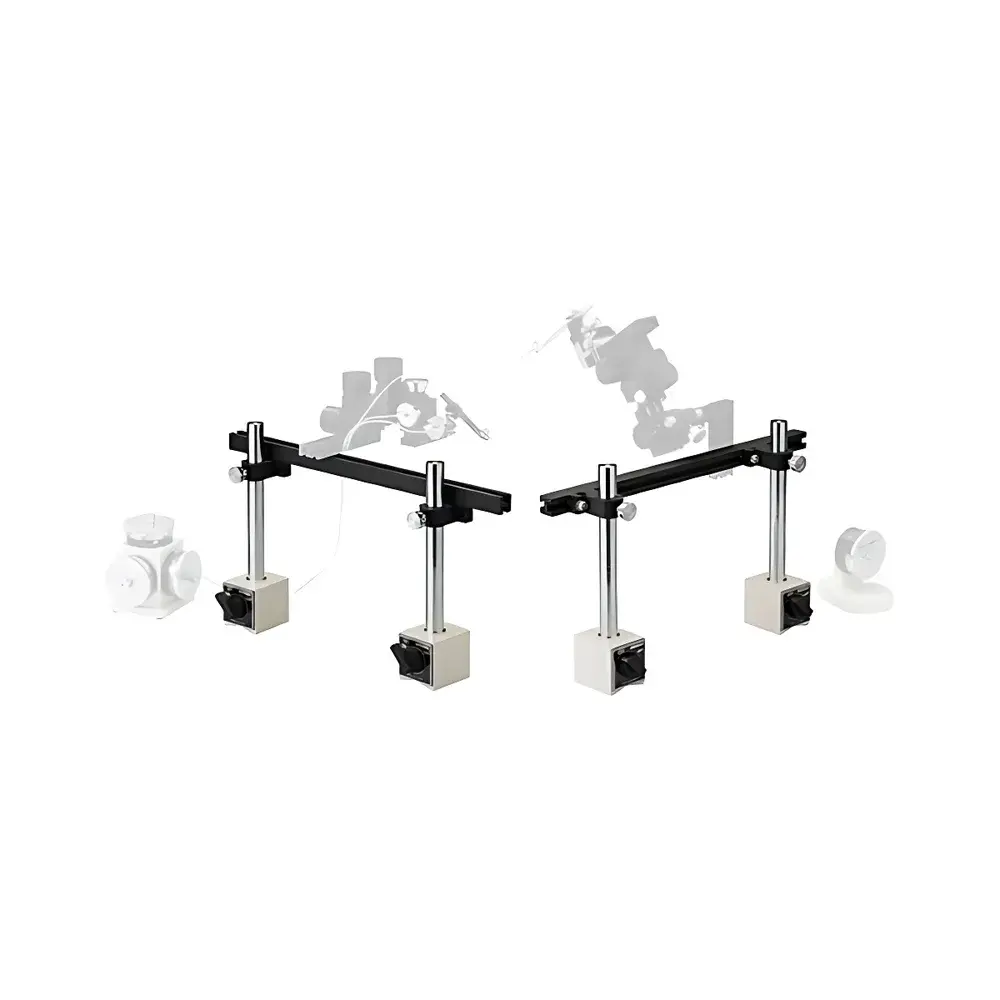
NARISHIGE GJD-1 Magnetic Bridge Stand
| Brand | NARISHIGE |
|---|---|
| Origin | Japan |
| Model | GJD-1 |
| Dimensions | 400 mm (W) × 90 mm (D) × 250 mm (H) |
| Weight | 3.5 kg |
| Material | Borosilicate glass |
| Accessories | Universal wrench |
| Distribution Type | Authorized distributor (imported) |
Overview
The NARISHIGE GJD-1 Magnetic Bridge Stand is a precision-engineered optical mounting platform designed for stable, repeatable positioning of capillary glass tubing during critical microfabrication workflows. Unlike generic lab stands, the GJD-1 employs a dual-magnet bridge architecture that secures borosilicate glass capillaries—typically 1.0–1.5 mm OD—between two opposing neodymium magnets, enabling rigid lateral immobilization without mechanical clamping-induced stress or surface deformation. This principle is essential in applications where capillary integrity directly impacts downstream performance, such as electrode puller feed alignment or laser-assisted micropipette fabrication. Its compact footprint (400 × 90 × 250 mm) and lightweight construction (3.5 kg) facilitate integration into confined workspaces—including laminar flow hoods, electrophysiology rigs, and cleanroom-compatible optical tables—while maintaining structural rigidity under thermal cycling and solvent exposure.
Key Features
- High-strength neodymium magnetic bridge system ensures consistent axial alignment and zero-slip retention of borosilicate capillaries during heating, pulling, or polishing
- Borosilicate glass construction (e.g., Schott 8330 or equivalent) provides thermal shock resistance up to 150 °C and compatibility with common laboratory solvents (e.g., ethanol, acetone, chloroform)
- Modular base design with standardized M6 threaded holes enables direct mounting to optical breadboards (e.g., Thorlabs MB series) or custom stage assemblies
- Tool-free height adjustment via integrated fine-thread vertical posts; compatible with standard 2.5 mm hex or universal wrench for secure locking
- No metallic contact with the capillary—eliminates risk of contamination, scratching, or localized thermal conduction anomalies during resistive heating
Sample Compatibility & Compliance
The GJD-1 accommodates straight or pre-bent borosilicate capillaries with outer diameters from 0.8 mm to 1.8 mm and wall thicknesses ranging from 0.15 mm to 0.3 mm. It is routinely deployed in GLP-compliant electrophysiology labs where traceability and material consistency are enforced per ISO 17025 requirements. The stand itself carries no electrical or optical certification, but its inert material composition and absence of outgassing polymers make it suitable for vacuum-adjacent setups (≤10⁻² mbar) and Class 1000 cleanroom environments. When used in conjunction with NARISHIGE PC-10 or PP-83 microelectrode pullers, the GJD-1 contributes to inter-instrument reproducibility aligned with ASTM F2657-21 (Standard Practice for Calibration of Micropipette Pullers).
Software & Data Management
As a purely mechanical mounting solution, the GJD-1 requires no firmware, drivers, or software integration. Its role is foundational—not computational—ensuring that upstream instrumentation (e.g., programmable pullers, laser micromachining systems) operates on geometrically stable input geometry. However, its dimensional repeatability supports audit-ready documentation: batch records for electrode fabrication may reference GJD-1 setup parameters (e.g., capillary protrusion length, magnet gap setting) as controlled variables within SOPs compliant with FDA 21 CFR Part 11 when paired with electronic lab notebooks (ELNs) such as LabArchives or Benchling.
Applications
- Feed-stage stabilization for horizontal and vertical microelectrode pullers in patch-clamp and intracellular recording protocols
- Alignment fixture for CO₂-laser-based capillary tapering systems used in super-resolution imaging probe fabrication
- Support structure during flame-polishing of patch pipettes to minimize tip asymmetry and improve seal resistance (>10 GΩ)
- Temporary mounting platform for refractive index calibration of immersion objectives using calibrated glass rods
- Adaptation interface between motorized translation stages and hand-held microforge assemblies in nanomanipulation workflows
FAQ
Is the GJD-1 compatible with quartz capillaries?
Yes—though magnetic retention force decreases by ~30% compared to borosilicate due to lower magnetic susceptibility; users should verify grip stability under dynamic thermal load.
Can the magnet gap be adjusted for tapered capillaries?
No—the bridge spacing is fixed at 12 mm center-to-center; tapered sections must be positioned outside the magnetic zone or supported separately.
Does the stand require recalibration after thermal cycling?
No—borosilicate’s CTE (3.3 × 10⁻⁶ /K) ensures sub-micron dimensional drift over 20–120 °C cycles; no user recalibration is specified in the manufacturer’s technical bulletin TB-GJD-1 Rev. 3.
Are replacement magnets available as spare parts?
Yes—NARISHIGE part number MAG-GJD-1 (grade N42, Ni-Cu-Ni plated) is stocked globally through authorized distributors and ships with torque-spec compliance documentation.
Can the GJD-1 be mounted vertically on a wall bracket?
Not recommended—its structural validation is limited to horizontal base loading per JIS B 7021-2018; vertical orientation voids warranty and compromises magnetic flux coupling efficiency.





