
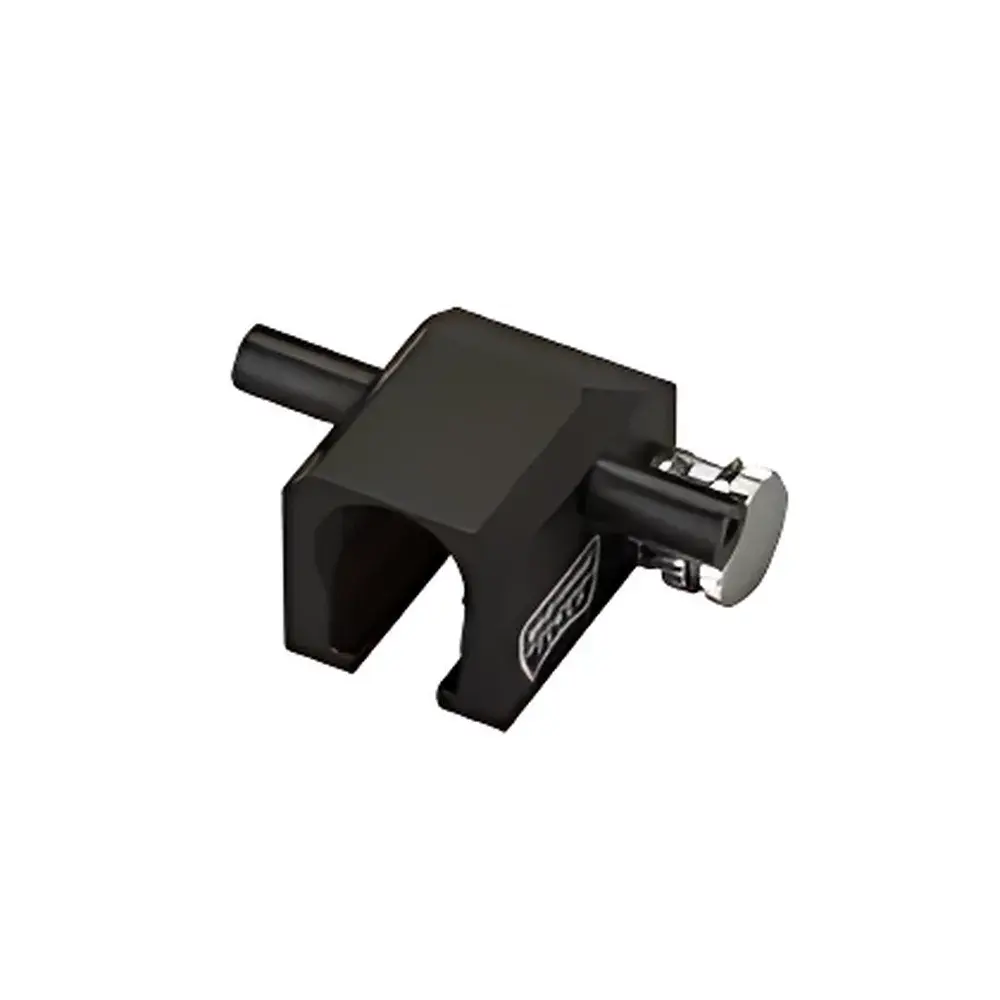
Narishige GM-4 Anesthetic Mask for Mice
| Brand | Narishige |
|---|---|
| Origin | Japan |
| Model | GM-4 |
| Dimensions | 20 × 28 × 14 mm (W × D × H) |
| Weight | 10 g |
| Anesthetic Inlet/Outlet OD | Ø4 mm |
| Application | Mouse-specific nasal anesthesia delivery and head stabilization during surgical or procedural interventions |
Overview
The Narishige GM-4 Anesthetic Mask for Mice is a precision-engineered, ultra-compact nasal anesthesia interface designed exclusively for murine models in preclinical neuroscience, pharmacology, and behavioral research. Unlike generic vaporizer adapters or bulkier mask systems, the GM-4 operates on a targeted nasal delivery principle—delivering calibrated anesthetic gas (e.g., isoflurane or sevoflurane) directly to the nares while minimizing dead space, CO₂ rebreathing, and systemic desiccation. Its miniature footprint (20 × 28 × 14 mm) and mass of only 10 g ensure mechanical neutrality when mounted on stereotaxic frames, head holders, or custom fixation rigs—eliminating torque-induced drift during microsurgical procedures such as craniotomy, intracranial injection, or two-photon imaging. The device does not generate or regulate gas flow; rather, it serves as a passive, low-resistance conduit engineered for seamless integration with standard veterinary-grade vaporizers and flow meters compliant with ISO 8536-4 and ASTM F2796 specifications for small-animal anesthesia delivery systems.
Key Features
- Minimalist form factor (20 × 28 × 14 mm, 10 g) optimized for unobtrusive mounting on stereotaxic apparatuses and head-fixation stages
- Smooth, rounded nasal interface contour validated for consistent contact across C57BL/6, BALB/c, and CD-1 mouse strains (20–30 g body weight)
- Standardized Ø4 mm inlet/outlet ports compatible with Tygon® LTX-100, PharMed® BPT, or silicone tubing (ID 2.4 mm / OD 4.0 mm), enabling leak-free connection to flow-controlled anesthesia circuits
- Autoclavable polycarbonate construction supporting repeated sterilization (up to 100 cycles at 121°C, 15 psi) without dimensional drift or surface degradation
- No internal valves, seals, or moving parts—ensuring long-term reliability, minimal maintenance, and full traceability under GLP-compliant laboratory protocols
Sample Compatibility & Compliance
The GM-4 is validated for use with adult mice (typically 20–35 g) under controlled inhalational anesthesia protocols. It is routinely deployed in conjunction with Narishige’s ASI-1 Adjustable Stereotaxic Adapter and NS-1 Nose Clamp Assembly to establish a three-point immobilization system—nasal interface + bilateral ear bars + incisor plate—thereby suppressing involuntary head motion during electrophysiological recordings or laser ablation. The device conforms to ISO 10993-5 (biological evaluation of medical devices) for cytotoxicity and ISO 13485-aligned manufacturing controls. While not a medical device per FDA 21 CFR Part 820, its design supports adherence to NIH OLAW guidelines and AAALAC International standards for humane endpoints and anesthesia monitoring in rodent surgery.
Software & Data Management
As a hardware-only interface, the GM-4 requires no embedded firmware, drivers, or proprietary software. All operational parameters—including gas flow rate (typically 0.5–1.5 L/min), vaporizer concentration setting, and duration of exposure—are managed externally via calibrated flowmeters (e.g., Brooks 5850E) and digital vaporizers (e.g., Matrx VIP 3000). Experimental metadata—including mask attachment time, animal ID, anesthetic agent batch number, and physiological monitoring timestamps (SpO₂, respiration rate)—are logged manually or imported into ELN platforms (e.g., LabArchives, Benchling) using standardized templates aligned with MIAME and MINSEQE reporting frameworks. Audit trails remain fully compatible with 21 CFR Part 11–enabled systems when paired with electronic anesthesia recorders.
Applications
- Stabilized isoflurane delivery during stereotaxic intracerebral injections (AAV, lentivirus, drugs)
- Head-fixed functional imaging (fMRI, intrinsic signal optical imaging, fiber photometry) requiring sub-millimeter positional fidelity
- Intraoperative neurophysiological mapping (cortical evoked potentials, single-unit recording) under continuous anesthesia
- Long-duration pharmacokinetic studies involving serial blood sampling or microdialysis under maintained anesthetic plane
- Behavioral assay preconditioning where consistent anesthetic depth must be replicated across cohorts (e.g., fear conditioning, Morris water maze baseline anesthesia)
FAQ
Is the GM-4 compatible with rats or larger rodents?
No—the geometry, port diameter, and facial ergonomics are specifically validated for mice (20–35 g). For rats, Narishige offers the GM-5 series with enlarged nasal aperture and reinforced mounting interface.
Can the GM-4 be used with nitrous oxide or oxygen-only delivery?
Yes—its passive design supports any non-corrosive medical gas mixture; however, vaporized halogenated agents require upstream temperature/humidity control per ISO 8536-4 Annex B.
Does the GM-4 include flow regulation or pressure sensing?
No—it is a fixed-geometry interface only. Flow control and pressure monitoring must be implemented upstream using certified veterinary anesthesia equipment.
How frequently should the GM-4 be sterilized between animals?
Per AAALAC recommendation, autoclave between subjects when used in survival surgery; for terminal procedures, chemical disinfection (70% ethanol, 10-min immersion) suffices.
What fixation accessories are required for full three-point stabilization?
The GM-4 is intended for use with Narishige’s NS-1 Nose Clamp and ASI-1 Stereotaxic Adapter—or equivalent third-party nose-holder systems meeting ISO 13485 mechanical tolerance specifications (±0.05 mm).
Related Products



