
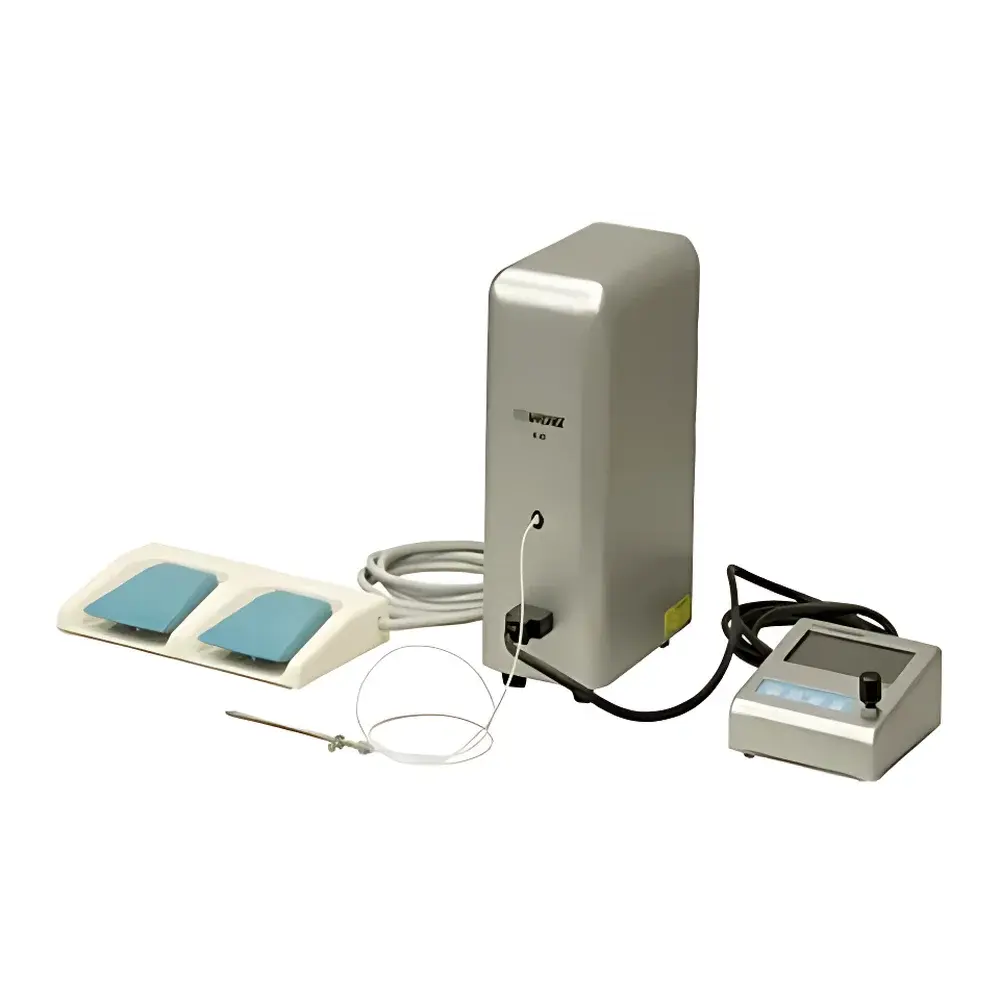
Narishige IM-400 Digital Pneumatic Microinjector
| Brand | Narishige |
|---|---|
| Origin | Japan |
| Model | IM-400 |
| Power Supply | AC 100–240 V, 50/60 Hz |
| Gas Input Pressure Range | 0.4–0.7 MPa |
| Injection/Balance Pressure Range | 0.005–0.5 MPa |
| Flushing Pressure Range | 0.4–0.7 MPa |
| Control Box Dimensions | 120 × 211 × 264 mm, 3.1 kg |
| Operation Unit Dimensions | 130 × 153 × 61.5 mm, 780 g |
| Power Consumption | 15 W |
| Fuse Rating | T1A/250V (EN60127-2 Sheet 3) |
| Accessories Included | HI-9 injection holder, CT-4 injection tube (Ø2 mm × 1.2 m), gas input hoses (Ø6 mm × 2 m & Ø6 mm × 1 m), tube fittings, T-joint with pressure relief valve, foot switch (2.9 m cable), connecting cable (2.9 m), power cord (1.5 m), silicone rubber gasket (HI01PK01) |
Overview
The Narishige IM-400 Digital Pneumatic Microinjector is a precision-engineered instrument designed for controlled, reproducible microinjection of nanoliter- to microliter-scale volumes into biological specimens. It operates on a regulated pneumatic principle: compressed gas—typically nitrogen or clean dry air—is delivered to the system at a stable supply pressure (0.4–0.7 MPa), then precisely modulated via solenoid-controlled valves to generate defined injection, balance, and flushing pressures. This architecture enables highly repeatable delivery kinetics without mechanical displacement components, minimizing shear stress on sensitive biomolecules such as DNA, RNA, proteins, or dyes. The IM-400 is optimized for applications requiring temporal resolution in pressure application (e.g., pulse duration control), making it suitable for delicate intracellular, intra-embryonic, or interstitial injections where volume accuracy and timing consistency are critical to experimental validity.
Key Features
- Digital pressure regulation with dual-mode operation: independent adjustment of injection pressure (0.005–0.5 MPa) and balance pressure (0–0.5 MPa) ensures fine-tuned control over both delivery and backflow suppression.
- Integrated foot switch interface enables hands-free initiation of injection cycles, preserving sterility and operator ergonomics during prolonged procedures.
- Touch-sensitive front panel with intuitive icon-based navigation simplifies parameter entry—no specialized training required for basic operation.
- Non-volatile memory stores up to 10 user-defined protocols, including pressure setpoints, dwell times, and sequence configurations, supporting rapid method recall across multiple users or experimental conditions.
- Modular hardware design facilitates seamless integration with standard micromanipulators (e.g., Narishige MO-202, MN-401) and glass capillary holders (HI-9 included), enabling alignment within inverted or stereomicroscope workstations.
- Compliance-ready architecture supports audit trails when paired with external logging software; pressure output signals can be monitored via analog voltage outputs (0–5 V) for synchronization with imaging or electrophysiology systems.
Sample Compatibility & Compliance
The IM-400 is routinely deployed in model organism laboratories working with Caenorhabditis elegans, Drosophila melanogaster, zebrafish (Danio rerio) embryos, Xenopus oocytes, and murine zygotes. Its low dead-volume fluid path (CT-4 tubing, Ø2 mm ID) minimizes sample waste and reduces risk of clogging with viscous solutions (e.g., morpholinos, CRISPR ribonucleoprotein complexes). All wetted materials—including silicone gaskets (HI01PK01), fluoropolymer-coated tubing, and stainless-steel fittings—meet USP Class VI biocompatibility requirements. While the IM-400 itself is not FDA-cleared or CE-marked as a medical device, its design adheres to ISO 13485-aligned manufacturing practices typical of research-grade instrumentation supplied by Narishige. For GLP/GMP environments, full traceability is achievable through documented calibration of pressure transducers and validation of injection volume repeatability per ASTM E2918-13 guidelines.
Software & Data Management
The IM-400 operates autonomously via its embedded firmware and does not require proprietary PC software for core functionality. However, analog output ports (0–5 V corresponding to real-time pressure) allow connection to data acquisition systems (e.g., National Instruments DAQ, Axon Digidata) for time-synchronized recording of injection events alongside fluorescence microscopy, patch-clamp recordings, or behavioral assays. Users may export protocol settings manually via printed logs or integrate the unit into custom LabVIEW or Python-controlled workflows using TTL-triggered foot-switch inputs. No cloud connectivity or remote access features are implemented—consistent with institutional IT security policies governing laboratory instrumentation.
Applications
- Transgenic line generation via pronuclear or cytoplasmic injection of plasmid DNA, CRISPR-Cas9 components, or transposase mRNA into zygotes.
- Lineage tracing and functional perturbation studies using fluorescent dextran or quantum dot tracers injected into specific blastomeres or neural progenitors.
- RNAi-mediated knockdown in early embryonic stages of C. elegans and D. melanogaster, where precise dosage control directly influences phenotypic penetrance.
- Delivery of pharmacological agents or optogenetic actuators into larval or juvenile stages for developmental pharmacology screening.
- In vitro fertilization support protocols involving sperm injection (ICSI-like approaches) in non-mammalian models with large oocytes.
FAQ
What gas sources are compatible with the IM-400?
Nitrogen, compressed air (oil-free and desiccated), or argon may be used, provided supply pressure remains within 0.4–0.7 MPa and particulate/moisture content complies with ISO 8573-1 Class 2:2:2 specifications.
Can the IM-400 be used with pulled glass micropipettes?
Yes—when mounted in the HI-9 holder and connected via CT-4 tubing, the system maintains stable pressure transmission to capillaries with tip diameters down to ~0.5 µm, though optimal performance is observed with outer diameters ≥1.0 mm.
Is calibration required before first use?
Narishige performs factory calibration of the integrated pressure sensors; users should verify zero-offset and linearity annually using a NIST-traceable digital manometer per internal SOPs.
How is injection volume quantified?
Volume is inferred indirectly from calibrated pressure-duration curves established empirically for each pipette geometry and solution viscosity; gravimetric validation using dye solutions and microbalance measurement is recommended for critical quantitative work.
Does the IM-400 support multi-step injection sequences?
No—the device executes single-phase pressure pulses only; complex multi-stage protocols (e.g., pre-injection balance → injection → post-injection wash) require external sequencing logic or manual intervention between steps.
Related Products



