
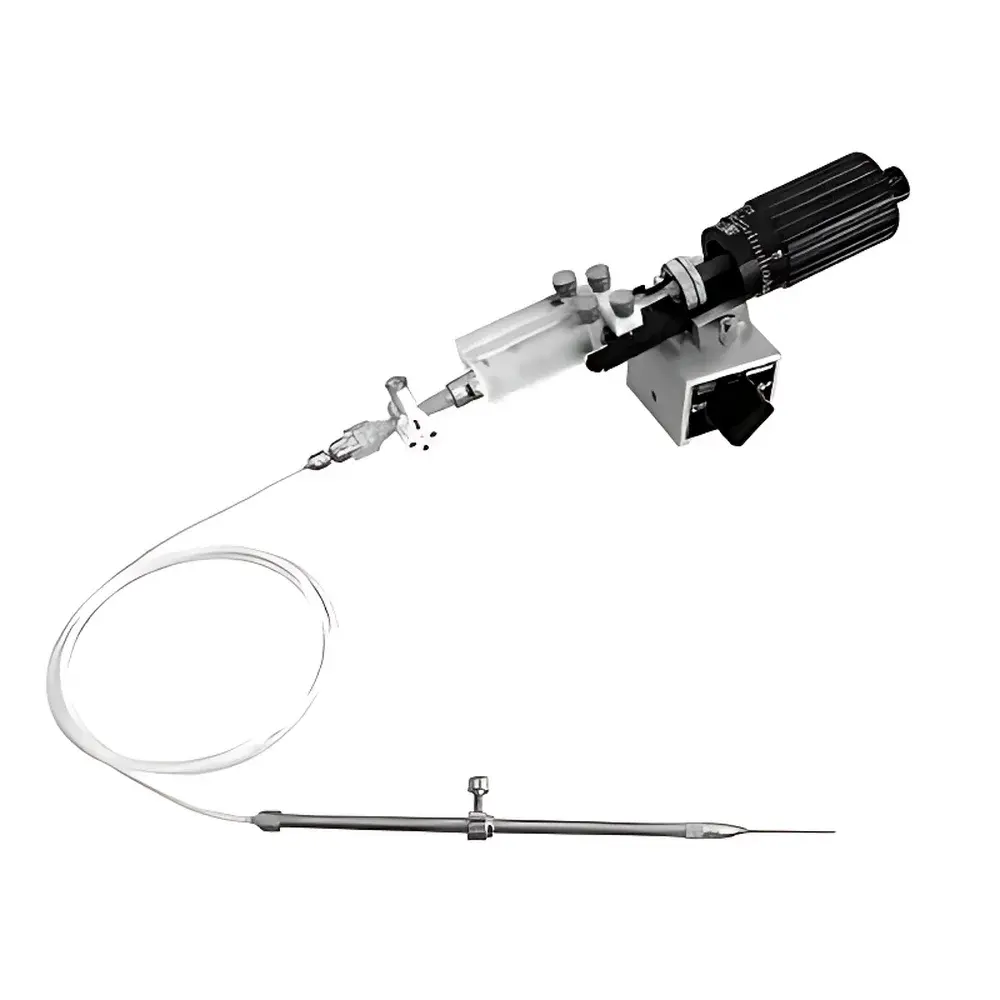
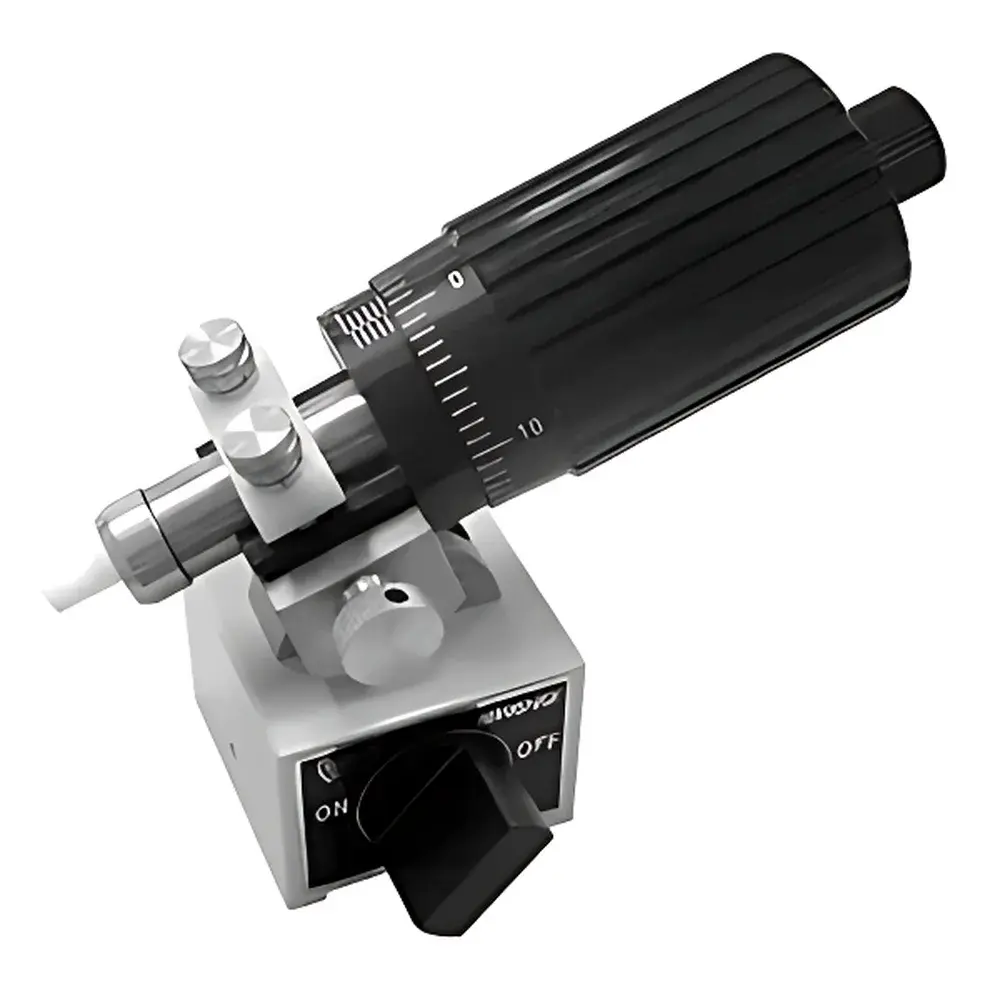
Narishige IM-9B Precision Microinjector
| Brand | Narishige |
|---|---|
| Origin | Japan |
| Model | IM-9B |
| Total Capacity | 1,060 µL |
| Plunger Stroke | 53 mm |
| Knob Full Rotation Volume | ~10 µL |
| Knob Full Rotation Travel | 500 µm |
| Dimensions (W×D×H) | 175–228 × 55 × 77 mm |
| Weight | 0.65 kg |
| Interface | Luer-lock (Ø7–14 mm compatible) |
| Accessories | IM-H1 Holder Set, O-rings (IMO2), Silicone Grease, Silicone Rubber Gasket (HI01PK01), Allen Wrench, Three-way Stop Cock, Cleaning Rod, Metal Syringe (1,060 µL) |
Overview
The Narishige IM-9B is a high-precision mechanical microinjector engineered for reproducible, low-force fluid displacement in demanding life science applications—including intracellular microinjection, oocyte manipulation, patch-clamp pipette filling, and microfluidic device priming. Unlike motorized or pressure-driven systems, the IM-9B operates on a purely mechanical screw-driven principle: rotation of the precision-machined control knob translates linearly into plunger advancement via a calibrated lead-screw mechanism. This eliminates hysteresis, thermal drift, and electronic noise—critical for sub-microliter dosing where volumetric fidelity and tactile feedback are paramount. Its dual-material design integrates the dimensional stability and chemical inertness of borosilicate glass syringes with the mechanical robustness and longevity of stainless-steel actuation components. The instrument’s architecture prioritizes ergonomic balance and mechanical isolation: all drive elements—including the novel counterbalanced plunger guide—are fully housed within the palm-sized handle, minimizing external vibration coupling and operator-induced torque fluctuations.
Key Features
- Calibrated mechanical displacement: 500 µm linear travel per full 360° knob rotation, enabling predictable, repeatable volume delivery (~10 µL per revolution) without reliance on external calibration or software compensation.
- Enhanced plunger alignment system: Redesigned internal guide rails ensure strict parallelism between plunger and barrel axis across the full 53 mm stroke, eliminating lateral play and reducing seal friction—key to maintaining consistent backpressure response during viscous or particulate-laden sample handling.
- Luer-lock interface compliant with ISO 8536-4 and ASTM D3107 standards: Accepts standard glass or metal syringes with outer diameters from 7 mm to 14 mm, supporting both Narishige OEM syringes (e.g., GD-1, SS-1) and third-party equivalents.
- Integrated lubrication and sealing architecture: Pre-filled silicone grease reservoir and replaceable O-rings (IMO2) ensure long-term leak-free operation under continuous use; recommended pre-use oil priming stabilizes hydraulic compliance and dampens transient pressure spikes.
- Modular accessory ecosystem: Includes IM-H1 injection holder set for stable mounting on micromanipulators (e.g., MO-202, MN-401), three-way stop cock for rapid solution switching, cleaning rod for syringe bore maintenance, and precision Allen wrench for tension adjustment.
Sample Compatibility & Compliance
The IM-9B is compatible with aqueous buffers, cell culture media, enzyme solutions, fluorescent dyes, nucleic acids, and low-viscosity polymers (≤50 mPa·s). It is not intended for use with organic solvents, strong acids/bases, or abrasive suspensions unless paired with chemically resistant syringes (e.g., fused silica or PTFE-lined barrels). The device meets mechanical safety requirements per IEC 61000-6-2 (immunity) and IEC 61000-6-3 (emission), though as a non-electronic instrument, it carries no CE marking obligation. Its manual operation and traceable mechanical calibration support GLP-compliant workflows where audit trails rely on procedural documentation rather than electronic logs. When used with FDA-listed syringes and validated protocols, the system supports USP analytical instrument qualification (AIQ) for Category C instruments.
Software & Data Management
The IM-9B operates independently of software or digital interfaces—consistent with its role as a primary mechanical dosing tool in regulated environments where software validation overhead is prohibitive. Volume delivery is determined solely by physical rotation count and calibrated displacement, enabling direct correlation between operator action and output volume without firmware dependencies. For laboratories requiring digital recordkeeping, integration is achieved via optional encoder-equipped knob add-ons (e.g., Narishige EC-1) or third-party rotary encoders mounted externally; such configurations require separate validation under 21 CFR Part 11 if used in GMP contexts. All accessories—including O-rings, gaskets, and syringes—carry batch-specific traceability documentation upon request.
Applications
- Intracytoplasmic sperm injection (ICSI) and pronuclear injection in transgenic mouse model generation.
- Filling of glass micropipettes (1–5 µm tip ID) for electrophysiology and single-cell electroporation.
- Controlled loading of hydrogel precursors into microfabricated PDMS channels.
- Dispensing defined volumes of CRISPR-Cas9 ribonucleoprotein complexes into zebrafish embryos.
- Calibration reference for gravimetric or fluorometric verification of automated liquid handlers (per ISO/IEC 17025).
FAQ
Is the IM-9B suitable for use with corrosive reagents such as concentrated HCl or NaOH?
No—standard stainless-steel and elastomer components are not chemically resistant to strong acids or bases. Use only with compatible syringes and verify material compatibility using Narishige’s chemical resistance chart before exposure.
Why is oil priming recommended prior to first use?
Silicone oil fills microscopic voids in the plunger seal assembly, ensuring uniform hydraulic transmission and minimizing compressibility-related lag during initial strokes.
Can the IM-9B be mounted vertically on a micromanipulator?
Yes—the IM-H1 holder set provides rigid 360° rotational locking and ±15° tilt adjustment, accommodating vertical, angled, or inverted orientation while maintaining coaxial alignment with the manipulator axis.
What is the maximum recommended operating force for sustained use?
The handle is rated for continuous manual actuation up to 2.5 N·m torque; exceeding this may accelerate wear on the lead screw or compromise plunger guide integrity.
How often should O-rings and silicone grease be replaced?
Replace O-rings (IMO2) every 6 months under daily use or after 500 full-stroke cycles; replenish silicone grease quarterly or when knob rotation resistance increases by >20% versus baseline measurement.



