
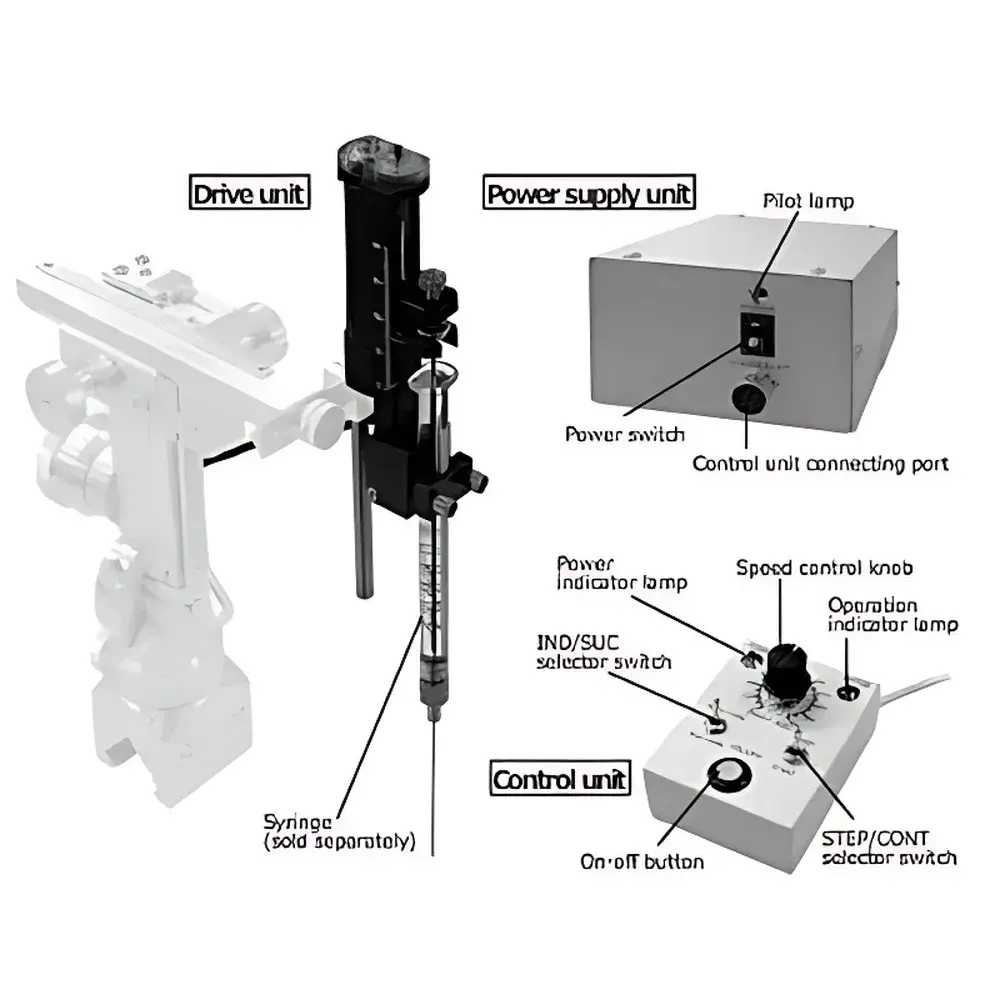
Narishige IMS-10 Motorized Microsyringe Pump
| Brand | Narishige |
|---|---|
| Origin | Japan |
| Model | IMS-10 |
| Drive Unit Dimensions | 20 × 30 × 130 mm, 0.16 kg |
| Control Unit Dimensions | 65 × 85 × 60 mm, 0.3 kg |
| Power Supply Unit Dimensions | 125 × 105 × 85 mm, 1.5 kg |
| Stroke Range (Fine Adjustment) | 40 mm |
| Speed Range | 24–180 µm/s |
| Power Input | AC 100–240 V (±5%), 50/60 Hz |
| Power Consumption | 15 W |
| Included Accessories | AC Power Cord, Syringe Mounting Knobs |
Overview
The Narishige IMS-10 Motorized Microsyringe Pump is a precision-engineered electromechanical actuator designed for controlled, repeatable fluid delivery in stereotactic neurophysiology, intracerebral microinjection, single-cell electrophysiology, and developmental biology applications. Unlike manual syringe manipulators, the IMS-10 employs a stepper motor-driven linear translation stage coupled with high-resolution gear reduction to convert rotational motion into highly stable axial displacement of the syringe plunger. Its core operating principle relies on open-loop positional control with calibrated step-to-displacement mapping—enabling consistent volumetric delivery independent of operator variability, syringe geometry, or fluid viscosity within defined operational limits. The system integrates seamlessly with Narishige’s line of stereotactic frames (e.g., SR series) and micromanipulators, supporting both acute and chronic in vivo experiments requiring sub-microliter dosing accuracy over extended timeframes.
Key Features
- Stable, programmable linear actuation with fine-adjustment stroke range of 40 mm—optimized for precise depth control during intracranial or intra-tissue cannula insertion and infusion.
- Adjustable speed range from 24 µm/s to 180 µm/s, enabling slow, diffusion-limited infusions (e.g., viral vector delivery) as well as rapid bolus injection protocols.
- Modular three-unit architecture: compact drive unit (0.16 kg), ergonomic control unit (0.3 kg), and isolated power supply (1.5 kg), minimizing electromagnetic interference near sensitive recording equipment.
- Universal AC input compatibility (100–240 V ±5%, 50/60 Hz), facilitating deployment across international laboratories without voltage conversion hardware.
- Low power consumption (15 W) and thermally passive design ensure minimal heat generation—critical for maintaining physiological temperature stability in live-tissue preparations.
- Tool-free syringe mounting via dual knurled knobs; accommodates standard Luer-lock glass or plastic microsyringes (e.g., Hamilton 7000 series, NanoFil, or custom capillary assemblies).
Sample Compatibility & Compliance
The IMS-10 is compatible with a broad spectrum of syringe types and volumes (1 µL to 100 µL), provided mechanical coupling integrity is maintained through proper knob torque and plunger alignment. It supports aqueous, organic, and viscous biological solutions—including AAV suspensions, fluorescent tracers (e.g., Alexa Fluor–conjugated dextran), pharmacological agents, and CRISPR ribonucleoprotein complexes—without requiring solvent-specific calibration. While the device itself carries no intrinsic regulatory certification, its mechanical design and electrical safety comply with IEC 61010-1:2010 for laboratory equipment. When integrated into GLP- or GCP-compliant workflows (e.g., preclinical neuropharmacology studies), users may document operation parameters—including speed, duration, and syringe type—in experiment logs to satisfy traceability requirements under ISO/IEC 17025 or FDA 21 CFR Part 11 (when paired with validated electronic lab notebook systems).
Software & Data Management
The IMS-10 operates via analog front-panel controls only—no embedded firmware, USB interface, or proprietary software is included. This intentional design eliminates driver dependency, firmware version conflicts, and cybersecurity exposure while maximizing long-term hardware reliability. All operational parameters (speed selection, direction toggle, start/stop activation) are executed via tactile rotary dial and momentary push-button inputs on the control unit. For labs requiring digital integration, third-party DAQ systems (e.g., National Instruments USB-6009, Arduino-based TTL-triggered controllers) can interface with the IMS-10’s external start/stop trigger input (TTL-compatible, 5 V logic). Experimental metadata—including injection timing, speed settings, and syringe ID—must be manually logged or synchronized externally using timestamped video or electrophysiology acquisition software (e.g., Spike2, OpenEphys).
Applications
- Intracerebral microinjection of adeno-associated virus (AAV) vectors in rodent models of neurodegeneration, with reproducible titer delivery across bilateral hippocampal targets.
- Controlled co-injection of calcium indicators (e.g., GCaMP6f mRNA) and morpholinos into zebrafish embryos during gastrulation-stage microinjection.
- Sequential multi-site infusion of neuromodulators (e.g., muscimol, optogenetic inhibitors) during in vivo patch-clamp recordings in awake, head-fixed mice.
- Calibration support for pressure-controlled picospritzer systems by serving as a reference volumetric flow source in benchtop validation setups.
- Long-duration (≥6 hr) slow-release drug delivery into organotypic brain slice cultures mounted on perfusion chambers.
FAQ
Is the IMS-10 compatible with non-Narishige stereotactic frames?
Yes—mechanical integration is achieved via standard M4 threaded mounting holes on the drive unit baseplate; custom adapter plates may be required for non-Narishige frames.
Can injection speed be changed mid-run?
No—the IMS-10 does not support dynamic speed modulation during active displacement; speed must be set prior to initiation.
What is the minimum resolvable displacement per step?
While the device uses open-loop control, empirical testing with 10-µL glass syringes yields typical resolution of ~0.15 nL per 1-µm plunger advance, assuming ideal plunger seal and zero compressibility.
Does the system include syringes or cannulas?
No—only AC power cord and syringe mounting knobs are supplied; users select syringes based on application-specific requirements (e.g., glass for organic solvents, polypropylene for aqueous buffers).
Is there a service or calibration program available outside Japan?
Narishige authorized distributors provide regional technical support and mechanical inspection services; full recalibration requires return to Narishige’s Tokyo facility or certified partner labs.



