
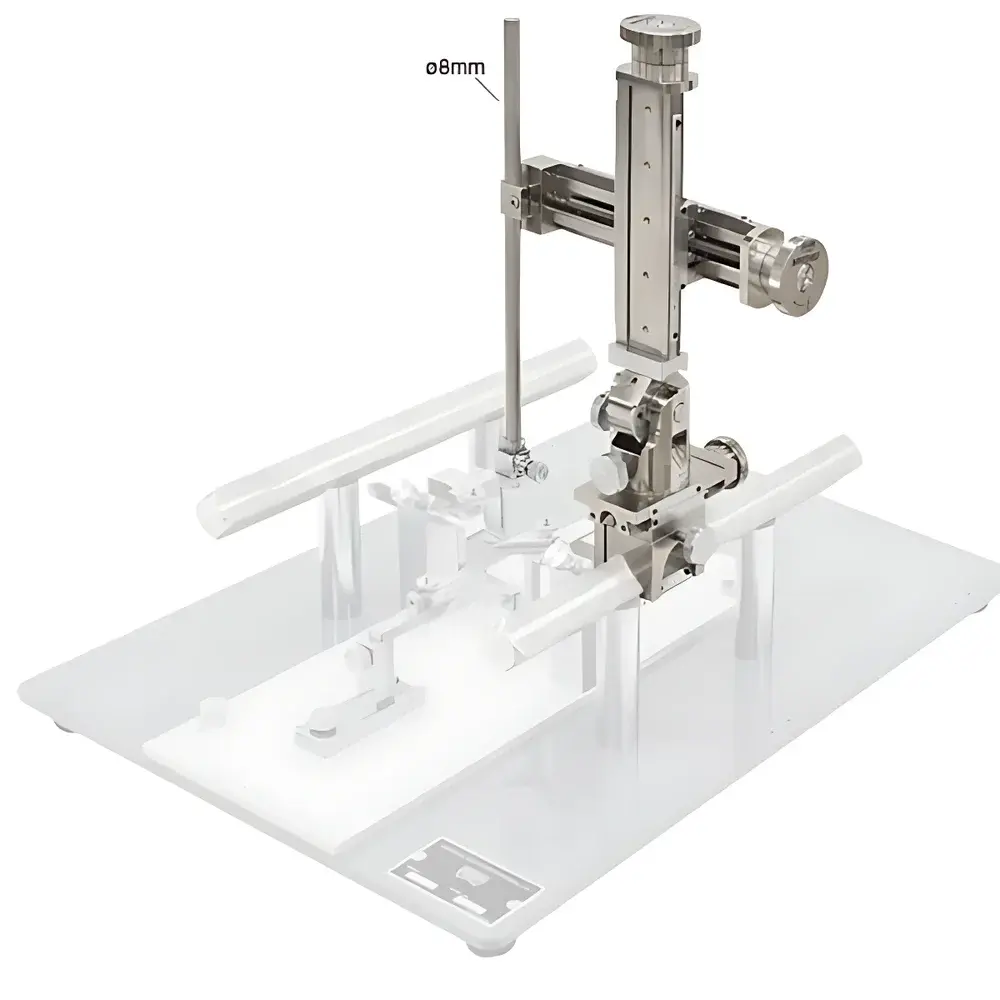
Narishige SMM-100 Stereotaxic Micromanipulator
| Brand | Narishige |
|---|---|
| Origin | Japan |
| Model | SMM-100 |
| Travel Range (X/Y/Z) | 80 mm / 20 mm / 80 mm |
| Minimum Increment | 10 µm per division |
| Full Rotation Displacement | 1 mm |
| Dimensions (W×D×H) | 85 × 162 × 256 mm |
| Weight | 1.84 kg |
| Y-Axis Adjustment | AP-direction fine-tuning knob |
| Upper Assembly | Switchable tilt orientation between AP and ML axes |
| Included Accessories | 2 mm & 2.5 mm hex wrenches, dedicated electrode holder with mounting hardware, grounding screw, Belleville washer, flat washer |
Overview
The Narishige SMM-100 Stereotaxic Micromanipulator is a precision-engineered mechanical positioning system designed for high-fidelity neuroscientific and electrophysiological applications in rodent and small-animal stereotaxic surgery. Built upon Narishige’s decades-long legacy in micromanipulation instrumentation, the SMM-100 operates on a robust, gear-driven coarse/fine dual-stage actuation principle—combining macro-positioning capability with sub-micron repeatability in manual mode. Its core functionality centers on three orthogonal axes (X: lateral, Y: anterior–posterior, Z: dorsal–ventral), each driven by calibrated, backlash-compensated micrometer screws. Unlike motorized or piezoelectric alternatives, the SMM-100 delivers deterministic mechanical control without electronic dependency—making it ideal for environments requiring electromagnetic silence (e.g., concurrent optogenetic stimulation, extracellular recording, or MRI-compatible setups). The device integrates seamlessly with standard stereotaxic frames (e.g., David Kopf, Stoelting) and supports both acute and chronic implantation paradigms, including multi-shank silicon probe insertion, glass pipette patch clamping, and fiber-optic cannula placement.
Key Features
- Three-axis mechanical translation (X: 80 mm, Y: 20 mm, Z: 80 mm) with independent, ergonomically positioned control knobs
- Y-axis fine-tuning knob enabling precise anterior–posterior (AP) micro-adjustments—critical for targeting small nuclei or layered cortical structures
- Rotatable upper assembly allowing rapid reorientation of the manipulator head between AP and ML (medial–lateral) alignment modes without realignment or recalibration
- Micrometer-scale resolution: 10 µm minimum readable increment per scale division; full 360° knob rotation corresponds to 1 mm linear displacement
- Modular accessory interface supporting Narishige’s standardized electrode holders, grounding hardware (including Belleville washers for stable electrical contact), and custom mounting brackets
- Compact footprint (85 × 162 × 256 mm) and low mass (1.84 kg) facilitate integration into densely equipped recording rigs or laminar airflow hoods without compromising stability
Sample Compatibility & Compliance
The SMM-100 is compatible with a broad range of experimental probes—including tungsten and platinum-iridium microelectrodes (1–50 µm shank diameter), borosilicate glass pipettes (tip OD 0.5–3.0 µm), silicon-based Neuropixels or Michigan arrays, and optical fibers (200–1000 µm core). Its rigid aluminum alloy construction ensures minimal thermal drift and vibration transmission during long-duration recordings (>6 hr). While the SMM-100 itself is not a medical device and carries no CE/UKCA or FDA 510(k) designation, its mechanical design adheres to ISO 9001-aligned manufacturing protocols at Narishige’s Japanese facilities. When deployed within GLP-compliant preclinical neuroscience workflows, the manipulator supports audit-ready documentation through traceable calibration logs and standardized mounting configurations.
Software & Data Management
The SMM-100 is a fully manual, analog-positioning instrument with no embedded electronics, firmware, or digital interface. Consequently, it requires no driver installation, software licensing, or cybersecurity validation—eliminating compatibility risks across operating systems (Windows/macOS/Linux) and reducing failure points in regulated environments. Position data must be recorded manually or synchronized externally via third-party motion-tracking systems (e.g., Phidgets spatial encoders or custom Arduino-based readouts). This architecture inherently satisfies requirements for electromagnetic interference (EMI)-free operation under IEC 61326-1 Class A and supports compliance with FDA 21 CFR Part 11 when used in conjunction with validated electronic lab notebooks (ELNs) that capture operator-entered coordinates and timestamps.
Applications
- In vivo single-unit and multi-unit extracellular recording in awake, head-fixed or anesthetized rodents
- Targeted intracranial microinjection of viral vectors, tracers, or pharmacological agents
- Chronic implantation of tetrode bundles, silicon probes, or optrodes for longitudinal neural monitoring
- Combined optogenetics-electrophysiology experiments requiring simultaneous light delivery and electrical readout
- Developmental neurobiology studies involving precise embryonic or neonatal brain targeting
- Validation and benchmarking of automated robotic micromanipulators in academic core facilities
FAQ
Is the SMM-100 compatible with non-Narishige stereotaxic frames?
Yes—the base plate features standardized ¼”-20 and M4 threaded mounting holes, enabling secure attachment to David Kopf, Stoelting, and other major-brand frames using included or user-supplied hardware.
Can the Y-axis knob be locked during recording sessions?
No—the SMM-100 does not incorporate axis-locking mechanisms; positional stability relies on inherent mechanical friction and proper torque application during setup. For extended stability, users may apply thread-locking compound (e.g., Loctite 222) to adjustment screws after final positioning.
What is the maximum load capacity supported on the electrode holder?
The manipulator is rated for static loads up to 500 g at the tip of a standard 100-mm electrode holder; dynamic loading (e.g., during insertion) should remain below 300 g to preserve micrometer longevity and positional fidelity.
Are replacement parts and calibration tools available separately?
Yes—Narishige offers certified replacement micrometer dials, knurled knobs, electrode holder inserts, and calibration test gauges (P/N SMK-100-CAL) through authorized global distributors.
Does the SMM-100 meet ISO 13485 or similar quality system standards?
While the SMM-100 is manufactured under Narishige’s ISO 9001-certified quality management system, it is not produced under ISO 13485 as it is classified as a research-use-only (RUO) laboratory instrument, not a medical device.



