
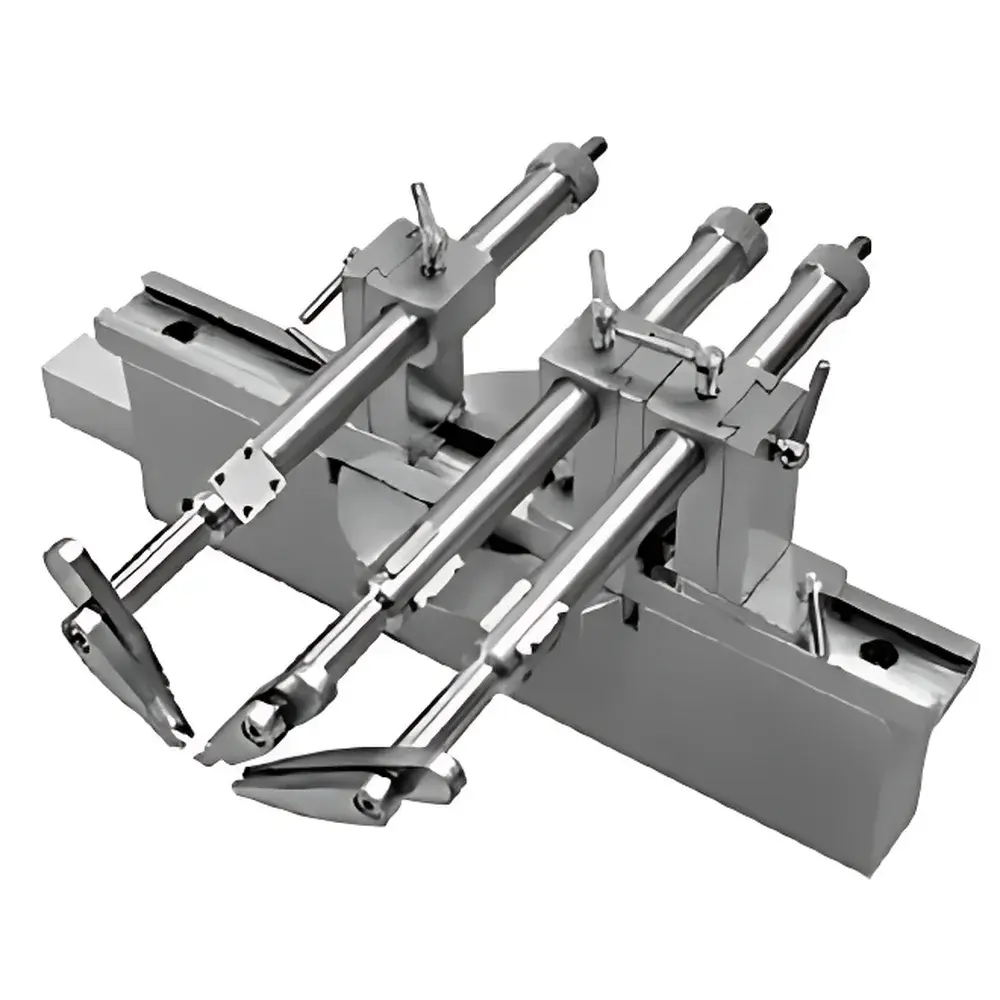
NARISHIGE STS-A High-Density Spinal Cord Clamp
| Brand | NARISHIGE |
|---|---|
| Origin | Japan |
| Model | STS-A High-Density Spinal Cord Clamp |
| Dimensions (W×D×H) | 170 × 115 × 82–112 mm |
| Weight | 860 g |
| Accessories | Mounting ring, M4 screws, 2.0 mm hex key |
| Intended Use | Spinal cord fixation in mice and neonatal rats during stereotactic surgery |
Overview
The NARISHIGE STS-A High-Density Spinal Cord Clamp is a precision-engineered neurosurgical accessory designed specifically for stable, low-trauma immobilization of the spinal cord in murine models—particularly adult mice and neonatal rats—during stereotactic procedures. It operates on a mechanical force-transmission principle: calibrated lever geometry translates subtle operator-applied torque into controlled, distributed clamping pressure across the dorsal surface of the exposed spinal cord. This tactile feedback mechanism enables real-time manual modulation of grip force without reliance on electronic sensors or preset thresholds—critical for preserving tissue integrity in delicate developmental or injury-model studies. The clamp is not a standalone instrument but an integrated component of the NARISHIGE SR-series stereotactic frame system, mounting directly onto AP (anterior–posterior) guide rods via its standardized mounting ring interface. Its compact form factor (170 × 115 × 82–112 mm) and 860 g mass ensure rigidity without excessive inertia, minimizing micro-vibrations during micromanipulator-assisted interventions such as intraspinal injection, electrode implantation, or laminectomy stabilization.
Key Features
- Force-sensitive mechanical design delivering direct haptic feedback to the user—enabling sub-millinewton-level manual control over clamping pressure
- Optimized jaw geometry with radiused contact surfaces to distribute compressive load uniformly across the dorsal spinal cord, reducing localized ischemia risk
- Modular mounting architecture compatible with NARISHIGE SR-1, SR-2, and SR-L stereotactic frames via standardized AP rod interface
- Lightweight yet rigid aluminum alloy construction (anodized finish) ensuring dimensional stability under repeated thermal and mechanical cycling
- Included accessories: stainless steel M4 mounting screws, 2.0 mm hex key, and adjustable mounting ring with dual-axis tilt compensation
- No electronic components—fully autoclavable (up to 134 °C, 3 bar) and compatible with standard biosafety cabinet workflows
Sample Compatibility & Compliance
The STS-A clamp is validated for use with C57BL/6, BALB/c, and CD-1 mice (P0–P21), as well as Sprague-Dawley and Wistar neonatal rats (P0–P7). Jaw opening range accommodates vertebral levels from C1 to L5, with particular suitability for thoracic (T3–T12) and lumbar (L1–L4) segments where dural tension and cord mobility are highest. The device conforms to ISO 13485:2016 requirements for design control of surgical accessories and meets biocompatibility standards per ISO 10993-1 (cytotoxicity, sensitization, intracutaneous reactivity). While not classified as a medical device under FDA 21 CFR Part 807, it is intended for research-use-only (RUO) applications compliant with AAALAC International accreditation guidelines and NIH Office of Laboratory Animal Welfare (OLAW) protocol standards.
Software & Data Management
As a purely mechanical, non-electronic tool, the STS-A clamp requires no software integration, firmware updates, or data logging. Its operation does not generate digital outputs; therefore, no cybersecurity protocols, audit trails, or electronic record retention apply. Documentation—including assembly instructions, torque specifications (recommended max hand-tightening torque: 0.35 N·m), and sterilization validation reports—is provided in English and Japanese PDF format with each unit. All technical documentation adheres to ISO/IEC 17025 traceability requirements for calibration-related supporting evidence.
Applications
- Stabilization during intraspinal stem cell or viral vector injections in spinal cord injury (SCI) models
- Secure positioning for high-resolution two-photon imaging of dorsal horn microvasculature or neuronal activity
- Support during laminectomy and durotomy in electrophysiological recording setups (e.g., patch-clamp or extracellular array placement)
- Fixation for ex vivo spinal cord slice preparation where axial alignment must be preserved prior to vibratome sectioning
- Integration with optogenetic fiber implantation rigs requiring millisecond-scale positional stability
FAQ
Is the STS-A clamp compatible with non-NARISHIGE stereotactic frames?
Yes—provided the frame features 16 mm diameter AP guide rods and accepts standard M4 threaded mounting interfaces. Adapters for Stoelting, Kopf, and David Kopf Systems are available upon request.
Can the clamp be used for larger rodents such as adult rats or rabbits?
No—it is biomechanically optimized for murine-scale anatomy. For adult rats, NARISHIGE recommends the STS-B model; for rabbits or larger species, custom fixation solutions are advised.
What is the maximum recommended sterilization cycle count?
Up to 500 autoclave cycles at 134 °C, 3 bar, 5 min exposure time, verified by post-cycle tensile testing per ASTM F1875.
Does the clamp include calibration certification?
No—mechanical clamps do not require periodic recalibration. However, a factory-assembled verification report confirming jaw parallelism (±5 µm tolerance) and torque transmission linearity is included.
Are replacement jaws or spare screws available separately?
Yes—NARISHIGE part numbers STS-A-JAW-SET (titanium-coated jaws) and STS-A-SCREW-KIT (M4 × 8 mm, stainless steel) are stocked globally through authorized distributors.



