
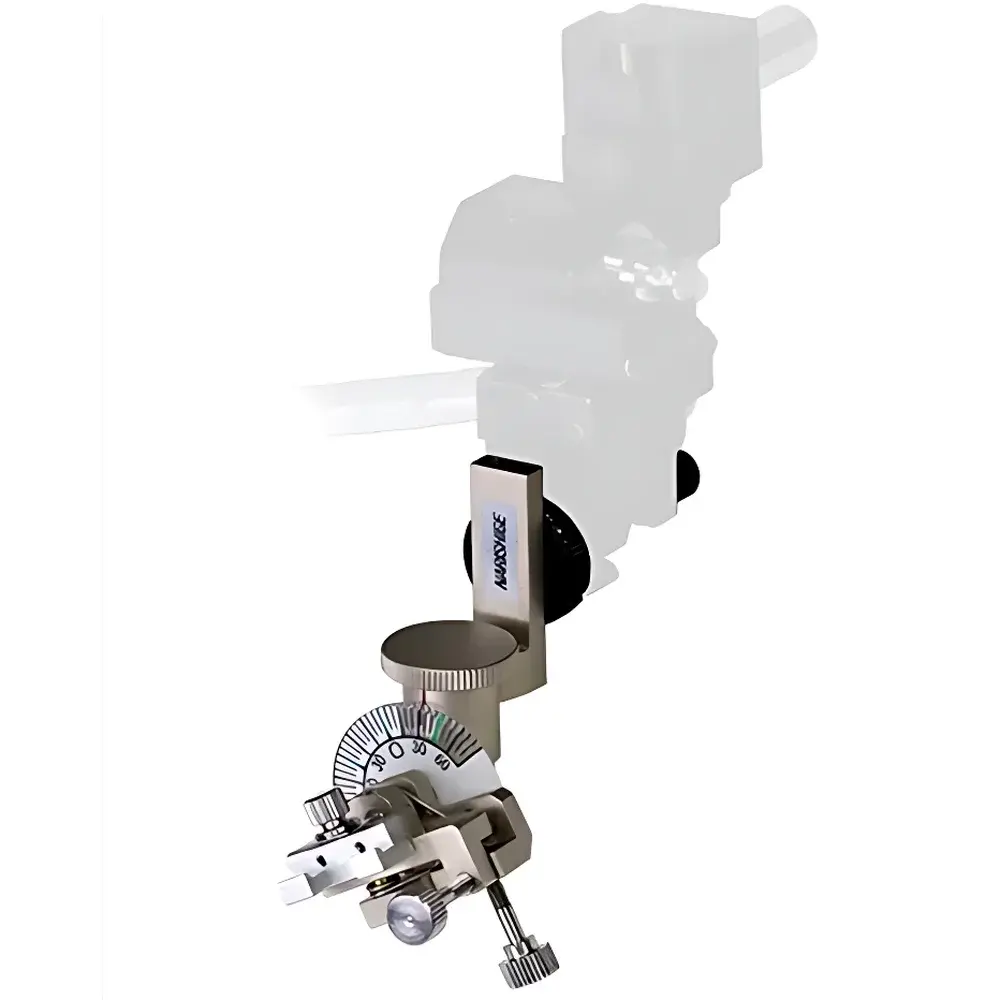
Narishige UT-10 Universal Joint with Integrated Angular Scale
| Brand | Narishige |
|---|---|
| Origin | Japan |
| Model | UT-10 |
| Dimensions | 110 × 34 × 71 mm (W × D × H) |
| Weight | 80 g |
| Adjustment Range | ±15° tilt & swing |
| Angular Resolution | 5° scale markings |
| Compatibility | Narishige MO-209, MO-10, and other three-axis hydraulic micromanipulators |
Overview
The Narishige UT-10 Universal Joint with Integrated Angular Scale is a precision mechanical coupling component engineered for high-stability positioning in electrophysiology, microinjection, and patch-clamp experimental setups. Designed specifically to interface Narishige three-axis hydraulic micromanipulators—such as the MO-209, MO-10, and MO-101—with pipette holders or injection holders, the UT-10 enables controlled angular alignment of glass micropipettes or injection needles relative to the sample plane. Its core function relies on dual-axis kinematic articulation: independent tilt (vertical plane) and swing (horizontal plane) mechanisms, each constrained within ±15° range and calibrated with engraved 5° incremental scale markings. Unlike its predecessor UT-2, the UT-10 incorporates enhanced mechanical rigidity in the pivot housing and improved friction-locking geometry, resulting in superior positional retention during long-duration recordings or pressure-controlled injections. The device operates without electronics or power, relying solely on precision-machined brass and stainless-steel components for thermal stability and corrosion resistance under standard laboratory conditions.
Key Features
- Integrated 5°-increment angular scale for repeatable, traceable orientation setup—critical for reproducible electrode approach angles in single-cell injection or intracellular recording.
- Dual-axis adjustment: independent tilt (up/down) and swing (forward/backward) with tactile locking knobs for fine-tuned, drift-free positioning.
- Compact footprint (110 × 34 × 71 mm) and lightweight design (80 g) minimize inertial load on manipulator arms while maintaining structural integrity.
- Optimized compatibility with Narishige’s standardized mounting interfaces—including 3/8″-24 UNC threads and M4 tapped holes—for seamless integration into existing MO-series manipulator systems.
- Enhanced mechanical stability over UT-2 via reinforced pivot pin retention and optimized bearing surface geometry, reducing angular creep during extended experiments.
Sample Compatibility & Compliance
The UT-10 is not a standalone analytical instrument but a critical mechanical interface component used in regulated life science workflows. It supports glass capillaries (OD 1.0–1.5 mm), borosilicate patch pipettes, and metal injection needles mounted in Narishige PH series pipette holders or IN series injection holders. While the UT-10 itself carries no intrinsic regulatory certification, its use conforms to standard laboratory practices aligned with ISO/IEC 17025 requirements for equipment calibration traceability when integrated into validated electrophysiology platforms. Its all-metal construction ensures compatibility with autoclaving (dry heat only; not steam-sterilizable) and ethanol-based disinfection protocols common in GLP-compliant cell culture and neurophysiology labs.
Software & Data Management
The UT-10 is a purely mechanical device with no embedded electronics, firmware, or digital connectivity. Consequently, it does not generate, store, or transmit data. Its operational parameters—angle settings—are manually recorded by users in lab notebooks or electronic lab notebooks (ELNs) as part of experimental metadata. For laboratories operating under FDA 21 CFR Part 11 or EU Annex 11 requirements, angle configuration logs may be included in audit trails when paired with compliant ELN systems (e.g., LabArchives, Benchling). No software drivers, SDKs, or API integrations are associated with this component.
Applications
- Precise horizontal alignment of bent-tip micropipettes in whole-cell patch-clamp recordings to ensure perpendicular contact with neuronal membranes.
- Angle-critical microinjection into zebrafish embryos or C. elegans gonads where consistent needle trajectory minimizes tissue damage and improves delivery efficiency.
- Co-alignment of dual-pipette configurations (e.g., recording + stimulation electrodes) in extracellular field potential studies requiring fixed inter-electrode geometry.
- Integration into custom-built optical trapping or combined patch-clamp/optogenetics rigs where mechanical decoupling from manipulator vibration is essential.
- Calibration reference point in multi-axis alignment procedures for confocal or two-photon imaging setups involving angled objective approaches.
FAQ
Is the UT-10 compatible with non-Narishige micromanipulators?
Yes—provided the host manipulator features a 3/8″-24 UNC female thread or equivalent M10×1.5 interface; adapter sleeves may be required for non-standard mounts.
Can the angular scale be recalibrated or replaced?
No—the scale is laser-etched onto the aluminum housing and is not user-serviceable; Narishige does not supply replacement scale plates.
Does the UT-10 support vacuum or cleanroom environments?
Yes—it contains no elastomers or outgassing plastics, making it suitable for Class 1000 cleanrooms and low-vacuum (<10⁻² mbar) applications when properly degreased.
What is the maximum torque load the UT-10 can withstand without deformation?
The joint is rated for static loads ≤0.5 N·m; exceeding this may compromise angular repeatability or pivot integrity.
Is there a CE or RoHS declaration available for the UT-10?
Yes—Narishige provides RoHS 2011/65/EU compliance documentation upon request; CE marking applies to complete manipulator systems, not individual accessories.
Related Products



