
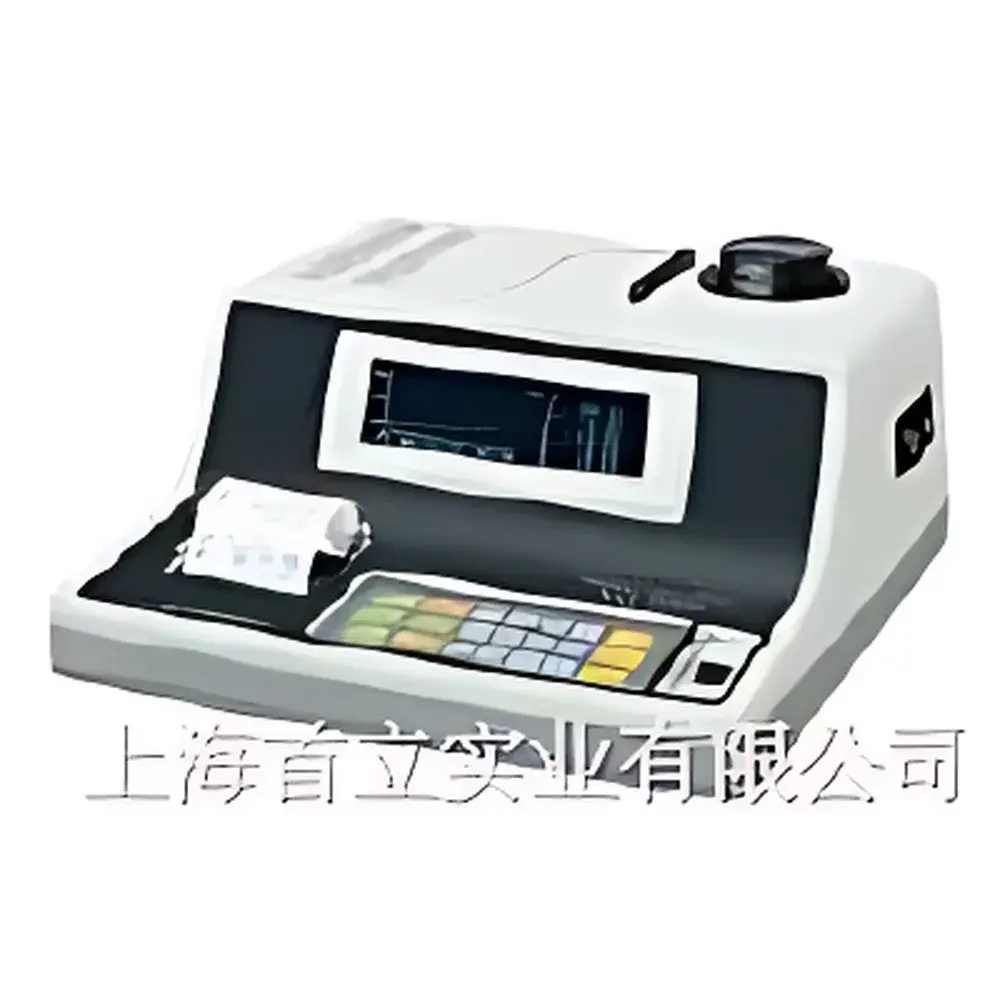
NIPPON DENSHOKU SQ-2000 Spectrophotometric Colorimeter
| Brand | NIPPON DENSHOKU |
|---|---|
| Origin | Japan |
| Model | SQ-2000 |
| Illumination/Viewing Geometry | 8°/d (Diffuse) |
| Spectral Range | 380–780 nm |
| Wavelength Interval | 10 nm |
| Optical System | Dual-beam compensation |
| Light Source | 12 V, 50 W Halogen Lamp (NA 55928) |
| Detector | High-speed Silicon Photodiode |
| Aperture Options | φ3 mm, φ10 mm, φ30 mm |
| Standard Illuminants | C/2°, D65/2°, A/2°, F6/2°, F8/2°, F10/2°, C/10°, D65/10°, A/10°, F6/10°, F8/10°, F10/10° |
| Color Spaces | CIE XYZ, CIELAB (L*a*b*), CIELCH, YI, WI, APHA, HVC, M(D:A), OD |
| ΔE*ab Repeatability | ≤ 0.06 |
| Spectral Reflectance Repeatability | ≤ 0.5% |
| A/D Resolution | 16-bit (with 18-bit internal auto-calibration) |
| Display | 256 × 64-dot Fluorescent Tube (Blue-Green) |
| Interface | RS-232C (Standard) |
| Power Supply | 100 V AC, 50/60 Hz |
| Power Consumption | 150 W |
| Dimensions & Weight | 15.0 kg |
| Operating Environment | 0–40 °C, 30–80% RH (non-condensing) |
Overview
The NIPPON DENSHOKU SQ-2000 Spectrophotometric Colorimeter is a precision optical measurement instrument engineered for high-fidelity color evaluation of materials with complex surface characteristics—particularly metallic, glossy, curved, or translucent substrates. It operates on the principle of spectral reflectance measurement using a dual-beam compensation system, enabling stable, drift-resistant photometric response across the full visible spectrum (380–780 nm). Unlike tristimulus colorimeters, the SQ-2000 acquires full spectral data at 10 nm intervals, allowing calculation of multiple color spaces (CIELAB, CIELCH, YI, APHA, etc.) and compliance with JIS Z 8722 Method II for relative spectral colorimetry. Its 8° illumination / diffuse viewing geometry supports both Specular Component Included (SCI) and Specular Component Excluded (SCE) measurement modes, ensuring metrological alignment with human visual perception under standardized illuminants—including D65, C, A, and F-series sources defined in JIS and ISO/CIE standards.
Key Features
- Dual-beam optical architecture with real-time reference compensation, minimizing thermal and lamp-intensity drift during extended operation.
- Three interchangeable aperture sizes (φ3 mm, φ10 mm, φ30 mm) accommodate diverse sample geometries—from small metallic parts and spherical objects to large flat panels, powders, films, liquids, and textured papers.
- High-speed 16-bit analog-to-digital conversion with embedded 18-bit auto-calibration ensures spectral accuracy to ±0.002% of full scale, critical for measuring low-reflectance dark surfaces and high-gloss metallic finishes with equal fidelity.
- Top-mounted sample compartment enables direct placement of non-rigid or viscous samples (e.g., gels, pastes, granular powders) without auxiliary holders—enhancing workflow efficiency in QC labs and R&D environments.
- Fluorescent display (256 × 64 dots, blue-green emission) provides clear visualization of spectral curves, color coordinates, ΔE*ab values, and user-configurable metrics—including YI (ASTM E313), WI (CIE/ASTM E313), APHA (ASTM D1209), and M(D:A) haze index.
- Onboard clock module timestamps every measurement; results—including sample ID (alphanumeric, up to 10 characters), date/time, and statistical averages—are exportable via RS-232C with full metadata integrity.
Sample Compatibility & Compliance
The SQ-2000 is validated for use across heterogeneous material classes per JIS Z 8722 and ISO 11664-4. Its SCE/SCI toggle functionality satisfies ASTM D2244 (color difference), ISO 7724-1 (colorimetric principles), and ISO 13655 (spectral measurement of printed materials). The instrument supports GLP-compliant data traceability through its built-in memory (battery-backed), audit-ready print logs (thermal dot-matrix, 80 mm width), and deterministic averaging of up to 99 measurements per batch. All standard illuminants and observer angles (2° and 10°) are pre-programmed per CIE 15:2018 and JIS Z 8701, eliminating manual spectral weighting errors. Accessories—including zero caps, white calibration tiles, spherical glass plates (φ30 mm, t = 2 mm), and powder beds—extend conformance to ISO 2813 (gloss), ISO 2554 (powder color), and TAPPI T485 (paper brightness).
Software & Data Management
While the SQ-2000 operates autonomously via front-panel interface, its RS-232C port enables integration into laboratory informatics systems. Raw spectral data (39 points × 10 nm), calculated colorimetric outputs (XYZ, L*a*b*, ΔE*ab, YI, APHA), and metadata (timestamp, aperture, illuminant, sample ID) are transmitted in ASCII format with configurable delimiters. This facilitates import into Excel, MATLAB, or LIMS platforms for SPC analysis, trend monitoring, and regulatory reporting. The device supports FDA 21 CFR Part 11–aligned workflows when paired with validated third-party software—enabling electronic signatures, audit trails, and role-based access control for GMP/QSR environments. Internal lithium backup preserves calibration constants and recent measurement history across power cycles.
Applications
The SQ-2000 serves as a primary color verification tool in industries where surface appearance directly impacts product acceptance: automotive OEMs (paint, trim, anodized aluminum), consumer electronics (anodized casings, PVD-coated components), packaging (metalized films, foil-laminated boards), and specialty chemicals (pigment dispersions, catalyst coatings). Its ability to resolve subtle metamerism—via full-spectrum acquisition—and quantify angular dependence (through SCI/SCE comparison)—makes it indispensable for quality assurance of brushed stainless steel, electroplated zinc, tempered glass, and pearlescent automotive finishes. In R&D settings, it supports formulation optimization by correlating spectral reflectance profiles with pigment concentration, film thickness, and curing parameters—providing quantitative input for DOE and multivariate regression modeling.
FAQ
Does the SQ-2000 comply with ISO 13655 for spectral measurement of printed materials?
Yes—the instrument implements CIE 15:2018 spectral weighting functions and supports M1/M2/M3 measurement modes via selectable illuminants and UV content control.
Can the SQ-2000 measure transparent or translucent films?
Yes—using the optional φ3 mm aperture and transmission-capable accessories (e.g., circular cuvettes, absorption cells), it quantifies colorimetric properties of clear and semi-opaque films per ISO 12048.
Is spectral data exportable in CSV or XML format?
Raw spectral data and derived color values are transmitted as plain ASCII over RS-232C; parsing scripts or LIMS middleware can convert them into CSV/XML for downstream analysis.
What is the calibration frequency recommendation for GLP compliance?
Daily verification with the supplied white reference tile is required; full recalibration using factory-traceable standards is recommended every 6 months or after 1,000 measurements—whichever occurs first.
Does the instrument support user-defined color tolerances (e.g., ΔE*ab < 1.0)?
Yes—tolerance limits can be stored per sample group; the display flags out-of-spec results with audible alert and on-screen indicator.



