
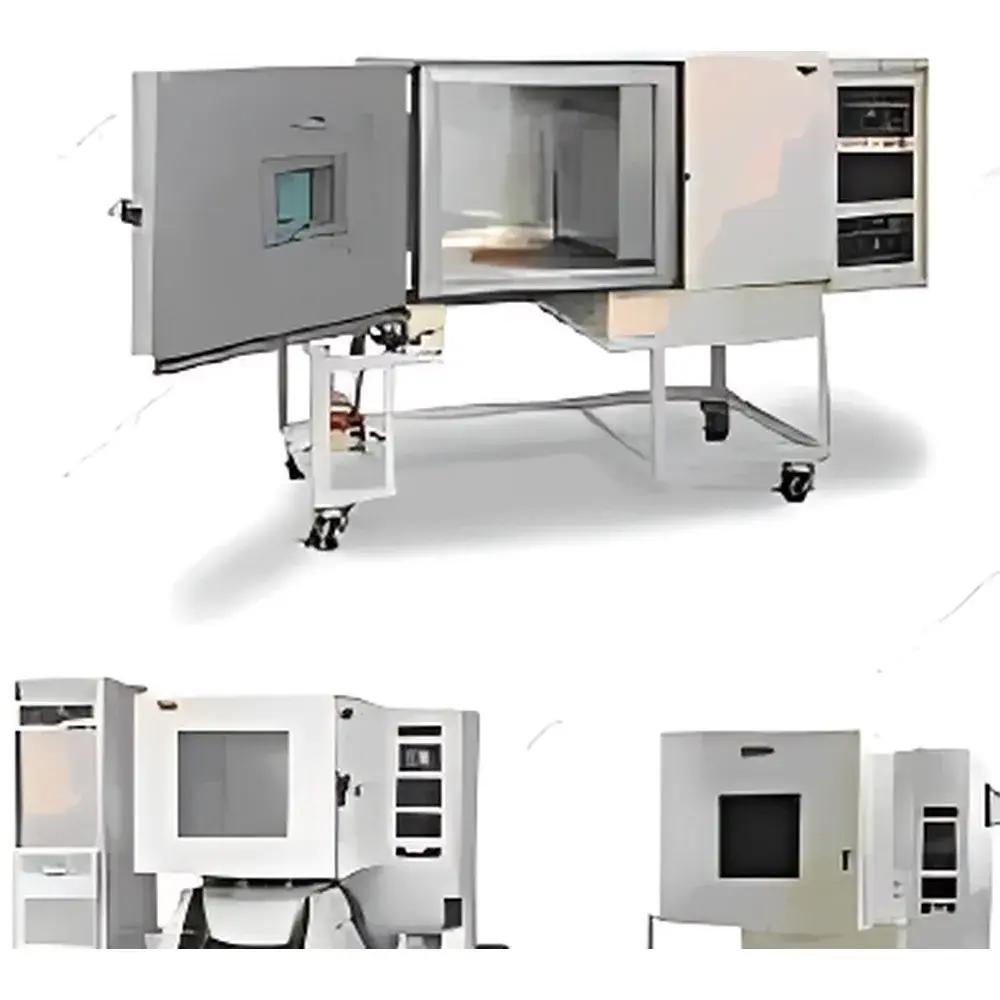
Tenney Vibration Test System
| Origin | USA |
|---|---|
| Manufacturer Type | Authorized Distributor |
| Product Origin | Imported |
| Model | Tenney Vibration Test System |
| Pricing | Upon Request |
Overview
The Tenney Vibration Test System is a precision-engineered environmental simulation platform designed to perform combined or sequential vibration and climatic stress testing on electronic components, aerospace assemblies, automotive modules, and medical devices. Unlike standalone shakers or basic thermal chambers, this integrated system couples electrodynamic or servo-hydraulic vibration excitation with tightly controlled temperature and humidity conditioning—enabling accelerated reliability validation per MIL-STD-810H, IEC 60068-2-64, and ASTM D4728. The system operates on a dual-axis or tri-axial vibration configuration (depending on selected exciter package), synchronized with a high-stability thermal/humidity chamber featuring vertical downward airflow, stainless-steel sealed construction, and Watlow 942 PID-based control architecture. Its modular compressor packages—available in 1.5, 2, 3, and 5-ton capacities—support single-unit or stacked configurations to scale thermal load capacity without compromising vibration fidelity or chamber uniformity.
Key Features
- Top-mounted exhaust ducting for efficient removal of heat, condensate vapor, and acoustic noise—minimizing operator exposure and lab ambient interference
- Versa Tenn proprietary control system with touchscreen-enabled microprocessor interface, positioned ergonomically within operator line-of-sight for real-time monitoring and parameter adjustment
- Electroheated, low-maintenance observation window (optional) with anti-fog coating and wipe-free optical surface for continuous visual inspection during test cycles
- Removable front access panels facilitating routine maintenance of air-cooled condensers, refrigerant lines, and modular compressor brake assemblies
- Integrated floppy disk drive (legacy interface) supporting program upload/download and time-stamped data logging for traceable test execution
- Dry-air purge option achieving ≤5% RH at 20°C (dew point ≤2°C), enabled via desiccant-based air drying module compatible with standard chamber airflow paths
- 19-liter recirculating humidity reservoir with soft-water filtration and auto-refill capability—reducing manual intervention and improving long-duration RH stability
- Vertical downward airflow design with optimized impeller geometry ensuring ±0.3°C temperature uniformity and ±2% RH repeatability after stabilization (per ISO 16750-4 Annex A)
- 100% welded 316 stainless-steel internal chamber walls and floor; non-asbestos, low-outgassing insulation compliant with NASA-STD-6002 and EU RoHS directives
- Watlow 942 multi-loop controller with platinum RTD (Class A, DIN EN 60751) and capacitive RH sensor—calibration traceable to NIST standards
Sample Compatibility & Compliance
The Tenney Vibration Test System accommodates test specimens up to 610 mm × 610 mm × 610 mm (W×D×H) with payload capacity ranging from 45 kg to 227 kg, depending on configured exciter and thermal package. Chamber ports (standard 100 mm diameter, configurable up to 300 mm) allow feedthrough of power, signal, and thermocouple cables while maintaining environmental integrity. All models meet UL 61010-1 and CE marking requirements for laboratory equipment safety. Humidity control complies with ISO 16750-4 (road vehicles), IEC 60068-2-78 (damp heat, steady state), and ASTM E145 (gravity-convection ovens). Optional IEEE-488, RS-232/422/485, and analog 0–10 V interfaces support integration into automated test systems governed by GLP/GMP documentation protocols—including 21 CFR Part 11-compliant audit trails when paired with Link Tenn software (Windows 95–XP compatible).
Software & Data Management
Link Tenn software provides full-cycle test definition, real-time waveform visualization, and post-test spectral analysis (FFT, PSD, SRS). It supports programmable profiles combining vibration spectra (random, sine sweep, shock pulses) with thermal/humidity ramps and dwells. Data export formats include CSV, MATLAB (.mat), and universal binary (IEEE 754). The system logs all setpoint changes, alarm events, and sensor readings with timestamped metadata—enabling full traceability for internal quality audits or third-party certification bodies. Optional relay I/O modules (6-channel, 1 A each) enable hardware-triggered actions such as emergency shutdown, external camera activation, or auxiliary cooling initiation based on chamber or vibration parameters.
Applications
- Accelerated life testing of printed circuit boards (PCBs) under combined thermal cycling and mechanical vibration per IPC-9701
- Qualification of avionics enclosures subjected to DO-160 Section 21 vibration + Section 4 temperature/humidity profiles
- Validation of battery packs for EV applications under dynamic load, elevated temperature (up to 150°C), and low-RH storage conditions
- Reliability screening of MEMS sensors exposed to resonant frequencies while operating at sub-zero dew points
- Environmental stress screening (ESS) of medical device sterilization packaging per ISO 11607-2 accelerated aging protocols
- Material compatibility studies involving elastomer seals, adhesives, and conformal coatings under simultaneous mechanical fatigue and moisture ingress
FAQ
Does the Tenney Vibration Test System support real-time synchronization between vibration profiles and environmental parameters?
Yes—via hardware-level trigger synchronization using TTL or analog voltage signals, enabling precise phase alignment between acceleration spectra and temperature/humidity transitions.
Is NIST-traceable calibration documentation included with shipment?
Calibration certificates for RTD and RH sensors are provided upon request; full metrological traceability requires optional on-site calibration service by certified Tenney field engineers.
Can the system operate continuously for extended duration tests (e.g., 1000+ hours)?
Yes—the semi-hermetic refrigeration system, redundant safety interlocks, and predictive maintenance alerts (via controller diagnostics) support unattended operation under validated test protocols.
What is the minimum achievable dew point with the dry-air option?
The desiccant-based dry-air package achieves a sustained dew point of ≤2°C at 20°C ambient, corresponding to ≤5% RH across the operational temperature range of –70°C to +180°C.
Are custom port configurations and internal mounting fixtures available?
Yes—custom flanges, cable glands, and adjustable shelf systems can be fabricated per customer mechanical drawings and integrated prior to factory acceptance testing (FAT).
Related Products



