
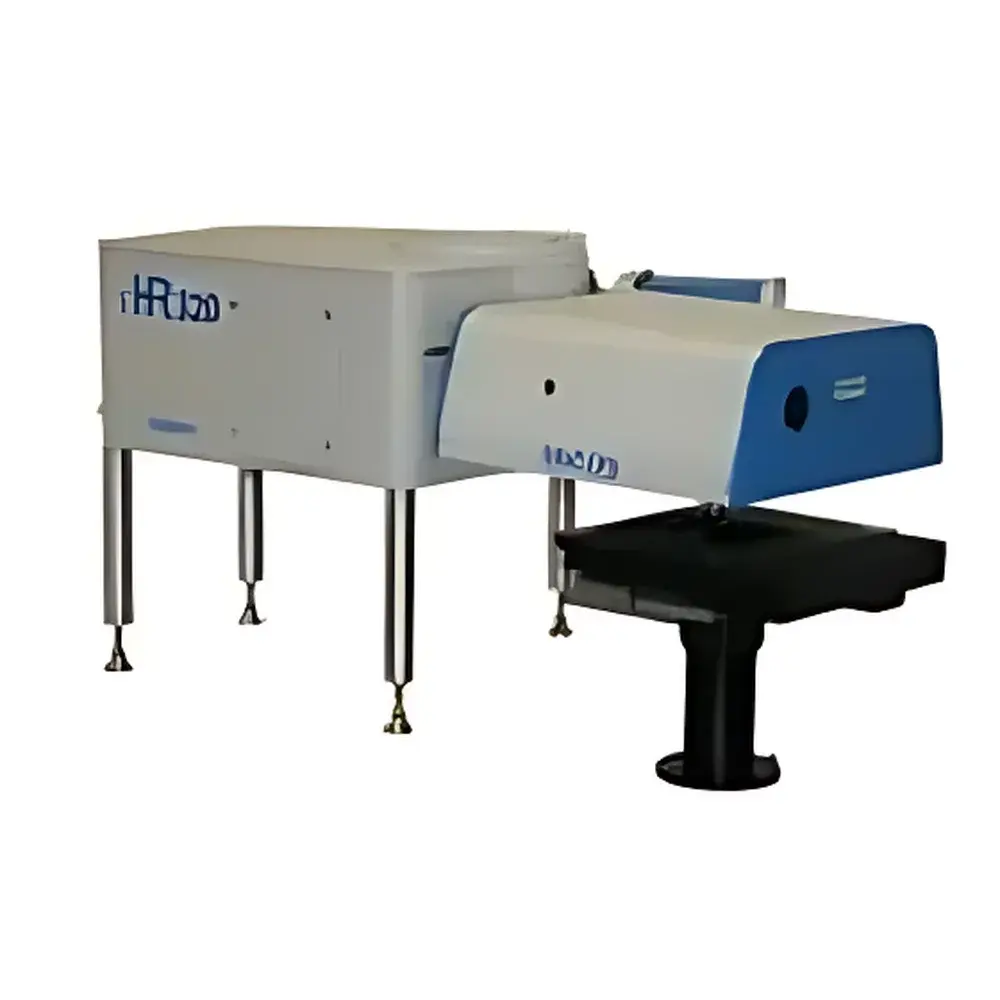
MicOS Microscopic Optical Spectroscopy System
| Brand | HORIBA |
|---|---|
| Origin | USA |
| Model | MicOS |
| Application | Fluorescence Spectroscopy |
| Grating Configuration | Triple-grating imaging spectrometer with motorized grating turret |
| Spectral Range | 200 nm – 1600 nm |
| Imaging Capability | Integrated digital camera for real-time sample visualization |
| Microscope Orientation | Inverted or side-entry configuration (compatible with cryostats) |
| Excitation Laser Compatibility | 325 nm, 405 nm, 488 nm, 532 nm, 633 nm, 785 nm |
| Objective Options | 10×, 50×, 100× (UV-VIS-NIR optimized) |
| Spot Size | down to <10 µm (dependent on objective and wavelength) |
| Detector Options | Back-illuminated CCD (200–1050 nm), InGaAs array (800–1600 nm), UV-enhanced CCD (190–1100 nm), selectable per spectral segment |
| Software Platform | LabSpec 6 (FDA 21 CFR Part 11 compliant audit trail, GLP/GMP-ready) |
Overview
The MicOS Microscopic Optical Spectroscopy System is a high-integration, research-grade platform engineered by HORIBA Scientific for spatially resolved optical spectroscopy at the microscale. Built upon a modular architecture coupling a precision microscope head directly to a triple-grating imaging spectrometer (iHR320/iHR550 series), the system enables simultaneous acquisition of luminescence, reflectance, and modulation spectroscopy data with diffraction-limited spatial resolution. Its core measurement principle relies on confocal or epifluorescence optical pathways combined with high-throughput Czerny-Turner spectrograph optics, delivering quantitative spectral signatures from sub-10 µm features across an ultra-broad 200–1600 nm range—spanning deep UV through visible to short-wave infrared. Designed for rigorous materials science and life science laboratories, MicOS supports both steady-state and time-resolved modalities when integrated with pulsed laser sources and gated detectors.
Key Features
- Triple-grating imaging spectrometer with motorized grating turret, enabling rapid switching between dispersion configurations without realignment
- Real-time visual feedback via integrated high-resolution digital camera synchronized with spectral acquisition
- Dual optical path flexibility: inverted configuration for cryogenic sample environments (e.g., variable-temperature cryostats) or side-entry geometry for in-situ reaction cells and large-stage setups
- Modular detector compatibility—including back-illuminated CCD (200–1050 nm), extended-range InGaAs array (800–1600 nm), and UV-optimized CCD (190–1100 nm)—ensuring optimal quantum efficiency across spectral segments
- Multi-laser excitation support (325 nm, 405 nm, 488 nm, 532 nm, 633 nm, 785 nm) with automated filter wheel integration for excitation/emission separation
- Precision XYZ sample stage available in manual or motorized versions, with micron-level repeatability and programmable coordinate mapping
Sample Compatibility & Compliance
MicOS accommodates diverse sample formats including bulk crystals, thin-film heterostructures, 2D materials (e.g., TMDCs, graphene), semiconductor wafers, biological tissue sections, and single cells. Its optical design minimizes thermal drift and stray light interference, ensuring stable signal-to-noise performance during long-duration acquisitions. The system meets ISO/IEC 17025 requirements for calibration traceability and supports compliance with ASTM E275 (UV-Vis-NIR spectrophotometer verification), ISO 13697 (optical radiation safety), and USP (spectroscopic instrumentation validation). All hardware control and data handling adhere to FDA 21 CFR Part 11 standards via LabSpec 6’s electronic signature, audit trail, and user-access hierarchy features—making it suitable for regulated QC/QA environments under GLP or GMP frameworks.
Software & Data Management
LabSpec 6 serves as the unified control and analysis environment, providing instrument orchestration, spectral deconvolution, multivariate curve resolution (MCR), hyperspectral image processing, and batch reporting. The software includes built-in spectral libraries (e.g., NIST SRM reference spectra), peak fitting algorithms (Voigt, Gaussian, Lorentzian), and export modules compatible with MATLAB, Python (via HDF5 and ASCII), and industry-standard LIMS platforms. Raw data are stored in vendor-neutral HDF5 format with embedded metadata (wavelength calibration, grating position, detector gain, exposure time, objective ID), ensuring full reproducibility and long-term archival integrity.
Applications
- Micro-photoluminescence (µ-PL) mapping of quantum well emission uniformity and defect-related recombination in GaN, SiC, and perovskite semiconductors
- Electroluminescence (EL) characterization of OLED pixel arrays and micro-LED chiplets
- Photoinduced absorption (PIA) and transient reflectance spectroscopy on photocatalytic nanomaterials
- Label-free Raman and fluorescence imaging of fixed and live-cell subcellular structures
- Optical bandgap profiling across grain boundaries in polycrystalline solar absorbers (e.g., CIGS, CZTS)
- Temperature-dependent exciton dynamics in 2D transition metal dichalcogenides using liquid helium cryostat integration
FAQ
What spectral resolution can be achieved with the MicOS system?
Resolution depends on selected grating density, slit width, and detector pixel size; typical values range from 0.1 nm (with 2400 g/mm grating and narrow slits) to 20 nm (broadband low-dispersion mode), as validated per ISO 14785.
Is the system compatible with time-resolved measurements?
Yes—when paired with pulsed lasers (ps/ns) and time-gated detectors (e.g., ICCD or TCSPC modules), MicOS supports lifetime-resolved spectroscopy and streak camera integration.
Can I upgrade detector options after initial purchase?
All detector bays are mechanically and electronically standardized; field-upgradable detector modules include BIUV, BIVS, BIDD, and InGaAs variants with plug-and-play alignment fixtures.
Does MicOS support automated spectral stitching across multiple detectors?
LabSpec 6 includes seamless multi-detector spectral stitching with intensity normalization and overlap-region averaging, fully traceable to NIST-traceable radiometric standards.
How is wavelength calibration maintained over time?
The system performs automatic internal calibration using Hg/Ar/Ne lamp references before each session; optional external fiber-coupled calibration sources enable continuous drift monitoring.





