
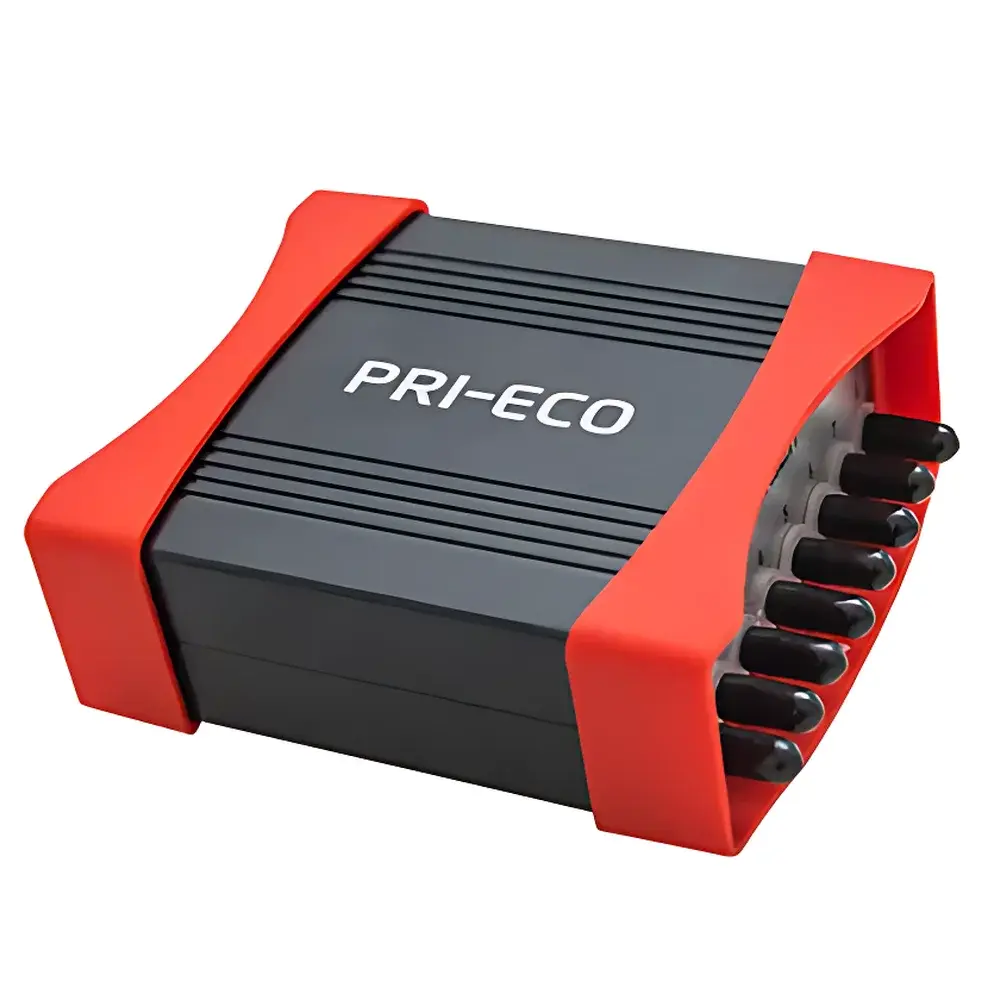
Pri-eco Warden Distributed Soil Moisture, Temperature & Electrical Conductivity Monitoring System
| Brand | Pri-eco |
|---|---|
| Model | Warden |
| Origin | Beijing, China |
| Manufacturer Type | Direct Manufacturer |
| Instrument Category | Multifunctional Soil Analyzer |
| Operating Temperature Range | −25 to 50 °C |
| Power Supply | 6–15 VDC |
| Measurement Principle | True Time-Domain Reflectometry (TureTDR®) at ~1.5 GHz |
| Sensor Compatibility | TDR-001 (moisture only), TDR-002 (moisture/temperature/conductivity), TDR-LMS/LP/LT (lab-grade mini sensors), TDR-020 (wireless IoT module) |
| Channel Capacity | 8 sensor channels per Warden node |
| Network Topology | Wired daisy-chain up to 16 nodes |
| Data Output | Raw TDR waveforms, calibrated volumetric water content (θv), bulk electrical conductivity (σb), and temperature (T) |
| Accuracy (field sensors) | θv ±2 % vol (±1 % vol with individual calibration), T ±0.5 °C (±0.3 °C with calibration), σb ±10 % (0–1 S/m) |
| Lab sensors | higher resolution and traceable calibration options available |
| Resolution | θv 0.1 % vol, T 0.1 °C, σb 1 mS/m |
| Probe Geometry (TDR-002) | Dual 100 mm × 3 mm stainless steel rods, 5 cm diameter × 11 cm height sensing volume, PVC probe body (Ø20 mm, 15–150 cm customizable length) |
| Cable Length | 1.5–6.0 m (field), 1–2 m (lab) |
| Compliance | Designed for long-term unattended operation in accordance with ISO 10390 (soil pH and EC measurement), ASTM D5084 (hydraulic conductivity correlation), and GLP-aligned data integrity workflows |
Overview
The Pri-eco Warden Distributed Soil Moisture, Temperature & Electrical Conductivity Monitoring System is an engineered field-deployable platform built upon True Time-Domain Reflectometry (TureTDR®) technology operating at a center frequency of approximately 1.5 GHz. Unlike conventional low-frequency TDR or capacitance-based soil sensors—whose measurements are compromised by ionic polarization and dielectric relaxation effects under saline or clay-rich conditions—the Warden system leverages high-frequency electromagnetic pulse propagation to directly resolve the travel time of incident and reflected signals along a coaxially shielded transmission line. This enables model-free, physics-based quantification of volumetric water content (θv), bulk electrical conductivity (σb), and temperature (T) from a single sensor interface. Its immunity to soil texture variability and salinity-induced drift makes it suitable for cross-regional validation studies, long-term ecological monitoring, and precision irrigation control where measurement stability over months or years is critical.
Key Features
- True TureTDR® measurement architecture at ~1.5 GHz ensures minimal signal dispersion and negligible polarization artifacts across diverse soil matrices—including high-clay, organic-rich, and saline-affected profiles.
- Non-model-dependent output: delivers calibrated θv (0–100 % vol), σb (0–1 S/m), and T (−25 to 50 °C) without empirical fitting or site-specific regression equations.
- Distributed architecture supports scalable deployment: each Warden data logger accommodates up to eight TDR-002 tri-parameter probes; up to 16 loggers may be connected via RS-485 daisy chain, while TDR-020 wireless modules enable secure LoRaWAN or NB-IoT transmission to cloud platforms such as Pri-eco’s Vista IoT infrastructure.
- Low-power design: operates continuously on 6–15 VDC with microamp-level quiescent current, enabling solar-battery hybrid configurations for remote off-grid installations.
- Modular sensor ecosystem: compatible with field-grade TDR-001/TDR-002 probes, laboratory-optimized mini-sensors (TDR-LMS for moisture/conductivity, TDR-LP for matric potential, TDR-LT for high-resolution temperature), and standardized mounting hardware including calibrated soil columns (55 mm ID × 100 mm H) with helically spaced 8 mm sensor ports.
Sample Compatibility & Compliance
The Warden system is validated for use in mineral soils, peatlands, volcanic ash, and reclaimed mine spoils. Its insensitivity to cation exchange capacity (CEC) and pore-water composition eliminates recalibration requirements when transitioning between loamy sand and montmorillonitic clay. All field sensors meet IP68 ingress protection standards and are rated for continuous burial at depths up to 1.5 m. The system adheres to metrological traceability principles outlined in ISO/IEC 17025 for field instrumentation and supports audit-ready data logging compliant with Good Laboratory Practice (GLP) and Good Agricultural Practice (GAP) frameworks. While not FDA-regulated, its data structure and timestamping protocol align with 21 CFR Part 11 expectations for electronic records in environmental research applications.
Software & Data Management
Raw waveform acquisition, sensor diagnostics, and parameter derivation occur onboard each Warden node using deterministic FPGA-based timing circuits. Calibration coefficients—including individual probe-specific velocity factors and temperature-compensated permittivity models—are stored in non-volatile memory and applied during real-time signal processing. Data export formats include CSV, NetCDF, and JSON, with optional integration into PRI-ECO’s Vista Cloud Platform for visualization, anomaly detection, and automated report generation. Firmware updates and configuration changes are delivered over-the-air (OTA) via encrypted TLS sessions. All timestamps are synchronized to UTC using NTP or GPS-derived time sources when available.
Applications
- Agricultural water-use efficiency studies requiring sub-daily θv resolution across heterogeneous fields.
- Long-term eddy covariance flux tower ancillary networks where decadal sensor stability is mandatory.
- Soil hydrology modeling inputs for SWAT, HYDRUS, or ParFlow simulations—particularly in regions with variable salinity or freeze-thaw cycles.
- Ecological restoration monitoring in arid and semi-arid zones where root-zone moisture dynamics govern species establishment success.
- Calibration reference systems for satellite-based soil moisture products (e.g., SMAP, Sentinel-1) through dense in situ validation arrays.
FAQ
Does the Warden system require soil-specific calibration?
No—its TureTDR® architecture eliminates dependence on empirical calibration curves. Individual probe calibration is optional and improves accuracy to ±1 % vol for θv and ±0.3 °C for T.
Can TDR-002 probes be used in frozen soil?
Yes—the system detects phase transitions and continues reporting temperature and bulk conductivity even below 0 °C; however, volumetric water content interpretation requires application of unfrozen water content models.
What is the maximum cable length between a Warden node and a TDR-002 sensor?
Standard configurations support up to 6.0 m of low-loss coaxial cable with SMA terminations; longer runs require impedance-matched extension kits to preserve signal fidelity.
Is the Vista Cloud Platform accessible outside China?
Yes—Vista is hosted on AWS infrastructure with regional endpoints in Frankfurt, Virginia, and Tokyo, supporting multi-language UIs and ISO 27001-certified data handling.
How is sensor drift monitored over time?
Each Warden node logs raw waveform metadata—including baseline noise floor, reflection coefficient magnitude, and pulse rise time—which serves as a quantitative health indicator for early detection of probe fouling or cable degradation.
Related Products







