
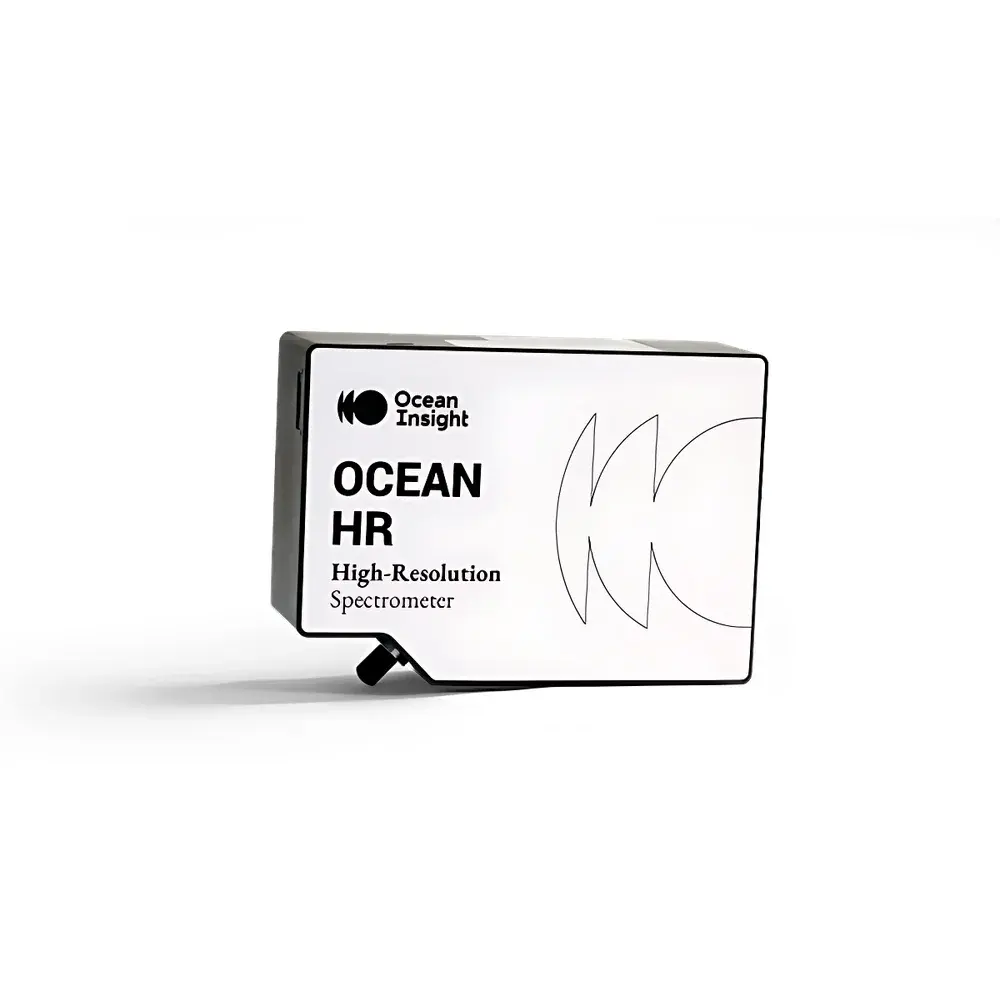
Ocean Optics Ocean HR2 High-Resolution Fiber Optic Spectrometer
| Brand | Ocean Optics |
|---|---|
| Origin | USA |
| Manufacturer Type | Original Equipment Manufacturer (OEM) |
| Product Origin | Imported |
| Model | Ocean HR2 |
| Spectral Range | 190–1150 nm (configurable) |
| Detector Type | CCD |
| Optical Resolution | <1.0 nm FWHM (configuration-dependent) |
| Signal-to-Noise Ratio | 380:1 (single-scan @ 10 ms integration time) |
| Dynamic Range | 2.46 × 10⁸ (system-level) |
Overview
The Ocean Optics Ocean HR2 High-Resolution Fiber Optic Spectrometer is an engineered solution for demanding UV-VIS-NIR spectral acquisition where resolution, thermal stability, and timing precision are critical. Based on a Czerny-Turner optical bench architecture with optimized grating selection and thermally stabilized detector mounting, the HR2 delivers high-fidelity spectral data across a broad 190–1150 nm range—configurable via grating and slit options to balance resolution, throughput, and stray light rejection. Its core design prioritizes metrological integrity in non-laboratory environments: the spectrometer achieves <1.0 nm full-width-at-half-maximum (FWHM) resolution under standard configurations, while maintaining sub-pixel wavelength stability (0.06 pixel/°C thermal drift) over extended operating periods. This level of spectral fidelity supports quantitative absorbance measurements up to 2 AU with excellent linearity, enabling robust calibration models in clinical chemistry and biopharmaceutical applications.
Key Features
- Thermally stabilized optical bench with low-drift mechanical design, minimizing wavelength shift under ambient temperature fluctuations (≤0.06 pixel/°C)
- Ultrafast spectral acquisition: programmable integration time from 1 µs to 10 s, supporting transient event capture and high-throughput process monitoring
- High dynamic range of 2.46 × 10⁸ (system), achieved through dual-gain analog-to-digital conversion and optimized CCD readout architecture
- Configurable input optics: interchangeable slits (10–200 µm) and optional fiber-coupled entrance optics for tailored light throughput and resolution trade-offs
- Ruggedized aluminum housing rated for industrial environments, including cleanroom-compatible variants suitable for semiconductor fab integration
- OEM-ready form factor (94 × 63.5 × 34.3 mm) with standardized USB 3.0 and TTL trigger I/O interfaces for embedded system integration
Sample Compatibility & Compliance
The Ocean HR2 accommodates diverse sample interfaces—including cuvette holders, flow cells, integrating spheres, and custom fiber-optic probes—enabling direct coupling to liquid, gas, solid, and plasma-phase measurement setups. It complies with key regulatory frameworks relevant to analytical instrumentation: its hardware design and firmware architecture support audit-trail-capable operation when integrated into GLP/GMP-compliant workflows. While the spectrometer itself does not carry FDA 21 CFR Part 11 certification, its data output and control interface are fully compatible with validated third-party software platforms that implement electronic signature, user access control, and immutable data logging per Part 11 requirements. The device meets CE marking standards (EMC Directive 2014/30/EU and RoHS Directive 2011/65/EU) and operates within ISO/IEC 17025-aligned laboratory environments when paired with traceable calibration standards.
Software & Data Management
Every Ocean HR2 ships with OceanDirect—a cross-platform SDK supporting Windows, macOS, and Linux. The SDK provides a comprehensive API for low-level instrument control, including real-time adjustment of integration time, boxcar averaging, dark correction, and nonlinearity compensation. Developers can embed OceanDirect into custom applications using C/C++, Python, MATLAB, LabVIEW, or .NET frameworks. Spectral data is exported in industry-standard formats (e.g., CSV, HDF5, JDX), facilitating interoperability with chemometric tools such as Unscrambler®, MATLAB Statistics Toolbox, or open-source libraries like scikit-learn. Firmware updates are delivered via signed binary packages, ensuring secure version control and backward compatibility across generations of Ocean Optics spectrometers.
Applications
- Semiconductor process control: real-time optical emission spectroscopy (OES) for plasma etch endpoint detection and chamber condition monitoring
- Pharmaceutical QA/QC: UV-Vis quantification of protein concentration (e.g., Bradford, BCA assays) and small-molecule dissolution profiling
- Environmental monitoring: multi-component water quality analysis (NO₃⁻, NO₂⁻, organic dyes) using multivariate regression on calibrated absorbance spectra
- Plasma diagnostics: time-resolved spectral acquisition of atomic and ionic emission lines for electron temperature and density estimation
- OEM integration: embedded spectral engine for portable blood analyzers, handheld material ID devices, and inline food quality sensors
FAQ
What spectral calibration standards are provided with the Ocean HR2?
Each unit includes NIST-traceable factory calibration data (wavelength and intensity) stored in onboard memory; optional annual recalibration services are available through Ocean Insight’s ISO/IEC 17025-accredited calibration lab.
Can the HR2 operate in continuous scanning mode for kinetic studies?
Yes—the spectrometer supports streaming acquisition at up to 1,000 spectra per second (depending on resolution and USB bandwidth), with hardware-triggered synchronization for reaction kinetics or pump-probe experiments.
Is the OceanDirect SDK compatible with Python 3.9+ and conda-based environments?
Yes—officially supported bindings include pip-installable packages for Python 3.8–3.12, with documentation covering virtual environment deployment and CI/CD pipeline integration.
How is stray light performance characterized across the 190–1150 nm range?
Stray light is measured per ASTM E275-21 (Standard Practice for Describing and Measuring Performance of UV-Vis-NIR Spectrophotometers) and typically remains below 0.05% at 220 nm and <0.01% above 350 nm for standard grating configurations.
Does the HR2 support external clock synchronization for multi-instrument setups?
Yes—via TTL-compatible sync-in/sync-out ports, enabling phase-locked acquisition with lasers, detectors, or other Ocean Optics devices in time-correlated measurements.





