
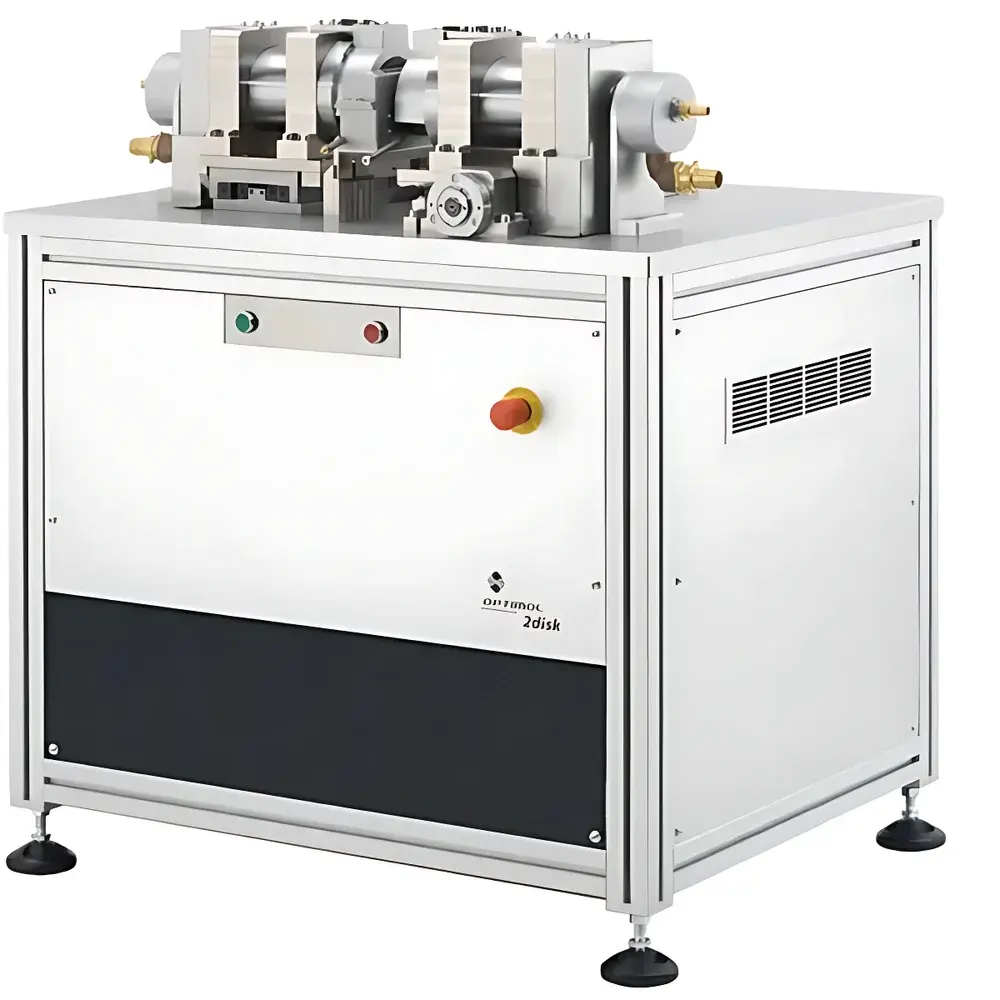
Optimol 2Disk Dual-Disk Tribometer
| Brand | Optimol |
|---|---|
| Origin | Germany |
| Model | 2Disk |
| Drive Speed Range | 1–3000 rpm |
| Applied Load Range | 10–5000 N |
| Maximum Test Duration | 999 h |
| Cooling | Optional Water-Cooled Drive Spindle |
| Temperature Monitoring | Integrated Spindle & Lubricant Temperature Sensors |
| Optional Measurements | Lubricant Film Thickness (Oil Gap), Electrical Resistance, Acoustic Emission (Noise), Wear Volume Quantification |
| Environmental Control Options | Heated Oil Bath, External Oil Circulation Pump |
| Software | Customizable LabVIEW- or Python-Based Control & Data Acquisition Suite |
Overview
The Optimol 2Disk Dual-Disk Tribometer is an advanced, modular benchtop tribological testing system engineered for precise simulation and quantitative analysis of sliding, rolling-sliding, and mixed-mode friction and wear behavior under controlled mechanical, thermal, and environmental conditions. Based on the well-established dual-disk configuration—where two independently driven, parallel rotating disks contact under axial load—the instrument replicates fundamental tribological interfaces found in gears, thrust bearings, clutch systems, and coated mechanical components. Its design adheres to principles defined in ASTM G99 (Standard Test Method for Wear Testing with a Pin-on-Disk Machine) and ISO 7148-1 (Rolling Bearings — Materials and Heat Treatment — Part 1: Steel), while supporting method development aligned with ISO 20808 (Lubricants — Determination of Wear Characteristics of Gear Oils) and ASTM D5183 (Standard Test Method for Determining the Coefficient of Friction of Lubricants Using the Four-Ball Wear Test Machine). The system operates via a high-torque, servo-controlled main drive motor coupled to a secondary disk actuator, enabling synchronized or differential rotation to emulate realistic kinematic conditions including pure sliding (zero roll-to-slide ratio), partial sliding, and full rolling.
Key Features
- Robust dual-disk architecture with precision-ground, hardened steel or ceramic test disks (standard diameters: 60 mm, 100 mm; custom sizes available)
- Adjustable normal load application via electro-mechanical or hydraulic loading system (10–5000 N, ±0.5% full-scale accuracy)
- Independent speed control for both upper and lower disks (1–3000 rpm, resolution ≤0.1 rpm, repeatability <±0.2%)
- Integrated water-cooled main drive spindle to maintain thermal stability during extended tests (up to 999 h continuous operation)
- Real-time monitoring of spindle surface temperature and bulk lubricant temperature via calibrated PT100 sensors
- Modular sensor integration ports for optional in situ measurement of oil film thickness (capacitive or optical interferometric gap sensing), electrical contact resistance (for boundary lubrication regime detection), and acoustic emission (for early-stage wear event identification)
- Environmental enclosure compatibility for inert gas purging, vacuum operation, or heated oil bath immersion (temperature range: –20 °C to +150 °C)
Sample Compatibility & Compliance
The 2Disk platform accommodates flat, circular specimens up to 100 mm in diameter and 25 mm in thickness, including metallic alloys (e.g., bearing steels, titanium grades), polymer composites, DLC and nitride coatings, and sintered ceramics. Disk substrates may be polished to Ra <0.02 µm or textured per ISO 25178 for structured surface studies. All mechanical and data acquisition subsystems comply with CE Machinery Directive 2006/42/EC and EMC Directive 2014/30/EU. When configured with audit-trail-enabled software and electronic signature modules, the system supports GLP and GMP environments per FDA 21 CFR Part 11 requirements for regulated wear testing in automotive lubricant qualification and biomedical implant material validation.
Software & Data Management
Control and analysis are performed using a customizable software suite built on LabVIEW or Python-based frameworks, supporting script-driven test sequencing, real-time parameter logging (friction torque, normal force, rotational speed, temperature, resistance, AE amplitude), and post-test wear quantification via profilometry or gravimetric mass loss correlation. Raw data are stored in HDF5 or CSV format with embedded metadata (test ID, operator, calibration timestamps, environmental setpoints). Version-controlled configuration files ensure method reproducibility across laboratories. Optional add-ons include automated wear scar imaging integration (via USB microscope), ISO-standardized friction coefficient calculation routines, and API connectivity for LIMS or MES systems.
Applications
- Quantitative evaluation of anti-wear and extreme-pressure (EP) additive performance in industrial and automotive lubricants
- Coating durability assessment under oscillatory and unidirectional sliding—particularly for PVD/CVD hard coatings and polymer overlays
- Fatigue wear mechanism mapping (delamination, pitting, scuffing) in gear and bearing steels under variable load/speed spectra
- Tribocorrosion studies in aqueous or saline environments using conductive disk configurations
- Validation of numerical wear models (e.g., Archard-based or finite-element wear simulations) against empirical friction and wear volume data
- Development and certification of low-friction materials for aerospace actuators and medical joint implants
FAQ
What types of lubricants can be tested on the 2Disk system?
Mineral oils, synthetic hydrocarbons (PAOs), ester-based fluids, greases (with appropriate dispensing fixtures), and aqueous coolants—all compatible with standard environmental enclosures and temperature control options.
Is the system suitable for high-temperature tribology studies?
Yes—when equipped with a heated oil bath and high-temperature disk substrates (e.g., M50 tool steel or Si₃N₄), the system supports sustained operation up to 150 °C with continuous thermal feedback control.
Can wear volume be measured automatically during testing?
While in situ volumetric wear measurement requires optional capacitive or optical gap sensors, post-test wear volume is routinely quantified via white-light interferometry or micro-CT scanning of disk surfaces, with traceable calibration against NIST-traceable standards.
Does the system support multi-axial loading configurations?
The base 2Disk configuration applies uniaxial normal load; however, custom adaptations—including combined torsional shear loading or oscillatory lateral displacement—can be implemented via auxiliary actuator integration upon engineering review.
How is data integrity ensured for regulatory submissions?
With validated software modules, electronic signatures, audit trails, and secure user access levels, the system meets documentation requirements for ISO/IEC 17025-accredited labs and FDA-regulated wear validation protocols.





