
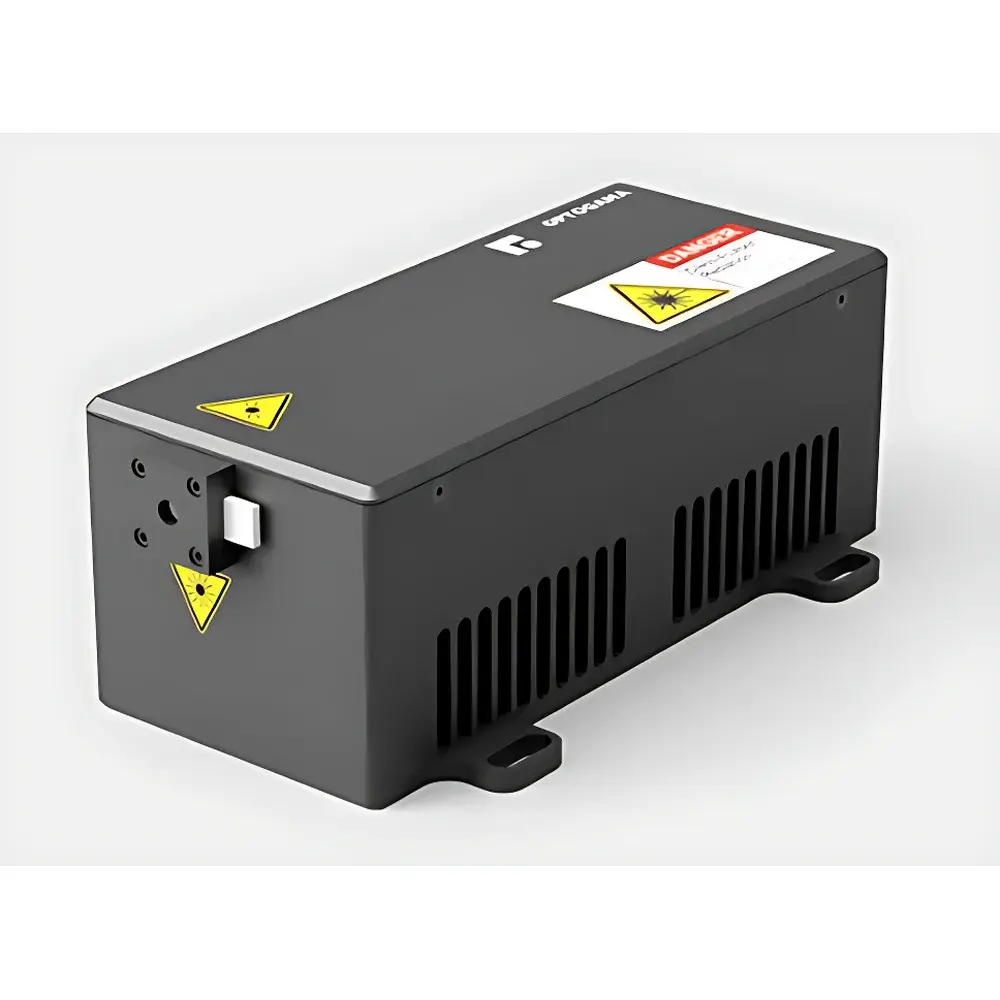
Optogama Waveguard Passive Q-Switched Nd:YAG DPSS Laser System
| Brand | Optogama |
|---|---|
| Origin | Lithuania |
| Manufacturer Type | OEM Laser Systems Provider |
| Product Type | Solid-State Passively Q-Switched DPSS Laser |
| Model | Waveguard |
| Wavelength Options | 1064 nm (fundamental), + optional harmonic modules at 532 nm, 355 nm, and 266 nm |
| Pulse Width | <1 ns (sub-nanosecond) |
| Peak Power | Up to tens of kW |
| Cavity Length | ~few mm |
| Operating Mode | Single Longitudinal Mode (SLM) |
| Triggering | Internal/External TTL-compatible |
| Control Interface | USB and RS232 |
| Form Factor | Compact OEM-ready platform |
| Compliance | CE-marked, RoHS-compliant, designed for integration into ISO/IEC 17025-compliant optical test benches |
Overview
The Optogama Waveguard is a passively Q-switched, diode-pumped solid-state (DPSS) laser system based on a monolithic Nd:YAG gain medium. Engineered for high temporal coherence and exceptional pulse-to-pulse stability, it operates in single longitudinal mode (SLM) with sub-nanosecond pulse durations (<1 ns) and peak powers reaching tens of kilowatts. Its ultra-compact resonator—measuring only a few millimeters in physical cavity length—leverages semiconductor saturable absorber mirror (SESAM) or Cr⁴⁺:YAG passive Q-switching technology to achieve robust, self-starting pulsed operation without active electronics in the cavity. The fundamental output at 1064 nm is intrinsically stable due to thermal and mechanical design optimizations, including low-thermal-expansion mounting and hermetically sealed cavity architecture. Harmonic generation modules (532 nm, 355 nm, 266 nm) are available as field-installable, alignment-free options, enabling wavelength flexibility while preserving beam quality (M² < 1.3) and pulse fidelity across harmonics. This system is not a turnkey instrument but a precision-engineered OEM laser source intended for integration into larger photonic systems requiring deterministic, low-jitter nanosecond pulses.
Key Features
- Single longitudinal mode (SLM) emission with narrow spectral linewidth (<0.1 nm FWHM) and high temporal coherence
- Sub-nanosecond pulse width (<1 ns) with excellent pulse shape reproducibility and minimal pedestal
- Passive Q-switching architecture eliminates need for RF drivers or electro-optic modulators—reducing EMI sensitivity and long-term drift
- Compact, rigid monolithic cavity design with integrated thermal management for stable operation over ambient temperature ranges (15–30 °C)
- Flexible triggering: supports both internal repetition rate control (1–100 Hz standard, up to 200 Hz optional) and external TTL synchronization with jitter < 1 ns RMS
- Dual-standard digital interface: full parameter control and real-time status monitoring via USB 2.0 and RS232 protocols
- OEM-optimized mechanical and electrical interfaces—including standardized 3U rack-mount brackets, SMA sync connectors, and 24 V DC input—enabling seamless integration into automated optical platforms
Sample Compatibility & Compliance
The Waveguard is designed for use with optically transparent, reflective, or scattering targets typical in time-resolved spectroscopy, ablation studies, and remote sensing configurations. Its short pulse duration and high peak intensity enable efficient nonlinear interaction with dielectrics, semiconductors, and biological tissues without significant thermal diffusion. All variants comply with EU Directive 2014/35/EU (Low Voltage Directive), 2014/30/EU (EMC Directive), and 2011/65/EU (RoHS). Laser safety classification is Class IV per IEC 60825-1:2014; appropriate interlocks and beam containment are required during integration. The system supports GLP/GMP-aligned audit trails when paired with compliant host software—logging timestamped trigger events, output energy readings, and thermal sensor outputs via its serial interface.
Software & Data Management
Optogama provides the Waveguard Control Suite—a cross-platform application (Windows/macOS/Linux) supporting configuration, diagnostics, and scripting via Python SDK (PySerial-based API). The software enables closed-loop energy stabilization (when used with optional external photodiode feedback), pulse train analysis, and automated calibration sequence execution. All communication adheres to ASCII command protocol with CRC error checking. For regulated environments, the system supports FDA 21 CFR Part 11–compliant electronic signatures and audit logs when deployed with validated third-party LIMS or MES platforms. No cloud connectivity or telemetry is embedded—data residency remains fully under user control.
Applications
- Laser-Induced Breakdown Spectroscopy (LIBS): High peak power and SLM stability ensure reproducible plasma initiation and spectrally resolved atomic emission acquisition
- Precision micromachining of polymers, ceramics, and thin-film photovoltaics—especially where heat-affected zone minimization is critical
- Time-of-flight laser ranging and atmospheric LIDAR: Sub-ns timing resolution enables centimeter-level distance accuracy at multi-kilometer ranges
- Fluorescence lifetime imaging (FLIM) and pump-probe spectroscopy: Low-jitter triggering synchronizes seamlessly with gated ICCD or SPAD detectors
- Marking and engraving of medical devices and aerospace components—meeting traceability requirements under ISO 13485 and AS9100
FAQ
Is the Waveguard suitable for continuous-wave (CW) operation?
No—it is strictly a passively Q-switched pulsed laser; CW operation is not supported.
Can harmonic modules be added post-purchase?
Yes—harmonic generators for 532 nm, 355 nm, and 266 nm are modular, factory-aligned units that can be retrofitted with mechanical and firmware updates.
What is the typical pulse energy stability over 8 hours?
RMS energy fluctuation is ≤1.5% under constant ambient conditions (22 ±1 °C, no air drafts), verified per ISO 11554 Annex B.
Does the system support analog modulation of repetition rate?
No—repetition rate is digitally set via USB/RS232 commands or TTL edge-triggered; analog voltage control is not implemented.
Is cooling water required?
No—all models use conductive air-cooling only; no liquid coolant loops or chillers are needed.




