

PalmSens EmStat4M Portable Electrochemical Module with SDK and Embedded Development Support
| Brand | PalmSens |
|---|---|
| Origin | Netherlands |
| Model | EmStat4M |
| Instrument Type | Portable Electrochemical Workstation |
| Channel Count | Single-Channel |
| Current Range | ±30 mA |
| Current Accuracy | ≤ 0.2% |
| Potential Accuracy | ≤ 0.2% |
| Potentiostatic Range | ±3 V |
| EIS Frequency Range | 10 µHz to 200 kHz |
Overview
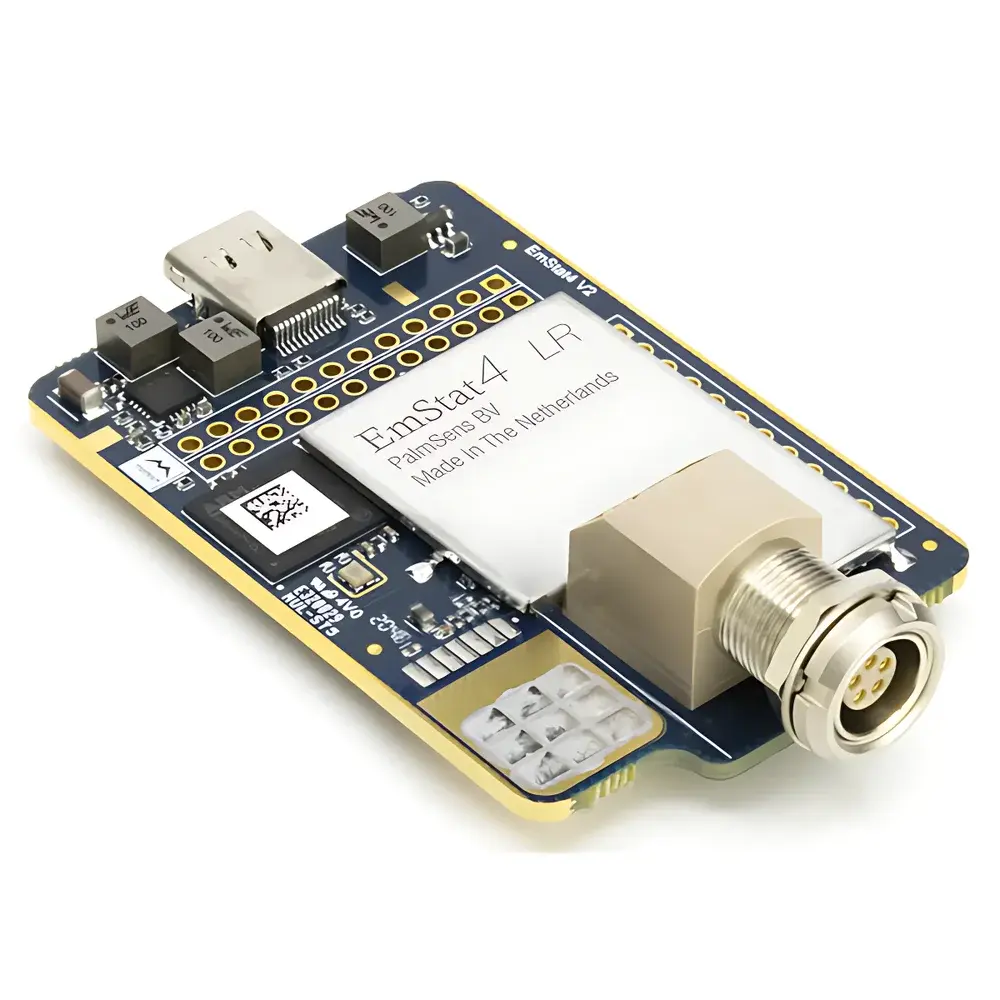
The PalmSens EmStat4M is a compact, high-fidelity electrochemical measurement module engineered for integration into custom analytical systems and field-deployable instrumentation. Measuring just 62 × 40 mm, this PCB-level electrochemical engine implements full potentiostatic, galvanostatic, and electrochemical impedance spectroscopy (EIS) capabilities in a single, low-power unit. It operates on standard USB-C power and communication—enabling direct connection to laptops, embedded hosts, or industrial controllers—while retaining pin-header access for flexible system-level integration via UART or USB CDC protocols. Its architecture adheres to fundamental electrochemical measurement principles grounded in three-electrode cell configuration, controlled-current/potential excitation, and synchronous analog-to-digital acquisition. Designed for reproducible quantitative analysis under variable environmental conditions, the EmStat4M meets the functional requirements of ISO 17025-compliant laboratories when deployed within validated instrument platforms and supports traceable calibration workflows.
Key Features
- Compact form factor (62 × 40 mm PCB) optimized for OEM integration and portable device design
- Full electrochemical functionality: potentiostat, galvanostat, and frequency-domain EIS (10 µHz–200 kHz)
- High-precision analog front-end: ≤ 0.2% accuracy for both current and potential control
- Wide dynamic range: ±30 mA current output with ±3 V compliance voltage
- Dual interface support: USB-C (CDC class) for host PC connectivity and UART (TTL-level) for microcontroller-based systems
- Standard LEMO connector for shielded sensor electrode cabling—minimizing noise in low-signal applications
- Two hardware variants (LR/HR) differentiated by supported waveform resolution and timing granularity for advanced pulse techniques
Sample Compatibility & Compliance
The EmStat4M is compatible with standard three-electrode electrochemical cells (working, reference, counter) and supports disposable screen-printed electrodes (SPEs), rotating disk electrodes (RDEs), and custom microfluidic electrochemical sensors. It accommodates aqueous and non-aqueous electrolytes across pH 1–13 and temperature ranges from 5 °C to 45 °C (with external thermal management). While the module itself is not individually certified, its firmware and signal chain are architected to support regulatory compliance pathways—including FDA 21 CFR Part 11 (when used with audit-trail-enabled host software), ISO/IEC 17025 method validation, and GLP/GMP-aligned data integrity practices. All electrical safety and EMC performance align with CE marking requirements per EN 61326-1:2013 for laboratory equipment.
Software & Data Management
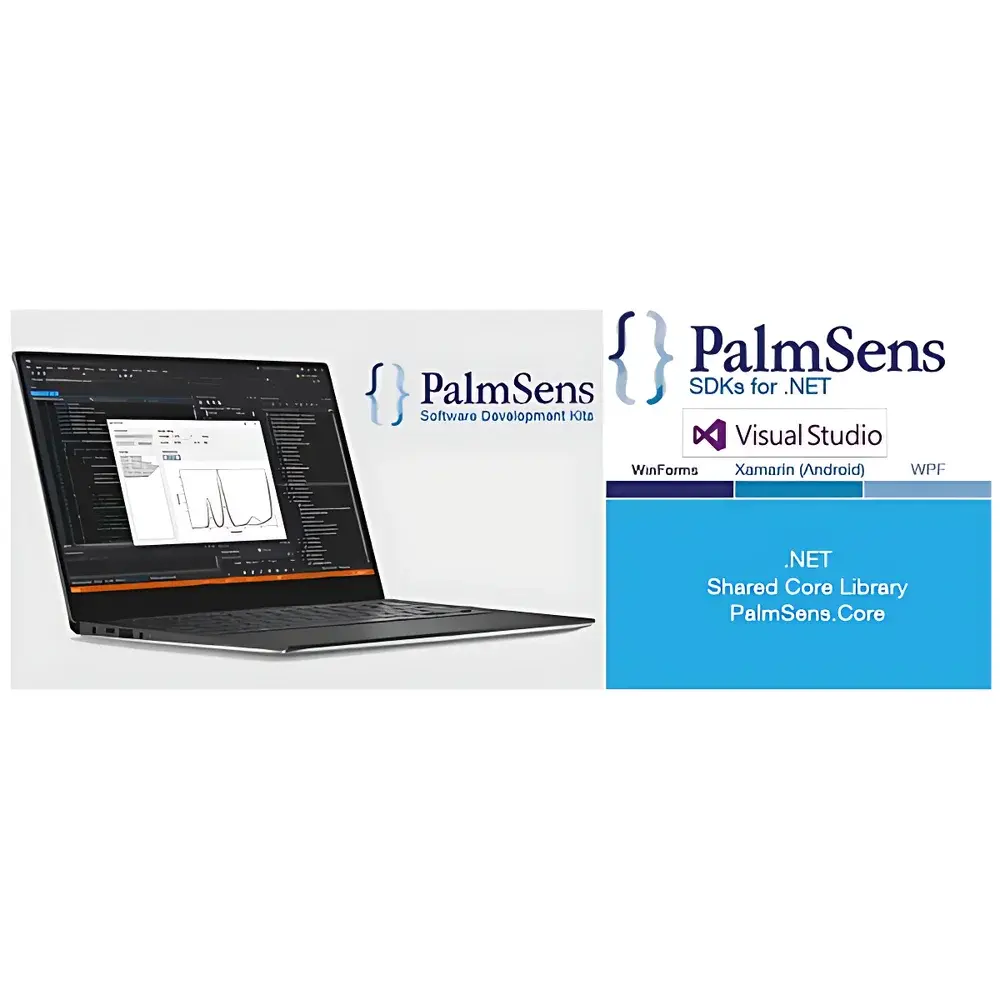
The EmStat4M ships with PSTrace—a Windows-based application for real-time visualization, parameter configuration, and post-acquisition analysis (peak detection, Savitzky-Golay smoothing, baseline correction, calibration curve fitting). For development, PalmSens provides the EmStat4X SDK targeting .NET Framework (C#), supporting WinForms, WPF, and Xamarin.Android deployments. The SDK includes fully documented APIs for device initialization, method execution, raw data streaming, and metadata tagging. Complementing this is MethodSCRIPT™—a domain-specific scripting language enabling on-device execution of electrochemical sequences without host intervention. MethodSCRIPT supports variables, nested loops, conditional branching, SD-card logging, digital I/O triggering, and auxiliary sensor input (e.g., temperature, pH). All acquired data adhere to open formats (CSV, JSON, and proprietary .pss binary with embedded metadata), ensuring interoperability with MATLAB, Python (via palmSensSDK PyPI package), and LIMS environments.
Applications
The EmStat4M serves as the core electrochemical engine in diverse application domains requiring miniaturization, remote operation, or system-level customization. In environmental monitoring, it powers handheld water quality analyzers measuring heavy metals (e.g., Pb²⁺, Cd²⁺) via anodic stripping voltammetry (ASV) with SPEs. In food safety, it enables on-site glucose quantification in potato extracts using disposable biosensors—demonstrated with Gwent Group’s carbon-based SPEs. In corrosion science, it executes ASTM G5/G59-compliant polarization resistance, Tafel analysis, and EIS-based coating degradation assessment in field-deployed probes. Medical diagnostics leverage its low-noise current detection for amperometric immunoassays and enzymatic biosensing. Integration with peristaltic flow cells supports in-line electrochemical detection in process analytical technology (PAT) frameworks, while wearable implementations utilize its ultra-low standby power and UART interface for continuous biofluid monitoring.
FAQ
Is the EmStat4M suitable for regulated environments such as clinical or pharmaceutical labs?
Yes—when integrated into a validated instrument platform with appropriate software controls (e.g., audit trails, electronic signatures, and data encryption), it supports compliance with FDA 21 CFR Part 11 and EU Annex 11 requirements.
Can I run EIS measurements autonomously without a PC?
Yes—using MethodSCRIPT™, you can program complete EIS sweeps (including frequency stepping, DC bias control, and result logging to SD card) to execute independently on the module.
What level of technical support does PalmSens provide for SDK integration?
PalmSens offers comprehensive documentation, GitHub-hosted code examples (C#, Python), video tutorials, and direct engineering consultation for commercial OEM partners under NDA.
Does the module support differential pulse voltammetry (DPV) and square-wave voltammetry (SWV)?
Yes—both DPV and SWV are natively implemented in firmware and accessible via PSTrace, SDK, or MethodSCRIPT™.
How is calibration handled for trace-level quantitative analysis?
The module supports multi-point current/potential calibration routines; users implement calibration curves in host software using standard addition or external standard methods per ISO 8466-1 guidelines.
Related Products




