


PalmSens EmStat4X Portable Electrochemical Workstation
| Brand | PalmSens |
|---|---|
| Origin | Netherlands |
| Model | EmStat4X |
| Instrument Type | Portable Electrochemical Workstation |
| Channel Count | Single-Channel |
| Current Range | ±30 mA |
| Current Accuracy | ≤ 0.2% |
| Potential Accuracy | ≤ 0.2% |
| Potentiostatic Range | ±3 V |
| EIS Frequency Range | 10 µHz to 200 kHz |
Overview
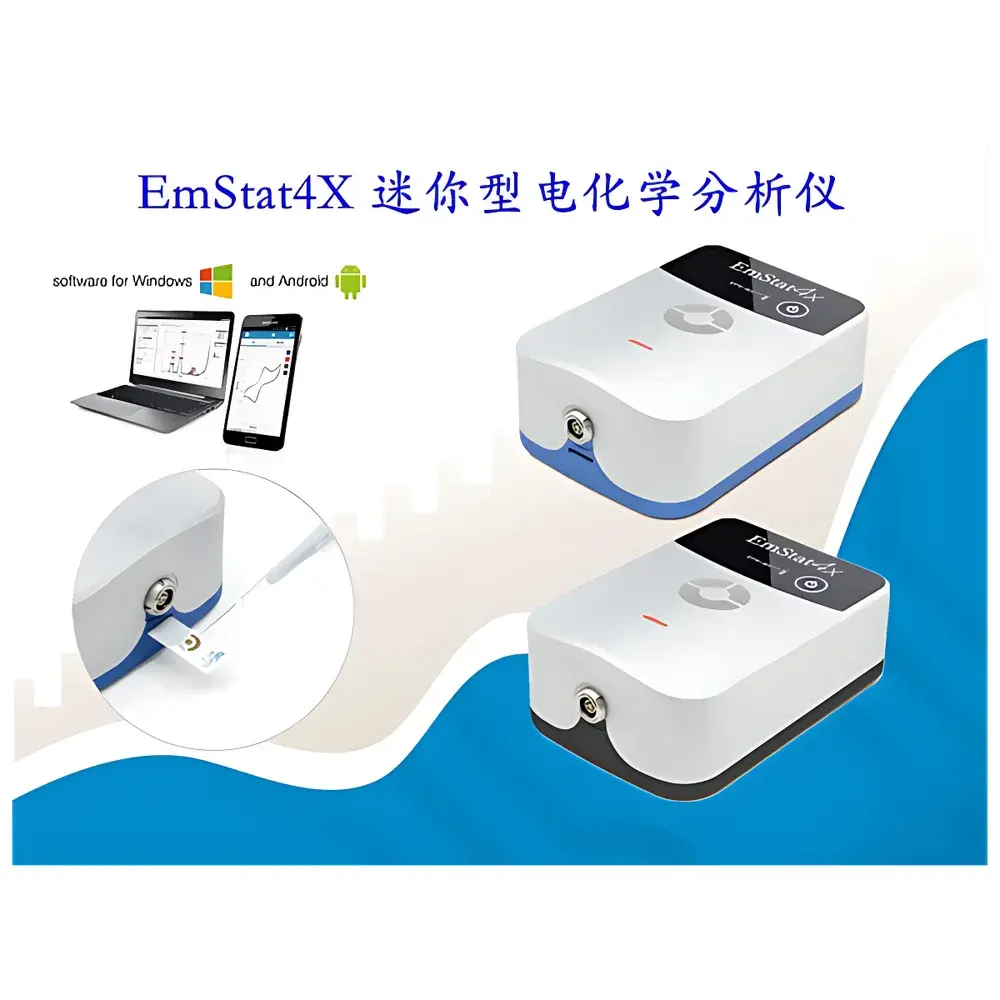
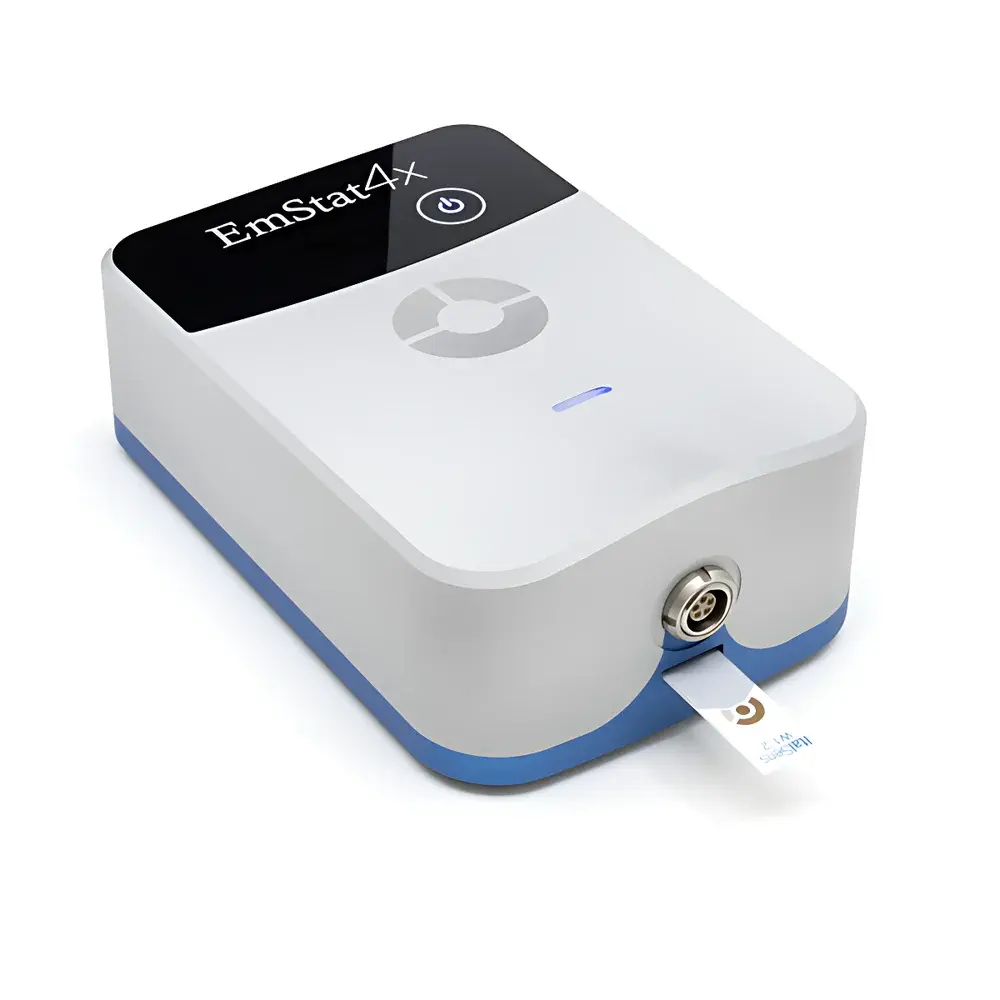
The PalmSens EmStat4X Portable Electrochemical Workstation is a compact, handheld potentiostat/galvanostat with integrated electrochemical impedance spectroscopy (EIS) capability. Engineered for field-deployable and benchtop electrochemical analysis, it operates on either internal rechargeable lithium-ion battery (11.1 Wh) or USB bus power—enabling uninterrupted operation for over eight hours in low-power (LR) mode. Its core architecture implements three-terminal electrochemical control (working, counter, and reference electrodes) using precision analog front-end circuitry compliant with modern potentiostatic design principles. The device supports fundamental electrochemical measurement modes—including cyclic voltammetry (CV), linear sweep voltammetry (LSV), differential pulse voltammetry (DPV), square wave voltammetry (SWV), chronoamperometry (CA), open-circuit potential (OCP), and full-frequency EIS—making it suitable for sensor development, corrosion monitoring, battery material screening, and trace metal detection via stripping voltammetry.
Key Features
- Integrated dual-mode operation: potentiostatic and galvanostatic control with real-time IR compensation (iR drop correction) between working and reference electrodes.
- High-speed fixed-frequency EIS acquisition with minimum data point interval of 1 ms—optimized for rapid stability assessment and transient response characterization.
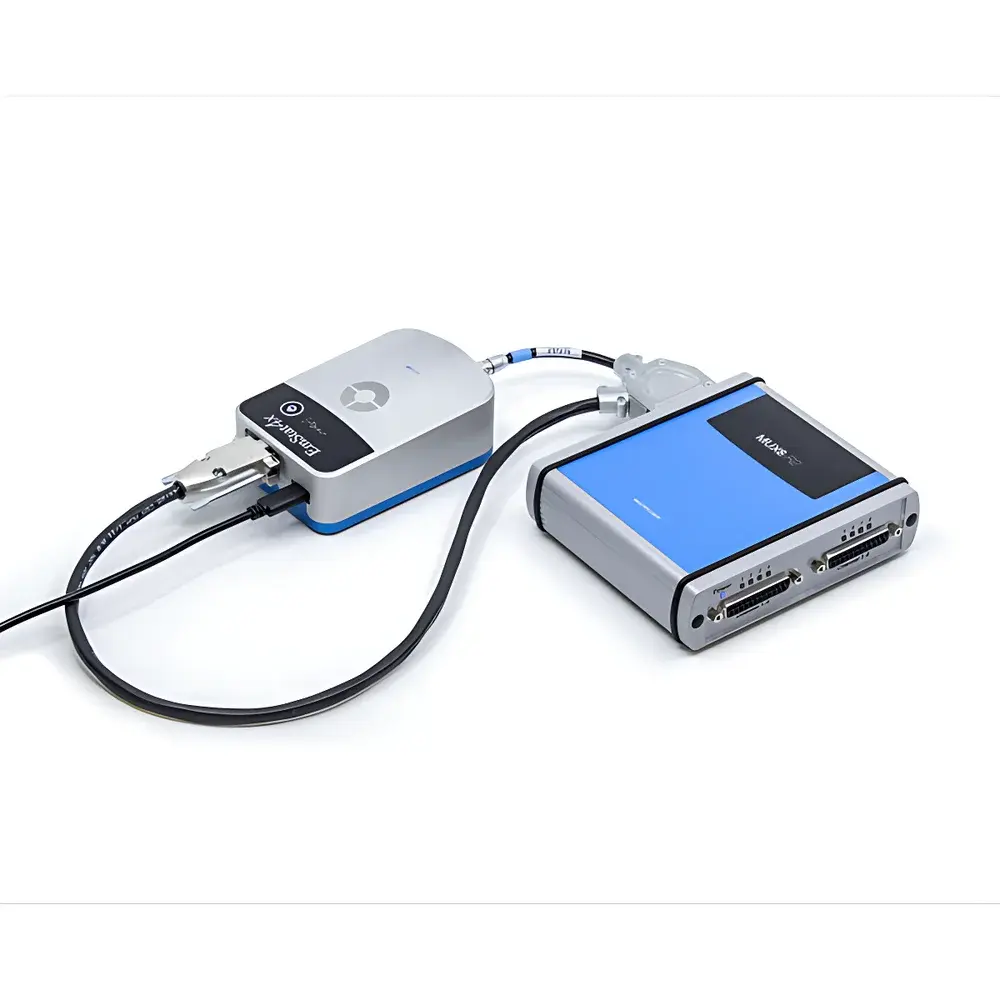
- Dedicated AUX port supporting external peripherals including the MUX8-R2 8-channel multiplexer, temperature probes, pH sensors, magnetic stirrer controllers, and TTL trigger inputs.
- Bluetooth 5.0 wireless interface for secure, low-latency communication with Windows PCs and Android devices—eliminating cable constraints during in-situ measurements.
- On-device status indicators for battery level and Bluetooth connectivity—enhancing operational transparency without requiring host software.
- Firmware-upgradable architecture with support for future protocol extensions and method enhancements via standardized firmware update packages.
Sample Compatibility & Compliance
The EmStat4X is compatible with standard three-electrode electrochemical cells using conventional solid-state or liquid-reference electrodes (e.g., Ag/AgCl, SCE). It supports microelectrodes, screen-printed electrodes (SPEs), and custom thin-film sensor arrays. All analog signal paths are designed to meet electromagnetic compatibility (EMC) requirements per IEC 61326-1 for laboratory and industrial environments. Data integrity and auditability align with GLP/GMP expectations through timestamped raw data logging, metadata tagging (method parameters, operator ID, instrument serial), and optional digital signature integration in post-processing workflows. While not pre-certified for FDA 21 CFR Part 11, its SDK enables developers to implement electronic signature and audit trail modules compliant with regulated environments.
Software & Data Management
The workstation is supported by two native applications: PSTrace (Windows desktop) and PSTouch (Android). Both provide full method configuration, real-time visualization, and export in CSV, TXT, and proprietary .pstat formats. PSTrace includes advanced features such as baseline subtraction, peak integration, Nyquist/Bode plot overlays, and equivalent circuit fitting (via Thales software integration). The EmStat4X SDK—built on Microsoft .NET Framework—exposes low-level command interfaces (ASCII-based protocol), enabling custom automation, integration into LIMS platforms, or incorporation into OEM analytical systems. Raw data files contain embedded calibration coefficients and hardware configuration metadata, ensuring traceability across instrument deployments and software versions.
Applications
- Environmental monitoring: heavy metal detection (Pb²⁺, Cd²⁺, As³⁺) via anodic stripping voltammetry (ASV) using disposable SPEs.
- Corrosion science: polarization resistance (Rp), electrochemical noise analysis (ENA), and EIS-based coating degradation assessment on metallic substrates.
- Battery R&D: half-cell characterization of cathode/anode materials, SEI formation kinetics, and charge-transfer resistance mapping under variable SoC conditions.
- Biosensor validation: redox mediator kinetics, enzyme electrode optimization, and immunosensor binding affinity studies using amperometric or impedimetric readouts.
- Academic teaching labs: hands-on instruction in electroanalytical techniques with intuitive GUI-driven method templates and error diagnostics.
FAQ
What is the maximum sampling rate for time-domain techniques like CA or DPV?
The EmStat4X supports up to 100 kS/s (100,000 samples per second) in high-speed acquisition mode, configurable per experiment.
Can the device perform true four-electrode (Kelvin) measurements?
No—it operates in standard three-electrode configuration; however, the AUX port allows auxiliary potential monitoring for pseudo-four-electrode setups when paired with external instrumentation.
Is EIS data acquisition compatible with Kramers–Kronig validation?
Yes—raw complex impedance datasets include phase and magnitude at each frequency point, enabling post-acquisition K–K transformation and linearity checks in third-party analysis tools.
How is calibration maintained across field deployments?
Factory calibration is stored in non-volatile memory; users may perform two-point current/potential verification using certified reference resistors and voltage standards—procedures documented in the technical manual.
Does the SDK support Python or MATLAB integration?
While the native SDK targets .NET languages (C#, VB.NET), community-developed wrappers and serial protocol documentation enable interoperability with Python (pySerial) and MATLAB (Instrument Control Toolbox) via ASCII command streaming.




