
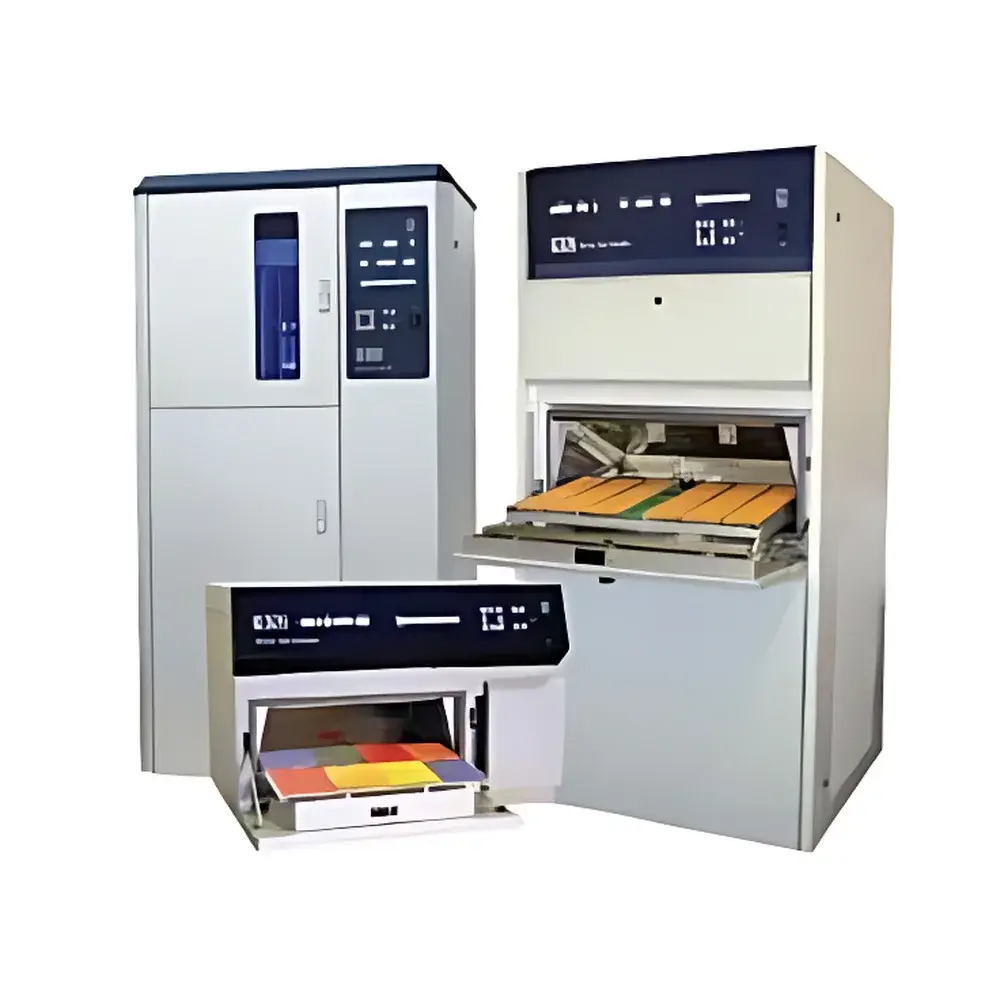
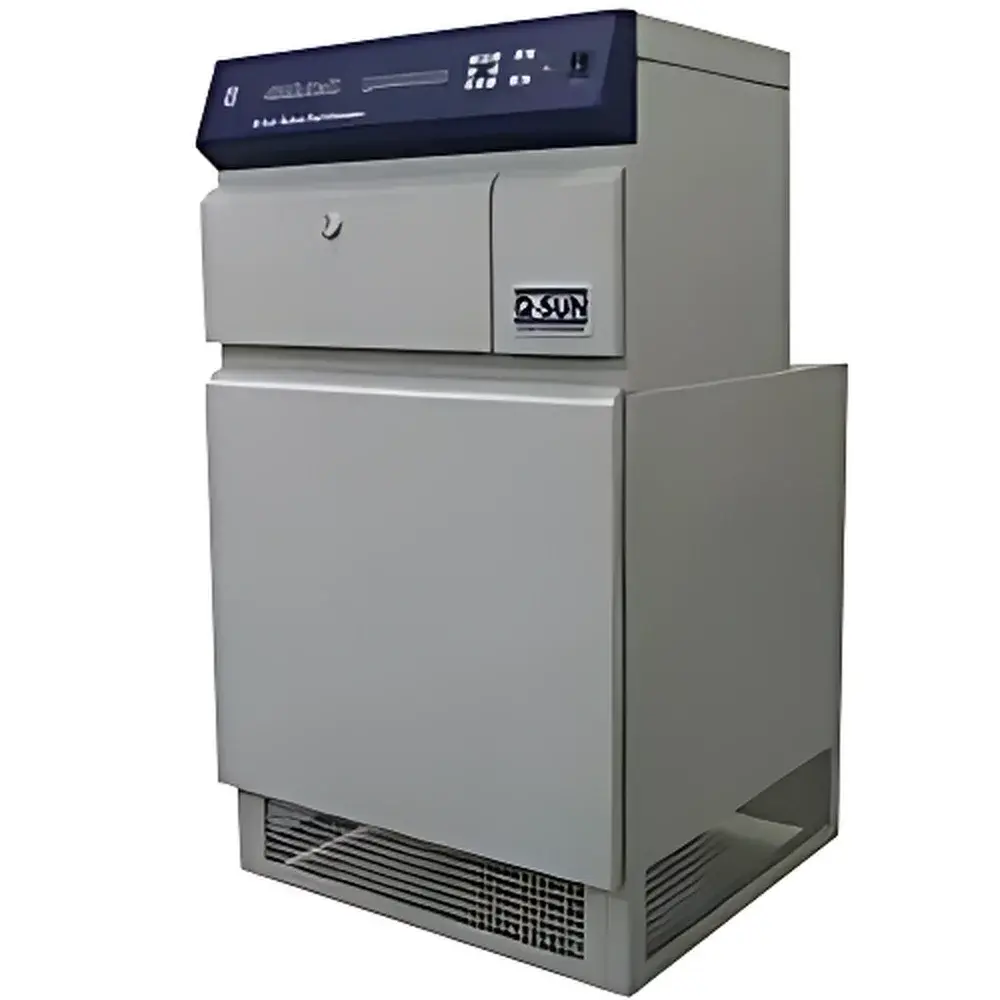
Q-Lab Q-SUN Xe-3-H Xenon Arc Weathering Test Chamber
| Brand | Q-Lab |
|---|---|
| Origin | USA |
| Model | Q-SUN Xe-3-H |
| Cooling Method | Air-Cooled |
| Light Source | Triple Full-Spectrum Xenon Arc Lamps |
| Humidity Control | Yes |
| Spray Function | Not Included (Standard Xe-3-H) |
| Compliance | ASTM G155, ISO 4892-2, SAE J2527, AATCC TM16, IEC 60068-2-9 |
| Calibration Support | SOLAR EYE Irradiance Sensor with CR20 Calibrator (340 nm / 420 nm / TUV options) |
| Filter Options | Daylight-Q/B, Window Glass-Q, Extended UV-Q |
Overview
The Q-Lab Q-SUN Xe-3-H is an air-cooled xenon arc weathering test chamber engineered for precise simulation of solar radiation, temperature, and relative humidity—key environmental stressors driving material degradation. Unlike UV fluorescent or metal halide systems, the Q-SUN Xe-3-H employs three vertically oriented, full-spectrum xenon arc lamps filtered to replicate terrestrial sunlight across UV-A, UV-B, visible, and near-infrared wavelengths (290–800 nm). This spectral fidelity enables quantitative assessment of photochemical degradation mechanisms—including polymer chain scission, chromophore bleaching, and oxidative crosslinking—under controlled, reproducible conditions. The chamber operates on the principle of accelerated exposure: by intensifying irradiance (typically 0.35–1.50 W/m² @ 340 nm), elevating black standard temperature (BST) up to 110°C, and modulating RH between 10–95%, it compresses years of outdoor service life into weeks or months. Its design conforms to internationally recognized exposure protocols, making it suitable for R&D labs, QC departments, and regulatory submission testing where traceable, repeatable data are required.
Key Features
- Triple xenon arc lamp array with integrated electronic ballasts ensures stable irradiance output and extended lamp life (typically 1,500–2,000 hours per set)
- Microprocessor-based Q-SUN controller with real-time monitoring of irradiance (via SOLAR EYE sensor), chamber air temperature, BST, and relative humidity
- Precise humidity control via steam generator and chilled mirror hygrometer—maintains setpoint accuracy within ±3% RH over full operating range
- Robust stainless-steel interior with seamless welds and non-reflective matte finish to minimize stray light and thermal gradients
- Modular filter system supporting interchangeable daylight (Daylight-Q/B), window-glass (Window Glass-Q), and extended-UV (Extended UV-Q) filters—each certified per ISO 4892-2 spectral requirements
- Self-diagnostic firmware with maintenance scheduling, error logging, and automatic safety shutdown for lamp failure, overheating, or sensor drift
Sample Compatibility & Compliance
The Q-SUN Xe-3-H accommodates flat-panel specimens up to 152 mm × 152 mm × 25 mm (6″ × 6″ × 1″) on a stationary horizontal sample plane. Its geometry supports standardized specimen mounting per ASTM D7869 and ISO 4892-2, enabling direct correlation with field exposure databases such as Q-Lab’s Florida and Arizona outdoor arrays. The chamber meets critical regulatory and industry standards including ASTM G155 (Practice for Operating Xenon Arc Lamp Apparatus), ISO 4892-2 (Plastics — Methods of Exposure to Laboratory Light Sources), SAE J2527 (Automotive Interior Materials), and AATCC TM16 (Textiles). For GLP/GMP environments, optional audit-trail-enabled firmware complies with FDA 21 CFR Part 11 requirements for electronic records and signatures. All calibration procedures—including SOLAR EYE sensor verification using NIST-traceable CR20 calibrators—are documented in accordance with ISO/IEC 17025-accredited practices at Q-Lab’s A2LA- and UKAS-certified laboratories.
Software & Data Management
The Q-SUN controller provides local operation via intuitive touchscreen interface and stores up to 100 test programs with multi-step profiles (irradiance ramping, cyclic RH, temperature hold). Optional Q-Lab’s Q-SUN Software Suite enables remote monitoring, real-time data export (CSV, XML), and automated report generation compliant with ISO 17025 documentation standards. Raw sensor outputs—including irradiance (W/m² @ 340 nm), BST (°C), chamber RH (%), and elapsed exposure time—are timestamped and stored with checksum validation. Historical calibration certificates, lamp usage logs, and filter replacement records can be archived and retrieved for internal audits or regulatory inspections. The system supports integration into enterprise LIMS platforms via Modbus TCP or OPC UA protocols.
Applications
The Q-SUN Xe-3-H serves as a primary tool for predictive durability evaluation across sectors where photostability dictates product lifetime. In automotive manufacturing, it validates colorfastness and gloss retention of interior trims per SAE J2527. Coatings formulators use it to rank pigment stability and binder resistance to chalking under simulated daylight + humidity cycling. Polymer compounders assess UV stabilizer efficacy in polyolefins and PVC compounds per ASTM D4329. Textile labs rely on it for fade resistance testing of dyed fabrics (AATCC TM16, ISO 105-B02). Additionally, it supports accelerated aging of medical device packaging (ISO 11607), architectural sealants (ASTM C1135), and photovoltaic encapsulants (IEC 61215), delivering data directly applicable to IEC, UL, and CSA certification pathways.
FAQ
What spectral filters are available for the Q-SUN Xe-3-H, and how do they differ?
The Q-SUN Xe-3-H supports three primary filter families: Daylight-Q/B (mimics unfiltered noon sun at sea level), Window Glass-Q (replicates solar radiation transmitted through standard architectural glass), and Extended UV-Q (enhances short-wave UV for aggressive stabilization testing). Each filter is manufactured to strict optical density tolerances and certified per ISO 4892-2 spectral irradiance requirements.
Does the Xe-3-H include water spray functionality?
No—the base Xe-3-H model does not include spray. Spray capability is available in the Xe-3-HS (single spray), Xe-3-HDS (dual spray), and Xe-3-HBS (back-spray) configurations. Spray nozzles are precision-engineered stainless steel and operate on demand during dark cycles.
How often must the SOLAR EYE irradiance sensor be calibrated?
Q-Lab recommends quarterly verification using a CR20 calibrator matched to the installed sensor’s wavelength band (340 nm, 420 nm, or TUV). Annual factory recalibration of the CR20 unit itself is required and performed at Q-Lab’s ISO/IEC 17025-accredited labs.
Can the Q-SUN Xe-3-H operate continuously without user intervention?
Yes—when configured with scheduled maintenance alerts and redundant safety interlocks, the Xe-3-H supports unattended 24/7 operation for extended exposure campaigns exceeding 1,000 hours, provided ambient cooling and power stability meet specifications.
Is humidity control mandatory for all test methods?
No—humidity control is optional but essential for standards requiring moisture-coupled degradation (e.g., ASTM D4329, ISO 4892-2 Cycle 1). Some protocols specify dry-only exposure; the Xe-3-H allows deactivation of the steam generator while retaining temperature and irradiance control.



