
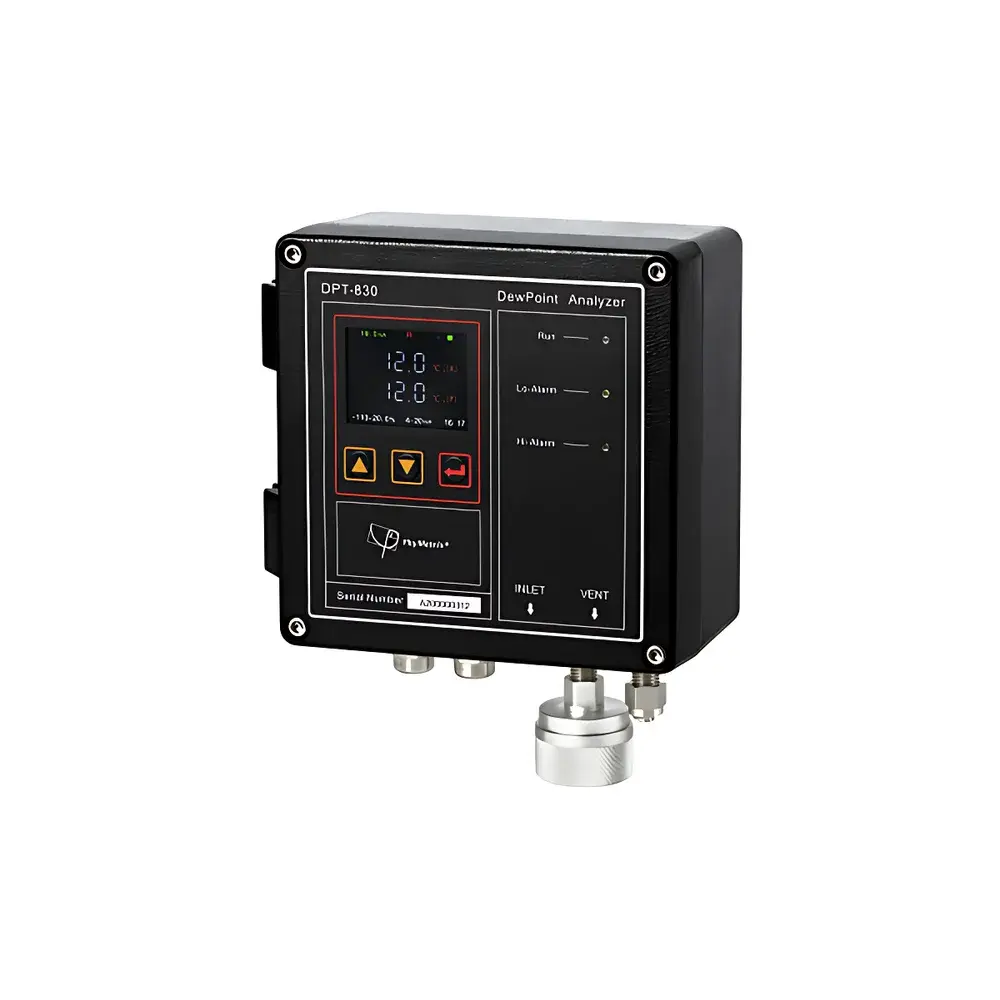
PhyMetrix DPT-830 Online Dew Point Analyzer
| Brand | PhyMetrix |
|---|---|
| Origin | USA |
| Model | DPT-830 |
| Product Type | Online Dew Point Analyzer |
| Measurement Principle | Capacitive Metal Oxide Thin-Film Sensor (Nanoporous Al₂O₃-based) |
| Operating Temperature Range | 0 °C to +45 °C |
| Dew Point Range | −110 °C to +20 °C |
| Accuracy | ±2 °C |
| Repeatability | ±0.8 °C |
| Response Time (T90) | < 3 min |
| Minimum Flow Rate | > 3 SCFH |
| Output Signals | 4–20 mA (user-configurable range), RS232 (configuration & data access), RS485 (Modbus RTU), Optional 433 MHz RF Wireless |
| Relay Outputs | 2 × 10 A / 240 V AC, fully user-configurable |
| Data Logging | Optional |
| Calibration Traceability | NIST-traceable |
| Safety Certification | Optional Intrinsically Safe (IS) Rating |
| Probe Configuration | Optional Remote-Mount Sensor Head |
Overview
The PhyMetrix DPT-830 Online Dew Point Analyzer is an industrial-grade, continuous-monitoring instrument engineered for precise and stable dew point measurement in compressed air, purified nitrogen, instrument air, semiconductor process gases, and other technically dry gas streams. It employs a proprietary capacitive sensing element based on a nanoporous aluminum oxide (Al₂O₃) thin-film dielectric deposited on a micro-machined metal substrate. This sensor architecture enables high sensitivity across an exceptionally wide dew point range—from −110 °C to +20 °C—while maintaining long-term stability under variable humidity and trace contamination conditions. Unlike chilled-mirror hygrometers, the DPT-830 operates without moving parts or refrigeration, delivering robust performance in fixed-installation environments where reliability, low maintenance, and minimal calibration drift are critical. Its compact form factor supports both wall-mount and panel-integrated deployment, with optional remote probe configurations enabling installation directly in high-pressure or high-temperature process lines.
Key Features
- Capacitive nanomaterial sensor with NIST-traceable calibration certificate and documented uncertainty budget
- Full-scale dew point range of −110 °C to +20 °C, supporting applications from ultra-dry purge gas monitoring to ambient-level moisture control
- Measurement repeatability of ±0.8 °C and accuracy of ±2 °C over the full operating temperature range (0 °C to +45 °C)
- User-configurable 4–20 mA analog output with programmable scaling—assignable to any supported engineering unit (°C dp, °F dp, ppmv, ppmw, µbar H₂O partial pressure, g/m³, lb/1000 ft³)
- Dual SPDT relays (10 A / 240 V AC), independently configurable for alarm, fault, or status signaling with hysteresis and delay settings
- Integrated RS232 interface for local configuration, real-time data streaming, and firmware updates via terminal emulator or proprietary utility
- Optional RS485 Modbus RTU interface compliant with Modbus Application Protocol v1.1b for seamless integration into PLC, DCS, and SCADA systems
- Optional 433 MHz RF wireless module enabling telemetry up to 300 m line-of-sight, with AES-128 encryption and configurable transmission intervals
- Intrinsically safe variants available per IEC 60079-0/-11 (Ex ia IIC T4 Ga) for Zone 0/1 hazardous area deployment
Sample Compatibility & Compliance
The DPT-830 is validated for use with non-corrosive, particle-free gases including compressed air, nitrogen, argon, helium, hydrogen, and carbon dioxide at pressures up to 150 psig (10 bar). It is not recommended for use with aggressive halogenated compounds, sulfur-containing gases, or high-concentration solvent vapors unless protected by certified pre-filters. The analyzer complies with electromagnetic compatibility standards EN 61326-1 (industrial environment) and safety standard UL 61010-1. Optional IS-certified versions meet ATEX 2014/34/EU and IECEx requirements. All factory calibrations are performed against primary-standard chilled-mirror reference instruments traceable to NIST SRM 2683 and documented per ISO/IEC 17025 procedures. The device supports audit-ready operation under GLP and GMP frameworks when paired with optional data logging and electronic signature-capable software.
Software & Data Management
Configuration and diagnostics are managed via ASCII command protocol over RS232 or Modbus RTU registers. Optional PC-based configuration utility provides guided setup, live trend visualization, alarm history export (CSV), and calibration log archiving. When equipped with the data logger option, the DPT-830 stores timestamped dew point readings at user-defined intervals (1 sec to 24 hr) onboard non-volatile memory (up to 1 million records). Logged data can be retrieved via RS232 or exported wirelessly. The system supports time-stamped event logging for relay state changes, sensor faults, and power cycles—enabling compliance with FDA 21 CFR Part 11 requirements when deployed with validated software and access controls.
Applications
- Compressed air quality monitoring per ISO 8573-1 Class 0, 2, or 4 specifications in pharmaceutical, food & beverage, and electronics manufacturing
- Moisture control in nitrogen blanketing systems for chemical reactors and storage tanks
- Purge gas verification in semiconductor fab tool chambers and gloveboxes
- Condition monitoring of desiccant dryers, membrane dryers, and refrigerated dryers
- Leak detection support through rapid dew point rise analysis in sealed systems
- Environmental chamber validation and stability testing per ICH Q5C guidelines
FAQ
What is the recommended minimum gas flow rate for accurate measurement?
A sustained flow rate of ≥3 SCFH (standard cubic feet per hour) is required to ensure representative sampling and thermal equilibrium at the sensor surface.
Can the DPT-830 be calibrated in-field without returning to the lab?
Yes—two-point field calibration is supported using certified dry and humid reference gases; NIST-traceable calibration kits are available separately.
Is the sensor affected by oil vapor or particulate contamination?
While the sensor includes a sintered stainless-steel filter (5 µm), prolonged exposure to aerosolized lubricants or condensed hydrocarbons will degrade response characteristics; upstream coalescing filtration is strongly advised.
Does the device support HART communication?
No—HART is not implemented; however, the 4–20 mA output is fully compatible with HART-enabled I/O systems via analog input cards.
What is the expected service life of the sensor under typical industrial conditions?
Under clean, dry gas conditions with proper filtration, the sensor demonstrates operational stability exceeding 5 years; annual verification is recommended per ISO/IEC 17025 quality protocols.





