
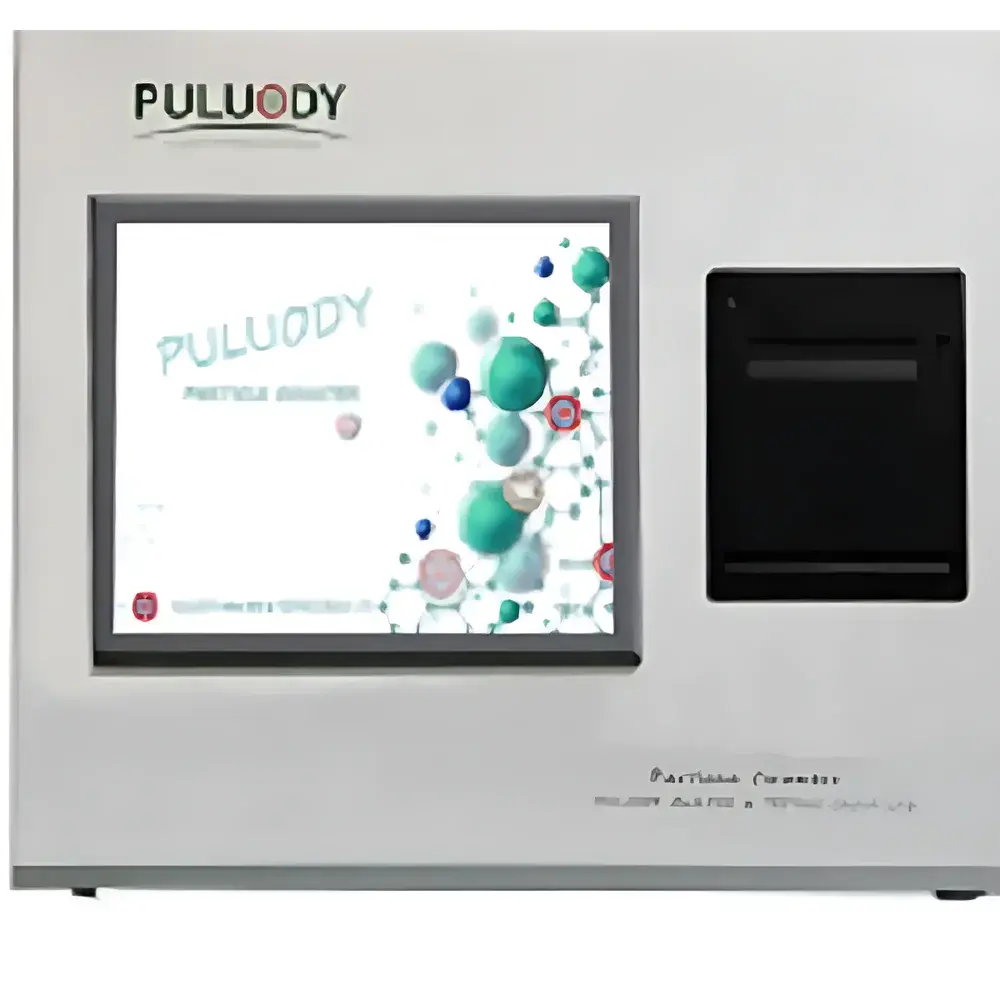
PULUODY DPC-1513-1 Oilfield Re-injection Water Particle Counter & Size Distribution Analyzer
| Brand | PULUODY |
|---|---|
| Origin | Shaanxi, China |
| Model | DPC-1513-1 |
| Measurement Principle | Optical Diffraction & Scattering (ISO 13320) / Laser Flow Imaging (ISO 13321) |
| Dynamic Range | 1 nm – 2000 µm (configurable sub-ranges: 1–10,000 nm |
| Repeatability | ≤ ±1% RSD for D50 (certified reference materials) |
| Sample Throughput | ≤2 min per analysis |
| Compliance | SY/T 5329–2022, SY/T 5523–2016, Q/SY 01004–2016, ISO 13320, ISO 13321 |
| Detector | 7th-generation dual-laser narrow-beam photodetector |
| Software | Windows-compatible bilingual (EN/CN), 20 report templates, automated workflow (alignment, background, concentration adjustment, acquisition, analysis, cleaning) |
| Power | AC 220 V ±10%, 50 Hz, 300 W |
| Operating Environment | 0–40 °C, clean lab environment |
Overview
The PULUODY DPC-1513-1 Oilfield Re-injection Water Particle Counter & Size Distribution Analyzer is a dual-mode, high-fidelity instrumentation platform engineered for precise, regulatory-compliant particle characterization in produced water management systems. It integrates two orthogonal measurement principles—laser diffraction and scattering (per ISO 13320) and laser flow imaging (per ISO 13321)—within a single compact architecture to deliver comprehensive particle size distribution (PSD), shape morphology (circularity, aspect ratio), and concentration data across an unprecedented dynamic range of 1 nm to 2000 µm. Designed specifically for oilfield water re-injection applications, the instrument addresses critical operational requirements defined in SY/T 5329–2022 (water quality specifications for clastic reservoirs), SY/T 5523–2016 (oilfield water analysis methods), and Q/SY 01004–2016 (gas field water re-injection technical standards). Its optical design eliminates parallax and defocus artifacts through hydrodynamic focusing—where sheath fluid precisely aligns particles into a single-file stream within the imaging plane—ensuring pixel-accurate silhouette capture by a high-frame-rate CMOS sensor. The diffraction module employs a multi-ring photodetector array calibrated to Mie and Fraunhofer theoretical models, enabling robust quantification of volume-weighted distributions (Dv10, Dv50, Dv90) and surface-area-based metrics (e.g., Sauter mean diameter D[3,2]).
Key Features
- Dual-sensor architecture supporting both ISO 13320-compliant laser diffraction and ISO 13321-compliant dynamic imaging—enabling cross-validated, orthogonal PSD and shape analysis
- Configurable measurement ranges: nanoscale (1–10,000 nm), microscale (0.02–2000 µm), or targeted re-injection bands (1–1000 µm or 1–500 µm)
- 7th-generation dual-laser narrow-beam detection system with enhanced signal-to-noise ratio and >50,000-hour detector lifetime
- Integrated hydraulic focusing module ensuring laminar, single-particle transit through the imaging zone—eliminating coincidence error and agglomeration bias
- Automated workflow engine: fully programmable sequence covering optical alignment, background subtraction, sample concentration optimization, real-time acquisition, statistical post-processing, and system rinse cycles
- Modular sampling interface accommodating both static cuvette (for low-volume, non-dilutive analysis) and recirculating flow cell (for continuous pipeline monitoring integration)
- Electrical and fluidic isolation architecture minimizing electromagnetic interference and thermal drift—critical for long-term stability in field-deployable labs
Sample Compatibility & Compliance
The DPC-1513-1 is validated for aqueous suspensions typical of upstream oilfield operations—including filtered and unfiltered produced water, tertiary-treated injection water, and gas field condensate returns. It accommodates turbidities up to 500 NTU without pre-dilution when using the flow imaging mode, and handles viscosities up to 10 mPa·s in diffraction mode. Regulatory traceability is embedded at the firmware level: all calibration routines adhere to NIST-traceable reference materials (e.g., NIST SRM 1963, 2800), and audit logs comply with GLP/GMP documentation requirements. Data integrity safeguards include time-stamped, user-locked measurement records, electronic signatures, and exportable metadata compliant with FDA 21 CFR Part 11 Annex 11 expectations. Certificates of calibration are issued by CNAS-accredited metrology institutes in China, with lifelong third-party recalibration support available.
Software & Data Management
The proprietary PULUODY ParticleSuite™ software runs natively on Windows 10/11 (64-bit) and supports seamless bilingual operation (English/Chinese toggle). It provides 20 customizable reporting templates—including ASTM E2457–22–aligned summary sheets and SY/T 5329–2022–formatted compliance dashboards—exportable as PDF, CSV, PNG, or XML. All raw image frames, diffraction patterns, and processed histograms are stored with full metadata (instrument ID, operator, timestamp, environmental conditions, SOP version). Built-in statistical tools compute not only standard percentiles (D10, D50, D90), but also derived parameters such as specific surface area (m²/g), particle count per mL, and shape descriptors (equivalent circular diameter, Feret max/min, convexity). Data synchronization via secure FTP or local network share enables centralized QA/QC review across multi-site operations.
Applications
- Verification of filtration efficiency in multi-stage water treatment trains (e.g., coalescers, cartridge filters, membrane units)
- Monitoring of suspended solids breakthrough during wellbore clean-up and matrix acidizing operations
- Baseline characterization of formation fines mobilization under varying salinity and pH conditions
- Validation of biocide efficacy on biofilm-derived particulates in injection lines
- Supporting root-cause analysis of formation damage via correlation between particle load, size distribution skewness, and injectivity index decline
- Regulatory submission packages for environmental permits requiring ISO 13320–based particle profiling
FAQ
Does the DPC-1513-1 meet international standards for regulatory submissions?
Yes. Its optical design and data reduction algorithms conform to ISO 13320 (laser diffraction) and ISO 13321 (imaging), and its operational protocols align with SY/T 5329–2022, SY/T 5523–2016, and Q/SY 01004–2016. Full validation documentation, including uncertainty budgets and inter-laboratory comparison reports, is provided upon request.
Can it differentiate between inorganic silt and organic biomass particles?
While optical methods cannot chemically identify composition, the dual-mode capability enables morphological discrimination: irregular, filamentous, or clustered shapes strongly suggest biological origin, whereas angular, equant particles correlate with quartz/feldspar fines. Integration with optional fluorescence modules (available as upgrade) adds biochemical contrast.
Is remote diagnostics and software update supported?
Yes. The instrument features embedded Ethernet and optional 4G LTE connectivity. Secure remote access allows PULUODY-certified engineers to perform real-time diagnostics, firmware updates, and parameter optimization without onsite visits—subject to customer-configured firewall policies.
What maintenance intervals are recommended for field deployment?
Daily: rinse cycle verification and background scan. Quarterly: optical window cleaning and flow cell inspection. Annually: full photodetector sensitivity calibration and sheath fluid pump performance validation—all tracked automatically in the onboard maintenance log.
How does it handle high-concentration samples without dilution?
The flow imaging module uses hydrodynamic focusing to maintain particle separation even at concentrations up to 1×10⁶ particles/mL. For diffraction mode, automatic concentration feedback control adjusts sample flow rate and laser intensity in real time to maintain optimal signal saturation—eliminating manual dilution steps while preserving statistical significance.



