
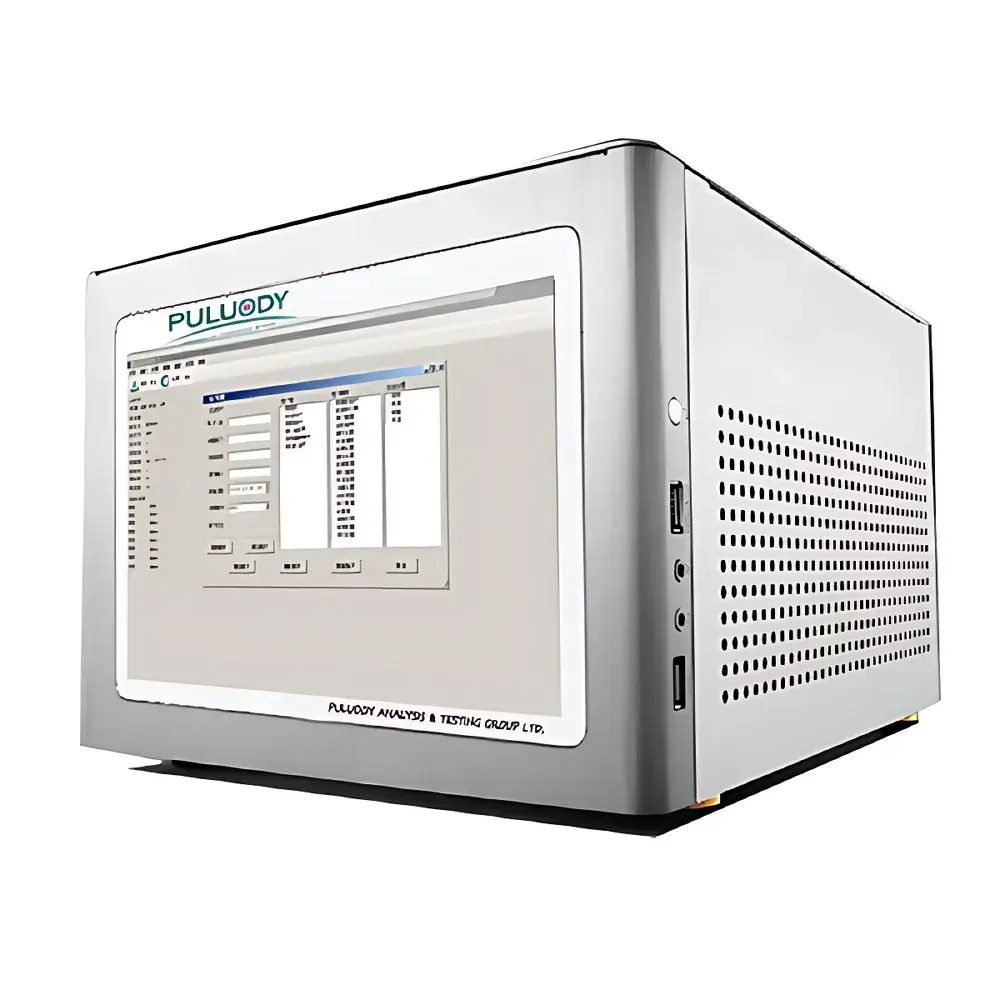
PULUODY PMT-2cs Industrial Ultra-Pure Water Liquid Particle Counter
| Brand | PULUODY |
|---|---|
| Origin | Shaanxi, China |
| Manufacturer Type | Authorized Distributor |
| Country of Origin | China |
| Model | PMT-2cs |
| Instrument Type | Optical Particle Counter |
| Detection Principle | Dual-Laser Narrow-Beam Light Scattering |
| Detection Range | 0.1–0.5 µm (standard) |
| Sampling Method | Precision Metering Piston Pump |
| Flow Control | Dual-Stage Electromagnetic + Precision Piston Pump |
| Accuracy | ±3% typical |
| Volume Accuracy | ±1% |
| Coincidence Limit | ≤2.5% at 1000 particles/mL |
| Output | 4–20 mA analog signal with configurable alarm threshold |
| Calibration Standards | JJG 1061, ISO 21501-4, NIST-traceable latex spheres |
| Software | V8.3 Integrated Analysis & Calibration Software (PC & Tablet-compatible) |
| Display & Control | Color LCD touchscreen + optional wireless keyboard/mouse |
| Reporting | Particles per mL & ISO 4406 / NAS 1638 contamination codes |
| Power Input | 100–265 VAC, 50–60 Hz |
| Compliance | Designed for GLP/GMP environments |
Overview
The PULUODY PMT-2cs Industrial Ultra-Pure Water Liquid Particle Counter is a high-sensitivity optical particle counter engineered for continuous, real-time monitoring of sub-micron particulate contamination in ultra-pure water (UPW) and aggressive process liquids used in semiconductor fabrication, flat-panel display manufacturing, photovoltaic cell production, and advanced electronics cleaning processes. It operates on the principle of dual-laser narrow-beam light scattering—utilizing two spatially separated, collimated laser sources to enhance signal-to-noise ratio and suppress false counts from refractive index fluctuations or bubble interference. This eighth-generation sensor architecture enables stable, reproducible detection down to 0.1 µm(c) under controlled laminar flow conditions, meeting the stringent sensitivity demands of Class 1 cleanroom UPW distribution systems and post-filtration validation workflows.
Key Features
- Dual-laser narrow-beam optical sensing platform with independent wavelength alignment and background noise suppression circuitry
- Two-stage precision fluidics: high-stability metering piston pump coupled with electromagnetic flow regulation for ±1% volumetric accuracy
- Configurable detection thresholds: standard 0.1–0.5 µm range; extended options include 4–70 µm(c) for filter integrity verification or 1–100 µm for polymer solution insoluble particle screening
- V8.3 integrated software suite supporting dual-mode operation—separate calibration and analysis environments to prevent data interference during routine testing
- Real-time analog output (4–20 mA) with programmable alarm triggers for integration into SCADA, DCS, or MES platforms
- Touchscreen HMI with optional wireless keyboard/mouse interface for flexible deployment in both fixed and mobile offline configurations
- Compliance-ready architecture: built-in user authentication, electronic signature support, and time-stamped audit logs aligned with FDA 21 CFR Part 11 and ISO/IEC 17025 documentation requirements
Sample Compatibility & Compliance
The PMT-2cs is validated for use with low-conductivity liquids (e.g., UPW with resistivity >18.2 MΩ·cm), aqueous cleaning agents (SC1, SC2, DHF), photoresist solvents, and polymer solutions exhibiting low UV absorption. Its wetted path employs chemically inert materials—including sapphire flow cells, PFA tubing, and ceramic pump components—to ensure compatibility with aggressive chemistries and minimize leachables. The instrument meets ISO 21501-4 for light-scattering particle counters and supports calibration traceability to NIST-certified latex standards per JJG 1061. It is routinely deployed in facilities operating under ISO 14644-1 Class 1–5 cleanrooms and complies with SEMI F63 guidelines for UPW particle monitoring in semiconductor fabs.
Software & Data Management
The V8.3 software platform provides full metrological separation between calibration management and sample analysis workflows—ensuring that instrument qualification data remains immutable during operational use. Features include automated baseline drift correction, dynamic coincidence error compensation up to 1000 particles/mL, and multi-parameter reporting (e.g., particle count/mL, ISO 4406 code, NAS 1638 grade, and cumulative/differential histograms). Data export supports CSV, PDF, and XML formats with embedded metadata (operator ID, timestamp, calibration certificate ID). Audit trail functionality records all critical events—including method changes, calibration actions, and result modifications—with tamper-proof digital signatures.
Applications
- Continuous online monitoring of UPW loop return lines in semiconductor front-end fabs
- Offline validation of point-of-use filters (e.g., 20 nm, 5 nm membrane filters) using batch sampling protocols
- Contamination diagnostics in TFT-LCD and OLED panel cleaning baths
- Insoluble particle quantification in photoresist developers and etchants per ASTM D7977
- Post-purification verification of nanopure water in pharmaceutical water-for-injection (WFI) polishing loops
- Trend analysis of particle shedding from wafer carriers, quartz boats, and wet benches
FAQ
What calibration standards are supported by the PMT-2cs?
The instrument supports calibration using NIST-traceable polystyrene latex (PSL) spheres per ISO 21501-4, national metrology standard JJG 1061, and customer-defined reference materials.
Can the PMT-2cs be integrated into an existing factory automation system?
Yes—it provides isolated 4–20 mA analog output with configurable alarm thresholds and Modbus TCP option for direct integration into PLCs, DCS, or cloud-based IIoT platforms.
Is the system compliant with FDA 21 CFR Part 11 requirements?
The V8.3 software includes role-based access control, electronic signatures, and immutable audit trails—fully supporting Part 11 compliance when deployed in validated environments.
What is the minimum detectable particle size under standard configuration?
The base configuration achieves reliable detection at 0.1 µm(c) in ultra-pure water with optimal signal-to-noise ratio; performance is fluid-dependent and requires proper system conditioning prior to measurement.
Does the instrument support both online and offline measurement modes?
Yes—its modular design allows seamless transition between continuous inline monitoring (via dedicated flow cell and bypass manifold) and portable offline analysis (using integrated syringe pump and sample vial adapter).



