
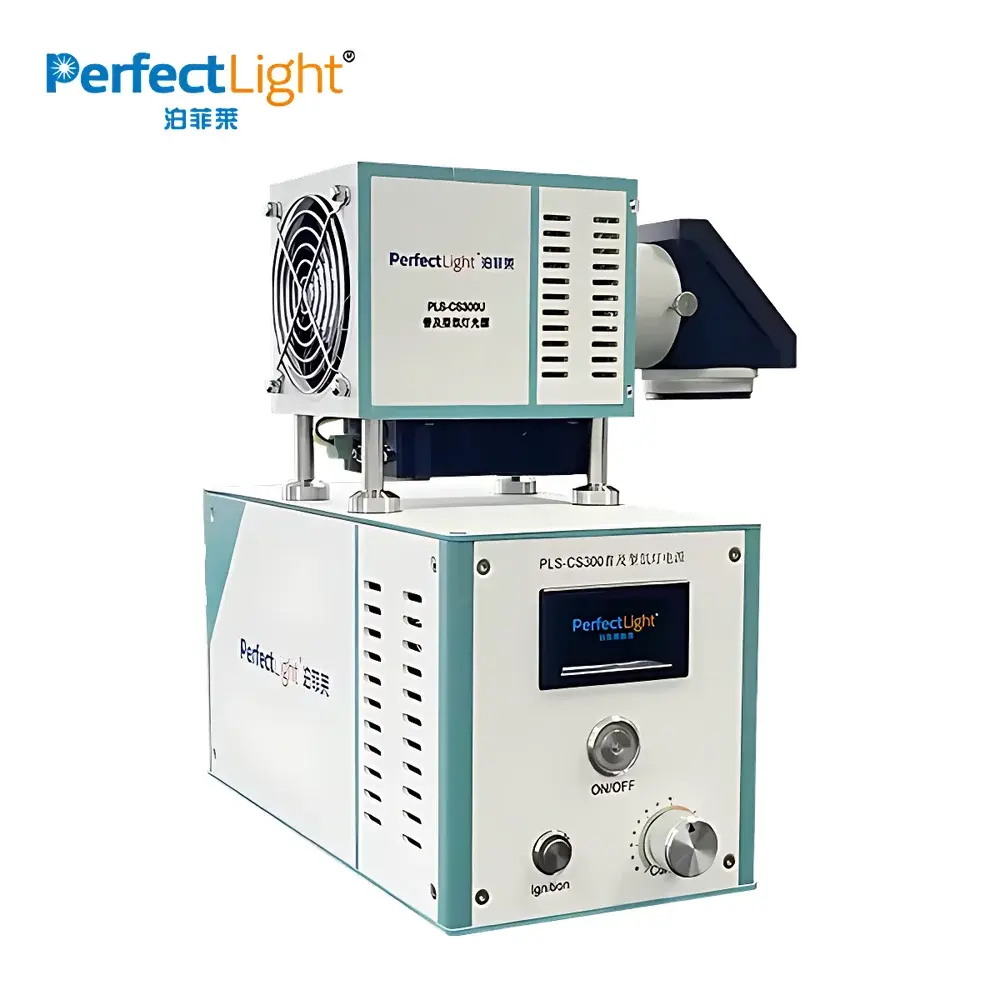
PLS-CS300 Xenon Light Source by PerfectLight
| Brand | PerfectLight |
|---|---|
| Origin | Beijing, China |
| Model | PLS-CS300 |
| Light Source Type | Xenon Lamp |
| Illumination Mode | External Irradiation |
| Output Power Range | 150–300 W |
| Spectral Range (Standard) | 320–780 nm |
| Extended Range | 200–2500 nm |
| Power Stability | ±2% |
| Current Adjustment Range | 10–22 A |
| Lamp Lifetime | ≥1000 h |
| Beam Diameter (Free Aperture) | ≥30 mm |
| Divergence Angle (Collimated Beam) | Avg. 6° |
| Filter Mount Thread | M52×0.75 |
| Clear Aperture | 46.5 mm |
| Dual Over-Temperature Protection | Yes |
| Digital Current/Voltage Display | Yes |
| Built-in Timer for Operating Duration | Yes |
| Weight | 7.8 kg |
| Orientation Flexibility | Horizontal or Vertical Irradiation |
Overview
The PLS-CS300 Xenon Light Source, engineered by PerfectLight, is a high-stability, externally irradiating broadband light source designed for rigorous optical laboratory applications—particularly in photocatalysis, photoelectrochemical (PEC) characterization, and quantum yield measurement. It operates on the principle of high-intensity arc discharge within a quartz-encapsulated xenon lamp, delivering continuous spectral output spanning 200–2500 nm—with standard visible–near-UV coverage from 320–780 nm. Its optical architecture integrates optimized reflector geometry, thermally stable lamp housing, and precision-aligned collimation optics to ensure spatial uniformity, temporal stability, and reproducible irradiance across experimental campaigns. The system is explicitly configured for external illumination setups, enabling seamless integration with reaction chambers, electrochemical cells, gas-phase reactors, and custom optical benches without internal cavity constraints.
Key Features
- Enhanced Optical Power Delivery: Structural redesign of the lamp chamber and light-guiding optics yields >30% increase in effective output power across the operational current range (10–21 A), verified under controlled beam geometry and fixed source-to-sample distance—directly improving photon flux density for accelerated reaction kinetics in photocatalytic water splitting, CO2 reduction, and VOC degradation.
- Rapid Lamp Replacement Protocol: A six-step maintenance sequence (“Loosen–Rotate–Clean–Blow–Replace–Tighten”) enables full xenon lamp exchange in <4 minutes—eliminating disassembly of heat sinks or chassis, thereby minimizing instrument downtime and reducing risk of thermal misalignment.
- Compact Modular Architecture: Lamp housing volume reduced to ~1/3 and power supply unit volume decreased by ~25% versus prior-generation models—facilitating space-constrained installations and compatibility with multi-instrument coupling (e.g., in situ spectroelectrochemical cells or vacuum-compatible photoreactors).
- Dual Thermal Safety System: Independent temperature sensors monitor both lamp housing and power electronics, triggering automatic shutdown if either exceeds safe operating thresholds—ensuring compliance with IEC 61000-6-2 immunity requirements for laboratory equipment.
- Real-Time Electrical Monitoring: Integrated digital display provides simultaneous readout of lamp current (A) and voltage (V) with resolution sufficient for closed-loop process control and long-term drift assessment.
Sample Compatibility & Compliance
The PLS-CS300 supports diverse sample configurations including flat-plate photocatalysts, thin-film electrodes, gas-phase flow reactors, and liquid-phase cuvettes. Its external irradiation design avoids internal reflection artifacts and enables precise incident angle control. The M52×0.75 filter thread and 46.5 mm clear aperture accommodate standard bandpass, longpass, and shortpass interference filters (e.g., UV-cutoff, VIS-transmitting, NIR-blocking). The system meets mechanical and electrical safety standards per GB/T 14710 (Chinese national standard for environmental adaptability of medical and lab equipment) and conforms to electromagnetic compatibility (EMC) Class B limits under CISPR 11. While not certified for FDA 21 CFR Part 11, its digital timer and parameter logging support GLP-compliant experiment documentation when integrated with validated third-party data acquisition software.
Software & Data Management
The PLS-CS300 operates as a standalone analog-controlled light source with no embedded firmware or proprietary software stack. All operational parameters—including current setpoint, runtime duration, and thermal status—are accessible via front-panel indicators and physical controls. For automated workflows, analog voltage outputs (0–5 V or 0–10 V) can be interfaced with programmable logic controllers (PLCs) or DAQ systems to synchronize irradiation timing with spectroscopic acquisition, potentiostat sweeps, or mass spectrometer triggers. Exported timestamped runtime logs (via optional RS-485 or USB-to-serial adapter) enable traceable correlation between light-on events and analytical measurements—critical for kinetic modeling and inter-laboratory reproducibility studies.
Applications
- Photocatalytic Water Splitting: Stable broadband irradiation enables quantification of H2/O2 evolution rates under AM1.5G-simulated conditions using Pt/TiO2, g-C3N4, or perovskite-based catalysts.
- Gas-Phase Pollutant Degradation: Facilitates kinetic analysis of formaldehyde, NOx, SOx, and VOC decomposition in annular or packed-bed photoreactors under controlled humidity and residence time.
- Liquid-Phase Organic Degradation: Supports standardized dye decolorization assays (e.g., methylene blue, rhodamine B) and aromatic compound mineralization studies (benzene, phenol) with calibrated actinometry.
- Photoelectrochemical Characterization: Delivers uniform illumination for J–V curve acquisition, IPCE mapping, and transient photocurrent analysis on semiconductor photoanodes/cathodes.
- Quantum Yield Determination: High radiometric stability (<±2% power fluctuation) and collimated beam profile (6° divergence) satisfy ISO 10678:2010 requirements for absolute quantum efficiency measurement in homogeneous and heterogeneous systems.
FAQ
What spectral calibration certificates are provided with the PLS-CS300?
No factory-issued NIST-traceable spectral irradiance certificate is included; users requiring metrological validation must perform independent calibration using a calibrated spectroradiometer (e.g., Ocean Insight HDX or Avantes AvaSpec-ULS2048L).
Can the PLS-CS300 be operated continuously for >8 hours?
Yes—provided ambient temperature remains ≤25°C and airflow around the lamp housing and power supply is unobstructed. Continuous operation beyond 1000 h total lifetime is not recommended due to progressive electrode erosion and quartz envelope darkening.
Is the light output polarized?
No—the xenon arc emits unpolarized, incoherent radiation. Polarization requires external components such as Glan–Taylor prisms or wire-grid polarizers mounted in the filter holder.
Does the system support TTL-triggered on/off control?
Not natively—but an external solid-state relay (SSR) can be driven by TTL signals to interrupt AC mains input to the power supply, enabling synchronization with pulsed measurement systems.
What is the recommended lamp replacement interval under typical usage?
For optimal spectral stability and output consistency, replace the xenon lamp after 800–1000 h of cumulative operation, or sooner if visible blackening of the quartz envelope or >10% drop in measured irradiance at 400 nm is observed.



