
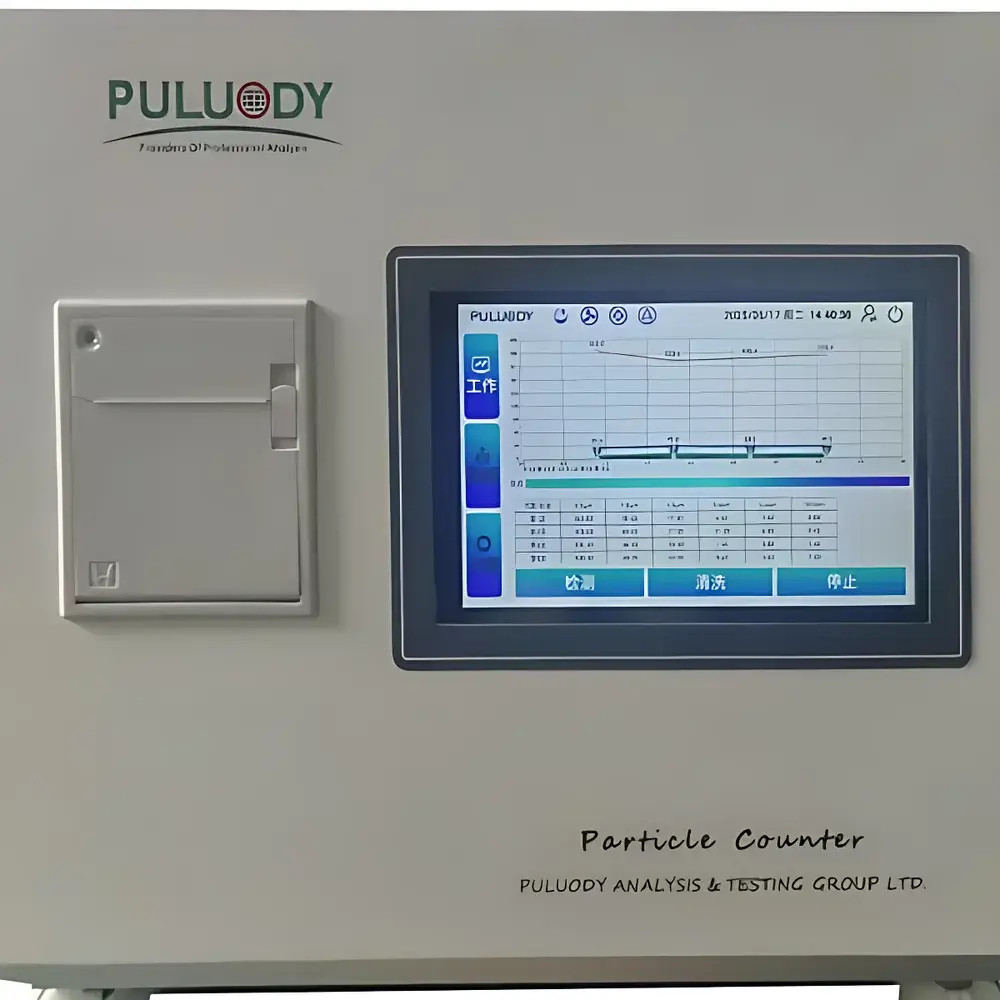
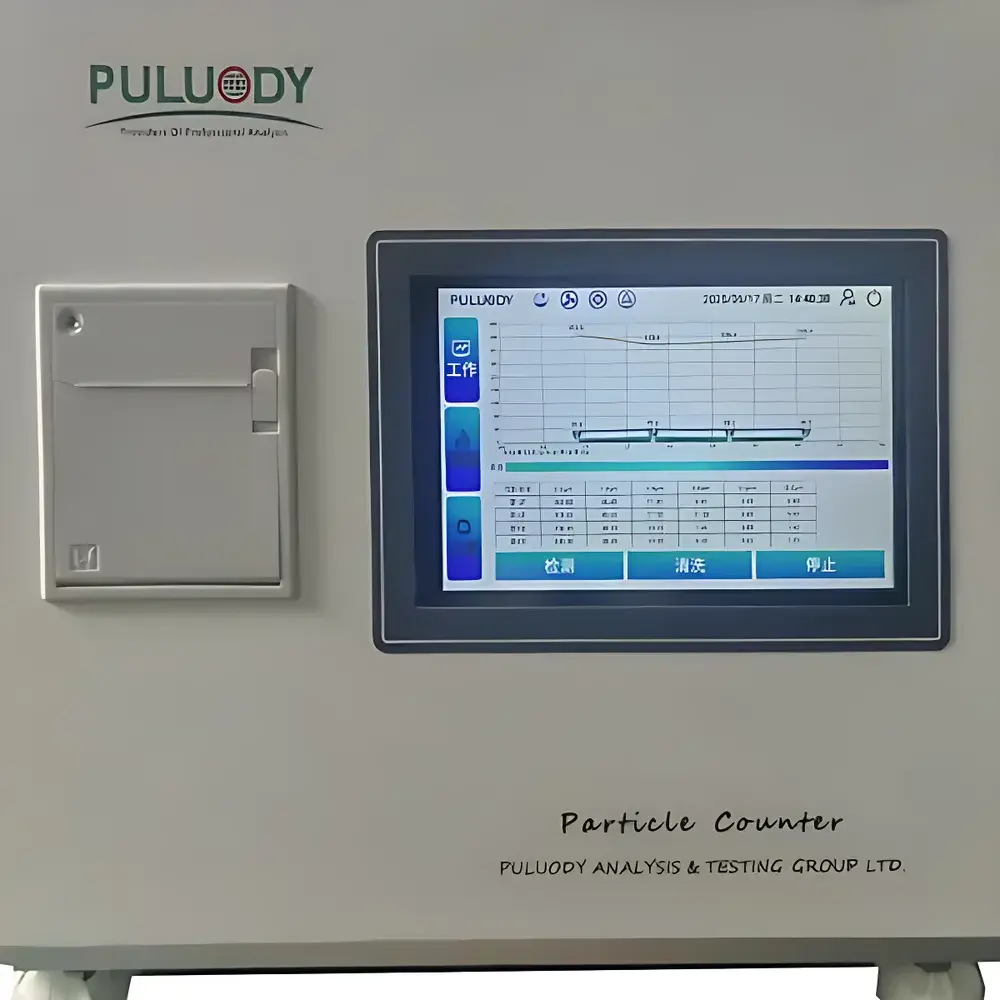
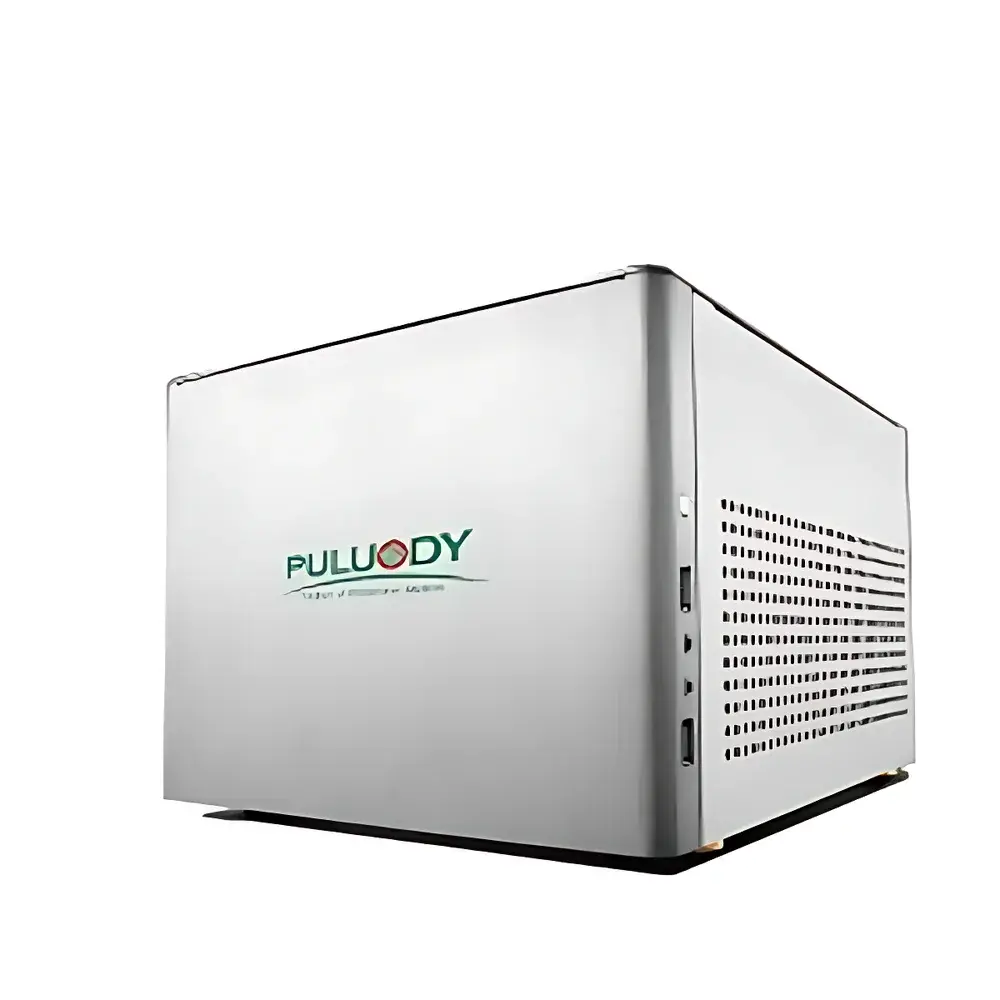
PULUODY OPC-1800A Optical Particle Counter for Water and Aqueous Solutions
| Brand | PULUODY |
|---|---|
| Model | OPC-1800A |
| Instrument Type | Optical Particle Counter (Light Obscuration Principle) |
| Detection Range | 1–450 µm |
| Channel Count | 1000 adjustable size channels |
| Resolution | <10% (per JJG 1061 or NIST-traceable latex standard calibration) |
| Accuracy | ±3% typical |
| Coincidence Limit | 10,000 particles/mL (5% coincidence error) |
| Sampling Precision | <±1% |
| Flow Rate (Sampling) | 5–60 mL/min |
| Flow Rate (Cleaning) | 5–500 mL/min |
| Fluid Temperature Range | 0–80 °C |
| Operating Ambient Temperature | −15–50 °C |
| Viscosity Range | 0–99 mm²/s (offline), up to 500 mm²/s (pressurized) |
| Interface | RS232, RS485-to-USB, USB, MODBUS RTU, 4–20 mA analog output |
| Display | Color LCD touchscreen |
| Data Storage | ≥20,000 test records (expandable via USB drive) |
| Laser Sensor | 7th-generation dual-laser narrow-beam obscuration detector |
| Software | P6.4 Particle Analysis Suite (Integrated & PC versions) |
| Calibration Standards | GBW certified reference materials |
Overview
The PULUODY OPC-1800A Optical Particle Counter is an advanced offline liquid particle counter engineered for high-precision quantification of insoluble particulate contamination in ultra-pure aqueous media—including pharmaceutical water (PW, WFI, Purified Water), beverage formulations, dialysis solutions, electronic-grade water, and industrial process waters. It operates on the light obscuration (LO) principle—where particles suspended in a laminar fluid stream pass through a focused laser beam, generating transient reductions in detected light intensity proportional to their cross-sectional area. Each pulse is digitized and classified into one of 1000 user-configurable size channels spanning 1–450 µm, enabling granular compliance reporting against global pharmacopeial and industrial standards. Designed for laboratory, QC/QA, and metrology environments, the OPC-1800A delivers traceable, reproducible results under GLP-aligned workflows and supports full audit trail functionality in regulated settings.
Key Features
- Seventh-generation dual-laser narrow-beam detection architecture ensures stable signal-to-noise ratio and minimizes optical drift across extended operation cycles.
- 1000-channel high-resolution sizing matrix allows flexible binning—from fixed 4-channel summaries to custom multi-threshold groupings (e.g., 4–70 µm(c), 1–100 µm), supporting simultaneous reporting per USP , EP 2.9.19, JP 6.06, and ChP 2015.
- Integrated industrial-grade touch interface with real-time histogram visualization, intuitive SOP-driven workflow navigation, and embedded calibration management tools.
- Modular fluidic path with precision metering pump and programmable cleaning protocol (5–500 mL/min), validated for low carryover (<0.01%) between samples.
- Comprehensive connectivity suite: native RS232/RS485, USB host/device, MODBUS RTU, and 4–20 mA analog output—enabling seamless integration into LIMS, SCADA, or MES platforms.
- Full compliance support: preloaded templates for ISO 4406, NAS 1638, SAE AS4059, ISO 11171, ISO 16889, GB/T 14039, and pharmacopeial water standards including USP and .
Sample Compatibility & Compliance
The OPC-1800A is validated for use with low-viscosity aqueous liquids (0–99 mm²/s offline; up to 500 mm²/s with optional pressurization module), including purified water, water-for-injection (WFI), saline solutions, ethanol–water mixtures, dialysate, oral rehydration solutions, soft drinks, wine, dairy emulsions, and cleaning agents. It meets the physical and procedural requirements of ISO 21501-4:2018 (determination of particle size distribution by light extinction), USP “Particulate Matter in Injections”, USP “Particulate Matter in Ophthalmic Solutions”, EP 2.9.19 “Sub-visible Particulate Matter”, JP 6.06 “Particulate Contamination Test”, and ChP 2020 General Chapter 0903. Calibration traceability is maintained using GBW-certified polystyrene latex standards and accredited verification reports issued by the National Institute of Metrology (NIM) Northwest Center or the National Defense Science & Technology Commission’s Level-1 Particle Metrology Station (No. 116).
Software & Data Management
The P6.4 Particle Analysis Suite provides dual deployment options: embedded firmware control for standalone operation and a full-featured PC application for advanced statistical evaluation, trend analysis, and report generation. The software enforces ALCOA+ data integrity principles—ensuring attributable, legible, contemporaneous, original, and accurate records. All measurement events are timestamped, user-authenticated, and stored with full parameter metadata (flow rate, temperature, dilution factor, channel thresholds). Audit trails comply with FDA 21 CFR Part 11 requirements when configured with electronic signatures and role-based access control. Export formats include CSV, PDF, XML, and direct database push to SQL Server or Oracle. U.S. and EU GMP laboratories routinely deploy P6.4 in conjunction with validated network storage and periodic third-party software validation packages.
Applications
The OPC-1800A serves critical quality control functions across multiple regulated sectors: pharmaceutical manufacturing (raw water qualification, WFI system monitoring, final fill verification); biotechnology (cell culture media filtration validation, buffer particulate screening); semiconductor fabrication (ultrapure rinse water certification per SEMI F57); food & beverage R&D (carbonation stability, colloidal suspension integrity, shelf-life particulate profiling); medical device production (sterile packaging wash water testing, dialyzer integrity verification); and power generation (condensate polishing loop surveillance, turbine lube oil–water interface analysis). Its adaptability to diverse sampling protocols—including syringe-driven offline injection, pressurized flow-through cells, and portable field kits—makes it suitable for both central QC labs and decentralized environmental monitoring programs.
FAQ
Does the OPC-1800A support USP and compliance reporting?
Yes—the instrument includes built-in calculation engines for both limits-based (threshold count) and cumulative distribution reporting aligned with USP monographs, including automatic pass/fail flagging and grade assignment per specified volume and size thresholds.
Can calibration be performed in-house using GBW reference materials?
Yes—GBW-certified latex sphere suspensions (e.g., GBW(E)130240 series) are supplied with each unit, and the P6.4 software includes guided calibration routines compliant with JJG 1061-2010 and ISO 21501-4 Annex B.
Is remote data export and LIMS integration supported?
Yes—via RS232/RS485 serial communication with MODBUS RTU protocol, USB mass storage mode, or TCP/IP-enabled PC client with configurable API endpoints for HL7 or ASTM E1384 message exchange.
What is the maximum allowable particle concentration before coincidence error exceeds specification?
At 10,000 particles/mL, the measured coincidence error remains ≤5%, as verified per ISO 21501-4 Clause 7.4. For higher concentrations, automated dilution modules or offline pre-dilution protocols are recommended.
Are validation documents (IQ/OQ/PQ) available for regulated users?
Yes—PULUODY provides customizable validation templates, risk assessments, and test protocols aligned with ASTM MNL13, ISPE GAMP5, and EU Annex 11, with optional on-site execution support from certified metrology engineers.



