
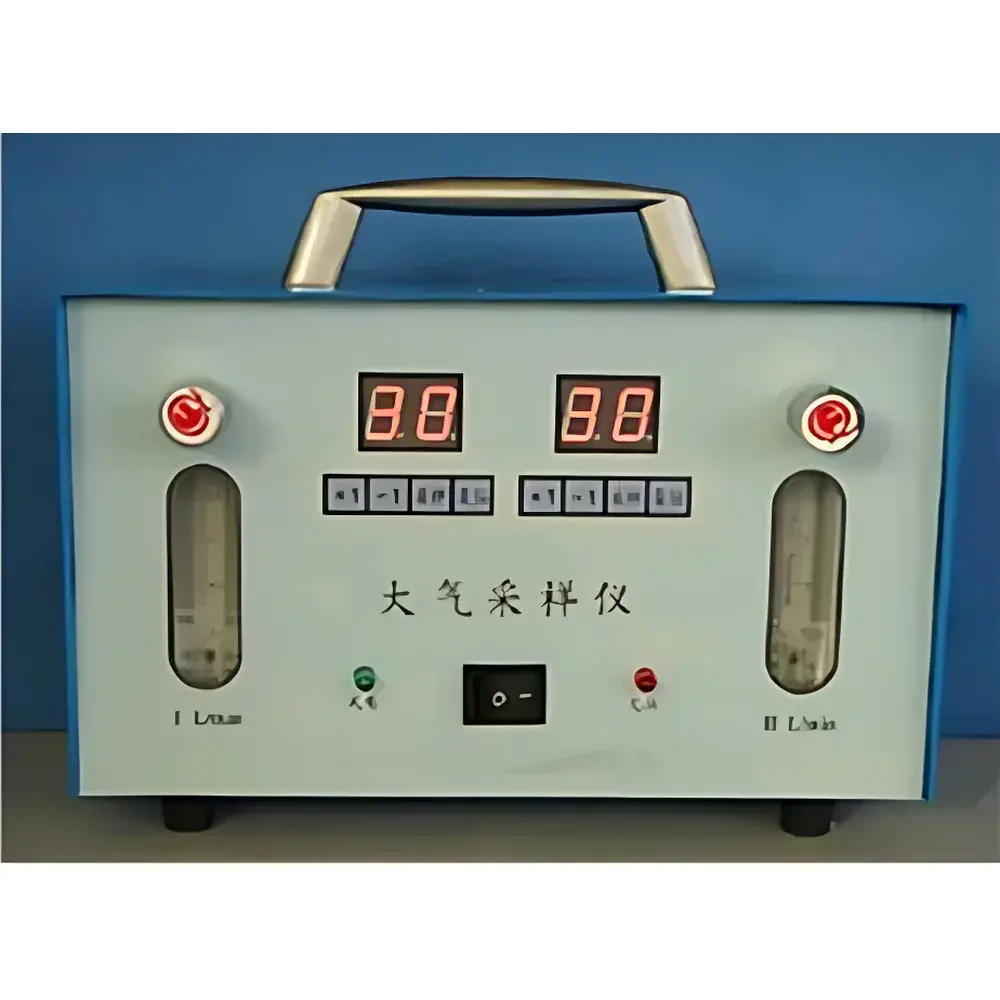
QC-2B Dual-Channel Ambient Air Sampler
| Origin | Beijing, China |
|---|---|
| Manufacturer Type | Authorized Distributor |
| Origin Category | Domestic (PRC) |
| Model | QC-2B |
| Price Range | USD 140–700 (FOB) |
| Instrument Type | Conventional Gas Sampler |
| Configuration | Dual-Independent-Channel Sampling System |
| Flow Range | 0.1–1.5 L/min |
| Maximum Vacuum Pressure | >26 kPa |
| Flow Stability | ≤5% |
| Flowmeter Accuracy Class | 2.5 |
| Service Life Under Max Load & Backpressure | 5–10 years |
| Continuous Operation Duration at Max Flow & Rated Resistance | 2–8 h |
| Rated Flow | 2.5 L/min @ 4.5 kPa Backpressure |
| Timing Range | 1–99 h (adjustable in 1-min increments) |
| Timing Accuracy | ≤0.01% (based on real-time clock) |
| Dimensions | 210 × 125 × 95 mm |
| Power Supply | AC/DC dual-mode (rechargeable Ni-MH battery included) |
| Battery Runtime | ≥6 h continuous operation |
| Operating Temperature | −10 °C to +40 °C |
| Net Weight | 2.8 kg (including battery) |
| Control Architecture | Dual-channel independent electronic timer with synchronized start/stop capability |
Overview
The QC-2B Dual-Channel Ambient Air Sampler is a precision-engineered, field-deployable instrument designed for simultaneous collection of two discrete gaseous samples from ambient or occupational environments. It operates on the principle of constant-flow volumetric sampling using two physically isolated diaphragm pump assemblies, each driven by an independent motor and regulated by a calibrated rotameter-based flow control system. This architecture ensures true parallel sampling—critical for comparative analysis (e.g., upwind/downwind monitoring), co-sampling of reactive species requiring separate adsorbent media, or redundancy validation in regulatory compliance workflows. Unlike single-channel samplers, the QC-2B eliminates sequential bias and inter-sample cross-contamination risk by maintaining strict pneumatic isolation between channels. Its compact form factor (210 × 125 × 95 mm), lightweight design (2.8 kg with integrated battery), and wide operating temperature range (−10 °C to +40 °C) make it suitable for unattended deployment across diverse field conditions—from urban air quality networks to industrial hygiene surveys in metallurgical plants, chemical processing facilities, and construction sites.
Key Features
- Dual independent sampling channels with fully isolated pneumatic paths and dedicated flow regulation per channel
- Electronic timer with programmable duration from 1 to 99 hours (1-minute resolution); factory default preset: 30 minutes per channel
- High-stability diaphragm pumps delivering consistent flow across the full 0.1–1.5 L/min range, with rated performance of 2.5 L/min at 4.5 kPa backpressure
- Calibrated glass rotameters conforming to accuracy class 2.5 per GB/T 2624 (equivalent to ISO 5167-3:2003 for variable-area meters)
- Flow stability maintained within ±5% under varying inlet resistance and battery voltage decay
- AC/DC dual-power architecture with built-in rechargeable Ni-MH battery supporting ≥6 hours of continuous operation
- Ruggedized ABS housing with IP54-rated ingress protection against dust and water splashes
- Real-time clock with timing accuracy ≤0.01%, traceable to internal quartz oscillator (no external synchronization required)
Sample Compatibility & Compliance
The QC-2B is compatible with standard 37-mm and 47-mm filter cassettes, sorbent tubes (e.g., activated charcoal, silica gel, Tenax TA), impingers, and diffusion badges. Each channel accepts independently selected media without mechanical or thermal interference. The instrument meets fundamental requirements of multiple international sampling protocols, including OSHA Method 0500 (total dust), NIOSH Method 1501 (formaldehyde), and EPA Compendium Method TO-17 (VOCs on sorbent tubes). While not certified for intrinsic safety (Class I, Div 1), its low-power design and absence of spark-generating components render it appropriate for use in non-hazardous classified areas. All electrical components comply with GB 4793.1–2007 (IEC 61010-1:2010), and firmware supports manual log recording aligned with GLP documentation practices.
Software & Data Management
The QC-2B operates as a standalone hardware platform with no embedded microcontroller-based data logging or Bluetooth/Wi-Fi connectivity. Timing parameters and operational status are displayed via a 3-digit LED readout per channel. Users record start/stop times, flow settings, and environmental notes manually in field logs—consistent with ISO/IEC 17025:2017 Clause 7.5.2 (control of recorded information). For laboratories implementing digital workflows, the instrument integrates seamlessly with LIMS platforms via standardized sample ID tagging during post-analysis; no proprietary drivers or software installation is required. Audit trails are maintained through paper-based or electronic lab notebooks referencing instrument serial number, calibration certificate expiry, and operator initials—fully compliant with FDA 21 CFR Part 11 when paired with validated electronic signature systems.
Applications
- Ambient air quality monitoring (PM2.5, PM10, SO2, NOx) using paired filter and sorbent sampling
- Occupational exposure assessment per OELs (e.g., benzene, hexavalent chromium, welding fumes) in foundries, power generation, and mining operations
- Indoor air quality surveys in schools, hospitals, and office buildings requiring side-by-side VOC and particulate sampling
- Method validation studies comparing collection efficiency across different adsorbent media or flow rates
- Emergency response deployments where rapid setup and dual-parameter capture reduce site revisit frequency
FAQ
Does the QC-2B support flow calibration traceable to national standards?
Yes—each unit ships with a factory calibration certificate referencing GB/T 27025-compliant procedures. Users may perform field recalibration using a primary-standard bubble meter or electronic calibrator (e.g., DryCal® series) following ASTM D3685–18 Annex A1.
Can both channels operate at different flow rates simultaneously?
Yes—the rotameters and control valves are mechanically independent; users set and verify flow individually per channel using the respective needle valve and float indicator.
Is the battery replaceable, and what is its expected cycle life?
The sealed Ni-MH battery pack is user-replaceable (model: 7.2 V / 2.2 Ah); typical service life exceeds 300 charge/discharge cycles under standard temperature conditions.
What maintenance intervals are recommended for long-term reliability?
Pump diaphragms and inlet filters should be inspected every 500 operating hours; full preventive maintenance—including flowmeter cleaning and timer verification—is advised annually or after 1,000 h of cumulative runtime.
Does the instrument meet any ISO or EN environmental testing standards?
It complies with GB/T 2423.1–2008 (IEC 60068-2-1) for cold testing and GB/T 2423.2–2008 (IEC 60068-2-2) for dry heat, ensuring functional integrity across its stated operating temperature envelope.







