
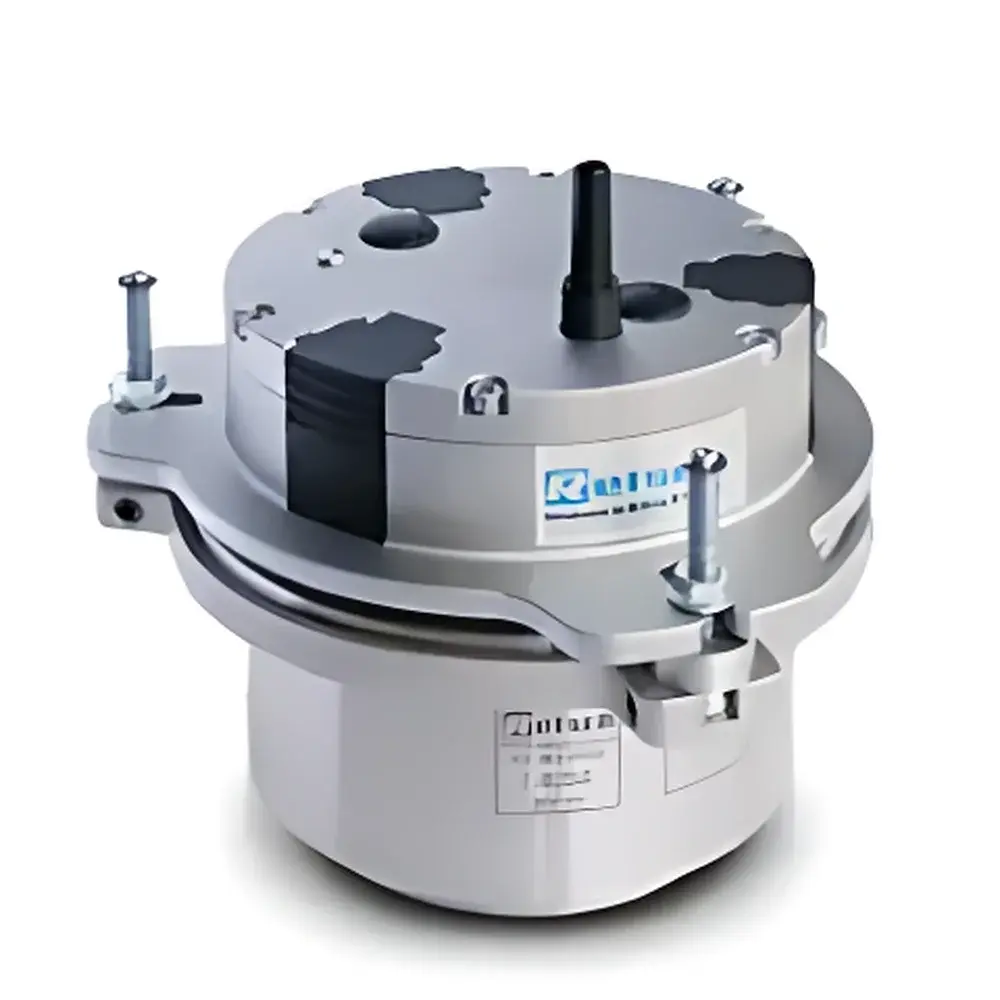
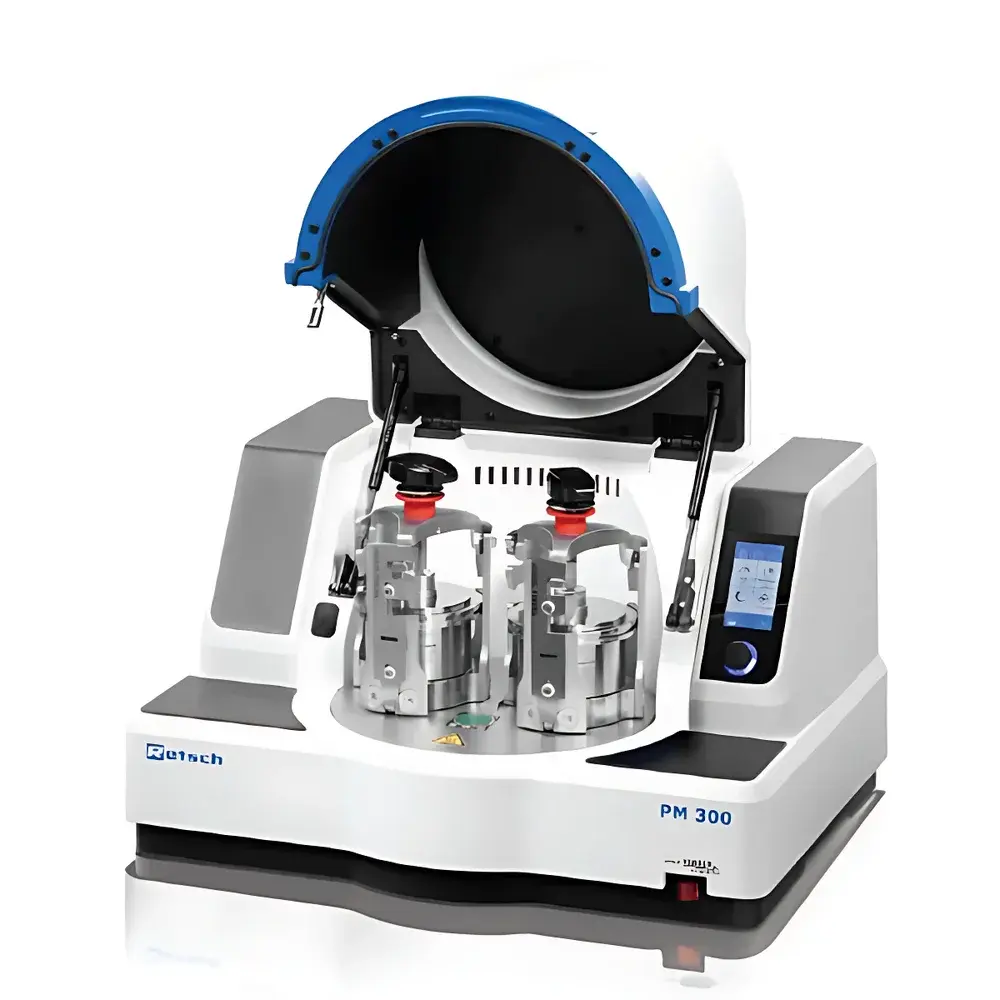
RETSCH PM 300 Planetary Ball Mill
| Brand | RETSCH |
|---|---|
| Origin | Germany |
| Model | PM 300 |
| Instrument Type | Planetary Ball Mill |
| Sample Applicability | Soft, Hard, Brittle, Fibrous (Dry/Wet Grinding) |
| Max Feed Size | < 10 mm |
| Final Particle Size | < 0.1 µm (colloidal grinding) |
| Batch Capacity | up to 2 × 220 mL |
| Sun Wheel Speed | 50–800 rpm |
| Effective Sun Wheel Diameter | 180 mm |
| Gravitational Force | up to 64 g |
| Number of Grinding Stations | 2 |
| Jar Volume Options | 12–500 mL (stackable for 12/25/50/80 mL) |
| Grinding Media Materials | Hardened Stainless Steel, Tungsten Carbide, Agate, Sintered Alumina, Zirconium Oxide |
| Drive | Frequency-Controlled Three-Phase AC Motor (2.5 kW) |
| Power Supply | 200–240 V, 50/60 Hz, Single-Phase |
| Dimensions (W×H×D) | 745 × 525 × 580 mm |
| Net Weight | ~118 kg |
| Protection Class | IP 20 |
| Compliance | CE Certified |
| Optional Accessories | GrindControl (temperature & pressure monitoring), Aeration Lids, Safety Closure Devices |
Overview
The RETSCH PM 300 Planetary Ball Mill is a high-energy, dual-station benchtop mill engineered for precision comminution, homogenization, mechanical alloying, and mechanochemical synthesis. Operating on the planetary principle—where grinding jars rotate eccentrically around a sun wheel while simultaneously revolving on their own axes—the PM 300 generates centrifugal accelerations up to 64 g. This kinetic configuration subjects samples to intense impact, shear, and friction forces, enabling reproducible particle size reduction down to sub-100 nm in colloidal grinding applications. Designed for laboratories requiring stringent control over process parameters, the PM 300 delivers exceptional repeatability across analytical, R&D, and quality assurance workflows. Its robust cast-iron housing, vibration-damped base, and integrated safety interlocks ensure stable operation under high-load conditions. The instrument meets CE regulatory requirements and supports compliance with ISO/IEC 17025, ASTM E11, and USP guidelines for particle size distribution validation when used with calibrated reference materials and documented SOPs.
Key Features
- Dual independent grinding stations accommodating jars from 12 mL to 500 mL—enabling parallel processing or comparative studies
- Digitally adjustable sun wheel speed (50–800 rpm) with real-time feedback and programmable acceleration/deceleration profiles
- GrindControl option for in-situ monitoring of jar temperature and internal pressure during operation—critical for exothermic mechanochemical reactions
- Touchscreen HMI with intuitive icon-based navigation, supporting storage of up to 12 user-defined operating modes and 4 nested cycle programs
- Stackable jar configurations (12/25/50/80 mL) optimized for low-volume, high-value samples—reducing cross-contamination risk and media consumption
- Five certified jar material options: hardened stainless steel, tungsten carbide, agate, sintered alumina, and yttria-stabilized zirconia—ensuring chemical inertness and wear resistance for diverse sample matrices
- Programmable intermittent operation with precise control over grinding time (00:00:01–99:59:59), pause duration, and reverse rotation sequences
- Integrated USB interface for data export and firmware updates; compatible with optional RASPI serial communication modules for lab network integration
Sample Compatibility & Compliance
The PM 300 accommodates a broad spectrum of inorganic and organic materials—including metals, alloys, ceramics, polymers, biological tissues (e.g., bone, hair, seeds), geological specimens (e.g., limestone, kaolin, iron ore), construction materials (e.g., cement clinker, slag), environmental samples (e.g., sewage sludge, compost), and electronic waste. It supports both dry and wet grinding protocols, with aeration lids available for controlled-atmosphere milling (e.g., inert gas purging for oxygen-sensitive catalysts or air-sensitive intermediates). All jar materials comply with FDA 21 CFR §177.1520 for food-contact suitability where applicable. The system’s design facilitates GLP/GMP-aligned documentation: timestamped operation logs, parameter traceability, and audit-ready event histories are retained locally and exportable via USB. Routine calibration verification using certified reference powders (e.g., NIST SRM 1977) is recommended per ISO 13320 Annex B.
Software & Data Management
The PM 300 operates via an embedded real-time OS with no external PC dependency. Its firmware enables full parameter logging—including rotational speed, elapsed time, direction changes, thermal events (when GrindControl is installed), and safety interlock status. All operational data are stored in non-volatile memory with automatic timestamping and user ID tagging (via configurable login). Export formats include CSV and XML, compatible with LIMS platforms and statistical process control (SPC) software. For regulated environments, the system supports 21 CFR Part 11-compliant configurations when paired with third-party electronic signature and audit trail middleware. Firmware updates are delivered via signed USB packages, ensuring cryptographic integrity and version-controlled deployment.
Applications
- Mechanochemical synthesis of metal–organic frameworks (MOFs), solid-state battery cathodes, and catalytic nanoparticles
- Homogenization of heterogeneous pharmaceutical blends prior to dissolution testing or content uniformity analysis
- Preparation of nanoscale reference standards for SEM-EDS, XRD line-broadening analysis, and laser diffraction validation
- Grinding of brittle geological samples for geochemical assay preparation (e.g., XRF fusion pellets, ICP-MS digestion)
- Colloidal milling of pigments, toners, and ceramic slurries to achieve narrow PSD distributions (D90 < 100 nm)
- High-energy milling of intermetallic precursors for additive manufacturing feedstock development
- Routine QC grinding of construction aggregates, fly ash, and recycled concrete fines per ASTM C110/C618 specifications
FAQ
What is the maximum recommended continuous operating time per cycle?
The PM 300 supports uninterrupted operation up to 99 hours, 59 minutes, and 59 seconds per program; however, thermal management considerations recommend limiting single-cycle duration to ≤4 hours for high-energy protocols without active cooling.
Can the PM 300 be validated for GMP-regulated pharmaceutical use?
Yes—when configured with GrindControl, audit-trail-enabled firmware, and documented IQ/OQ protocols, the system meets foundational requirements for equipment qualification under EU Annex 15 and FDA Process Validation Guidance.
Is cryogenic grinding supported?
The base PM 300 does not integrate liquid nitrogen cooling; however, externally jacketed jars (e.g., stainless steel with coolant channels) can be adapted with custom mounting solutions—subject to mechanical compatibility assessment and safety review.
How is jar balancing verified before operation?
Each jar must be loaded symmetrically with identical mass and media-to-sample ratios across both stations; imbalance detection is enforced by the motor controller, which halts startup if rotational asymmetry exceeds ±2.5% mass deviation.
What maintenance intervals are specified for the drive system?
The frequency-controlled three-phase motor requires no scheduled lubrication; annual inspection of belt tension, electrical connections, and vibration isolation mounts is advised per RETSCH Service Bulletin SB-PM300-2023.



