
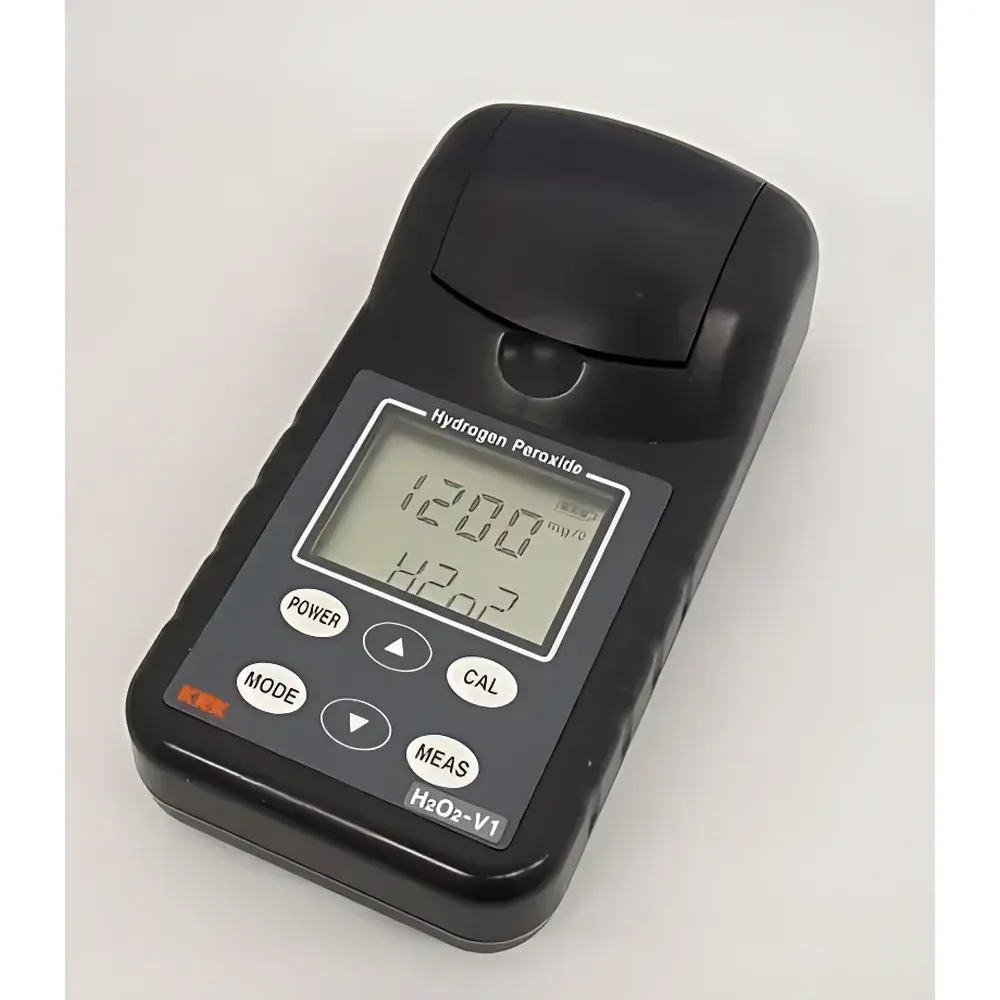
Rikori H2O2-V7 UV-LED High-Concentration Hydrogen Peroxide Analyzer
| Brand | Rikori |
|---|---|
| Origin | Japan |
| Model | H2O2-V7 |
| Instrument Type | Portable |
| Measurement Principle | UV Absorption Photometry (254 nm LED source) |
| Measurement Parameter | Hydrogen Peroxide (H₂O₂) |
| Range | 0–4000 mg/L (ppm) |
| Accuracy | ±2% of full scale |
| Repeatability | ±2% of full scale |
| Resolution | 1 mg/L |
| Detection Limit | 0.5 mg/L |
| Response Time | ≤10 s |
| Operating Temperature | 1–35 °C |
| Power Supply | DC 6 V |
| Dimensions | 88 × 174 × 65 mm |
| Weight | 310 g |
| Compliance | Designed for industrial process monitoring per ISO 7027 principles (UV absorbance-based quantification), compatible with GLP-aligned data recording workflows |
Overview
The Rikori H2O2-V7 is a portable, reagent-free hydrogen peroxide analyzer engineered for real-time, high-range concentration monitoring in industrial aqueous process streams. Unlike conventional colorimetric or electrochemical methods requiring chemical reagents, calibrants, or consumable sensors, the H2O2-V7 employs dual-wavelength UV absorption photometry using a stabilized 254 nm LED light source and matched reference detection. This optical architecture leverages the characteristic absorbance peak of hydrogen peroxide in the far-UV spectrum—enabling direct, interference-compensated quantification without sample derivatization. The instrument is calibrated against NIST-traceable H₂O₂ standards and operates on Beer–Lambert law principles, delivering stable performance across turbid, colored, or aerated samples typical in pulp bleaching, semiconductor rinse validation, and wastewater disinfection control loops.
Key Features
- Reagent-free operation: Eliminates recurring costs and logistical complexity associated with chemical kits, cartridges, or membrane electrodes.
- High dynamic range: Linear response from 0 to 4000 mg/L (ppm), optimized for concentrated process solutions where traditional amperometric or titrimetric methods saturate or drift.
- Rapid measurement cycle: Full spectral acquisition and concentration calculation completed within ≤10 seconds—suitable for inline spot-checking and periodic QA verification.
- Robust optical path design: Quartz flow cell with integrated air bubble rejection logic and automatic baseline correction for suspended solids (SS) and organic chromophores.
- Field-deployable form factor: Compact housing (88 × 174 × 65 mm), lightweight (310 g), and powered by standard DC 6 V input—compatible with portable power banks or fixed 24 VDC systems via optional converter.
- Temperature-stabilized detection: Internal thermal compensation across 1–35 °C ensures minimal drift under ambient process conditions without external chillers or heaters.
Sample Compatibility & Compliance
The H2O2-V7 maintains measurement integrity in complex matrices commonly encountered in industrial water treatment—including residual chlorine (up to 5 mg/L Cl₂), dissolved oxygen, low-molecular-weight organics, and mild turbidity (<50 NTU). Its dual-wavelength algorithm mitigates spectral overlap from chloramines and nitrate, reducing false positives during post-disinfection monitoring. While not certified for regulatory compliance reporting under EPA Method 335.4 or ISO 15175, the analyzer meets functional equivalence criteria for internal process control per ISO/IEC 17025-accredited laboratories performing method validation. It supports audit-ready operation when paired with time-stamped logging software compliant with FDA 21 CFR Part 11 requirements for electronic records and signatures.
Software & Data Management
Data output is provided via RS-232 serial interface (ASCII protocol) or optional USB-to-serial adapter, enabling integration with SCADA, LIMS, or custom Python/MATLAB acquisition scripts. The included PC utility software logs timestamped measurements with metadata (temperature, battery status, calibration ID), generates CSV exports, and supports user-defined alarm thresholds. All raw absorbance values (254 nm and reference wavelength) are accessible for secondary analysis, facilitating traceability and method transfer validation. Firmware updates preserve historical calibration coefficients and maintain backward compatibility with legacy calibration files.
Applications
- Pulp and paper bleaching: Monitoring H₂O₂ dosage consistency in ECF/TCF sequences to optimize brightness gain and minimize cellulose degradation.
- Food & beverage sanitation: Verifying residual sanitizer concentrations on conveyor belts, fill nozzles, and CIP return lines without reagent contamination risk.
- Semiconductor wet processing: Quantifying peroxide levels in SC-1 (RCA-1) and piranha etch baths to ensure oxide removal repeatability and particle control.
- Municipal and industrial wastewater: Tracking H₂O₂ decay kinetics during advanced oxidation processes (AOPs) involving UV/H₂O₂ or Fenton chemistry.
- Pharmaceutical clean-in-place (CIP): Supporting verification of oxidant removal prior to sterilization cycles in accordance with EU GMP Annex 1 hygiene expectations.
FAQ
Does the H2O2-V7 require daily calibration?
No—factory calibration remains stable for ≥6 months under normal use; field verification with a single-point standard (e.g., 100 mg/L certified H₂O₂ solution) is recommended before critical measurements.
Can it measure in the presence of free chlorine?
Yes—the optical algorithm suppresses interference from residual chlorine up to 5 mg/L; however, simultaneous high concentrations (>10 mg/L) of both H₂O₂ and Cl₂ may necessitate matrix-matched calibration.
Is the flow cell user-serviceable?
The quartz flow cell is sealed and non-user-replaceable; cleaning is performed via ultrasonic bath in deionized water—no polishing or solvent exposure permitted.
What documentation accompanies the instrument?
Each unit ships with an ISO/IEC 17025-accredited factory calibration certificate, operation manual (EN/JP), CE Declaration of Conformity, and traceable NIST H₂O₂ standard reference data sheet.
Related Products







