
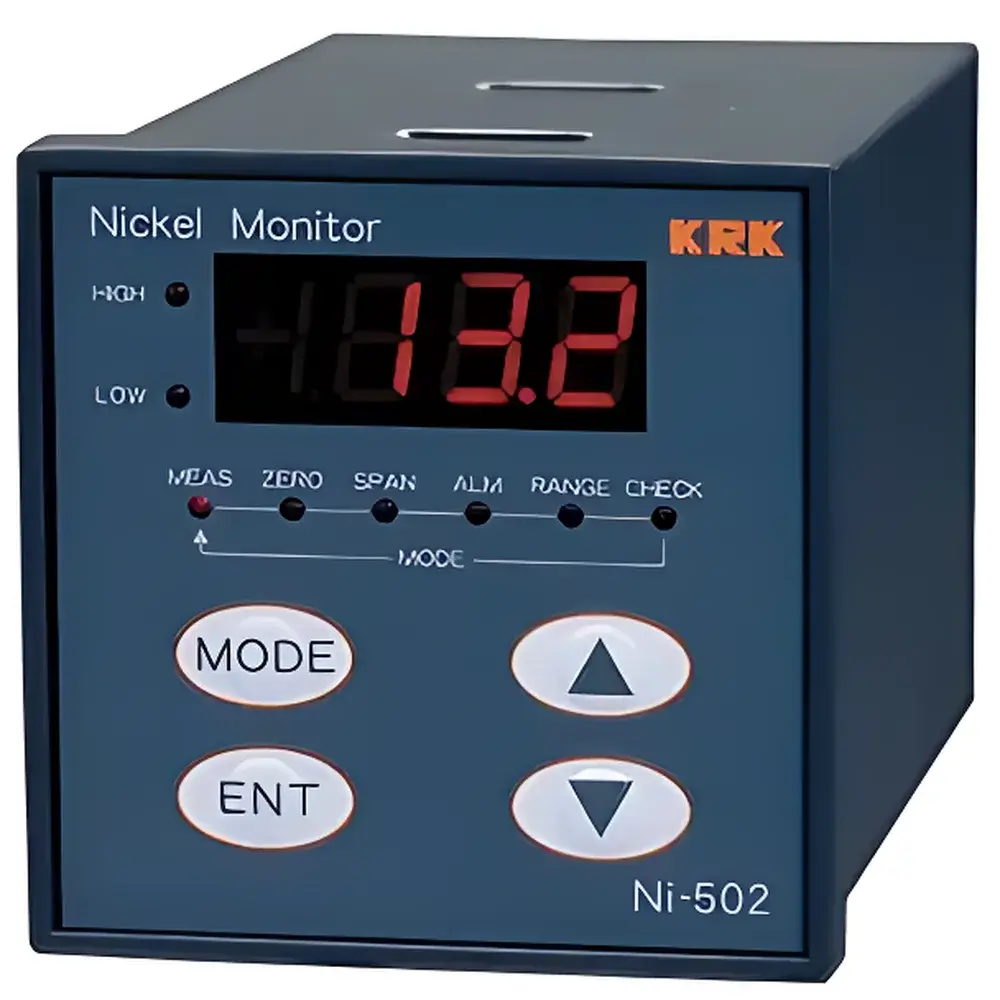
Rikuri NI-502 Nickel Ion Online Monitor
| Brand | Rikuri |
|---|---|
| Origin | Japan |
| Model | NI-502 |
| Instrument Type | Online Multi-Ion Analyzer |
| Measurement Principle | Absorption Photometry (Visible Spectrophotometric Detection at Characteristic Wavelength) |
| Measurement Range | 0–199.9 g/L (High Range) / 0.00–19.99 g/L (Low Range) |
| Detection Limit | 1 g/L |
| Resolution | 0.1 g/L (High Range), 0.01 g/L (Low Range) |
| Accuracy | ±2% FS |
| Response Time | ≤1 s |
| Output Signal | Isolated 4–20 mA DC (3-Stage Range Selection) |
| Alarm Outputs | Dual SPDT Dry Contacts (AC 200 V, 1 A resistive load max) |
| Operating Environment | 0–40 °C, ≤85% RH |
| Power Supply | AC 85–240 V, 50/60 Hz |
| Sensor Options | High-Temperature Flow-Cell Sensor (for plating bath immersion) or Ambient-Temperature Immersion Probe |
| Compliance | Designed for continuous industrial process monitoring in electroplating and semiconductor wet processing lines |
Overview
The Rikuri NI-502 Nickel Ion Online Monitor is an industrial-grade photometric analyzer engineered for real-time, continuous measurement of nickel ion concentration in aggressive electroplating electrolytes—particularly Watts nickel, sulfamate nickel, and high-speed nickel baths used in PCB manufacturing, semiconductor packaging, and precision metal finishing. Based on absorption photometry in the visible spectrum, the instrument quantifies nickel concentration via the formation of a stable colored complex between Ni²⁺ ions and a proprietary chromogenic reagent under controlled pH and temperature conditions. Unlike discrete lab-based atomic absorption or ICP-OES methods, the NI-502 delivers process-critical data with sub-second response latency, enabling closed-loop feedback control of nickel replenishment systems. Its dual-range optical detection architecture supports both high-concentration plating baths (up to 199.9 g/L Ni) and low-concentration rinse or drag-out monitoring (down to 0.01 g/L resolution), making it suitable for multi-point deployment across bath conditioning, filtration, and effluent diversion loops.
Key Features
- True online operation with ≤1 second response time—optimized for dynamic bath management in high-throughput plating lines
- Dual-range photometric detection: selectable high-range (0–200 g/L, 0.1 g/L resolution) and low-range (0–20 g/L, 0.01 g/L resolution) modes via front-panel or remote 4–20 mA configuration
- Two sensor configurations: high-temperature flow-cell sensor (rated to 60 °C, chemically resistant PFA/PVDF wetted parts) for direct inline installation; or ambient-temperature immersion probe for tank-side mounting
- Isolated 4–20 mA analog output with three programmable full-scale ranges per mode—fully compatible with DCS, PLC, and SCADA systems
- Two independent alarm relays (SPDT, dry contact) configurable as upper/lower concentration limits—supports automated chemical dosing, bath shutdown, or sampling triggers
- Robust industrial enclosure (IP65-rated front panel) with wide-input AC power supply (85–240 V, 50/60 Hz), eliminating need for external transformers in global facilities
Sample Compatibility & Compliance
The NI-502 is validated for use in acidic nickel sulfate–chloride electrolytes (pH 3.0–4.5), common in functional and decorative nickel plating processes. It exhibits minimal interference from Co²⁺, Fe²⁺/Fe³⁺, and Cu²⁺ at typical plating bath concentrations (<50 mg/L), though Cr⁶⁺ and high nitrate levels require pretreatment or calibration correction. The system meets general requirements for industrial process analyzers under IEC 61000-6-2 (EMC immunity) and IEC 61000-6-4 (EMC emissions). While not certified for hazardous area installation, its non-intrusive optical design and isolated outputs support integration into Class 1 Div 2 environments when installed with appropriate conduit and barrier systems. For regulated pharmaceutical or medical device manufacturing sites, the NI-502’s fixed calibration protocol and audit-ready output logging (via optional analog recorder or third-party historian) align with GLP documentation expectations—though full 21 CFR Part 11 compliance requires integration with validated data acquisition software.
Software & Data Management
The NI-502 operates as a standalone hardware analyzer with no embedded microprocessor or onboard data storage. All configuration—including range selection, alarm thresholds, and output scaling—is performed via front-panel membrane keys and displayed on a 3½-digit LED screen. For centralized data aggregation, the 4–20 mA output is designed for seamless connection to plant-wide systems such as Siemens Desigo CC, Honeywell Experion PKS, or Emerson DeltaV. Optional analog chart recorders or Modbus RTU-to-analog converters (sold separately) enable basic trend logging. While the instrument does not feature native digital communication protocols (e.g., Modbus TCP, Profibus), its analog interface ensures long-term compatibility with legacy and modern control infrastructures alike—critical for brownfield electroplating facility upgrades where protocol obsolescence poses integration risk.
Applications
- Real-time nickel concentration control in automated nickel plating lines for automotive ABS plastic, aerospace fasteners, and connector pins
- Monitoring nickel drag-out in counter-current rinse tanks to optimize reclaim efficiency and reduce wastewater treatment load
- Verification of nickel bath composition during startup, maintenance, or after carbon treatment—reducing reliance on offline titration or AAS verification
- Integration with automated chemical dosing pumps to maintain Ni²⁺ within ±1 g/L of target—improving deposit uniformity and reducing reject rates in high-reliability PCB plating
- Supporting ISO 9001 and IATF 16949 process monitoring requirements for plating process stability and traceability
FAQ
Does the NI-502 require daily reagent addition or consumables?
No—the NI-502 is a reagent-free photometer that relies on inherent absorbance of the Ni²⁺–ligand complex formed in situ; no liquid reagents, cartridges, or membranes are consumed during operation.
Can it be calibrated with standard nickel sulfate solutions?
Yes—calibration is performed using traceable aqueous NiSO₄·6H₂O standards prepared per ASTM D1093 or internal lab SOPs; factory calibration certificates include uncertainty statements referenced to NIST-traceable materials.
Is the flow-cell sensor compatible with hot (>50 °C) nickel sulfamate baths?
Yes—the standard flow-cell variant is rated for continuous operation up to 60 °C and features PFA-lined stainless steel body and quartz optical windows resistant to thermal shock and acid corrosion.
How is measurement drift managed over extended operation?
The optical path includes dual-beam compensation and temperature-stabilized LED source; drift is typically <0.5% FS per month under stable ambient conditions—requiring quarterly verification against reference standards per ISO/IEC 17025-aligned QA procedures.
What certifications accompany the instrument for import into the EU or USA?
Units shipped to EEA markets carry CE marking per EMC and LVD directives; North American shipments include cULus recognition (UL 61010-1) and RoHS 3 compliance documentation. No FDA listing is required as the NI-502 is classified as industrial process equipment, not a medical device.
Related Products







