
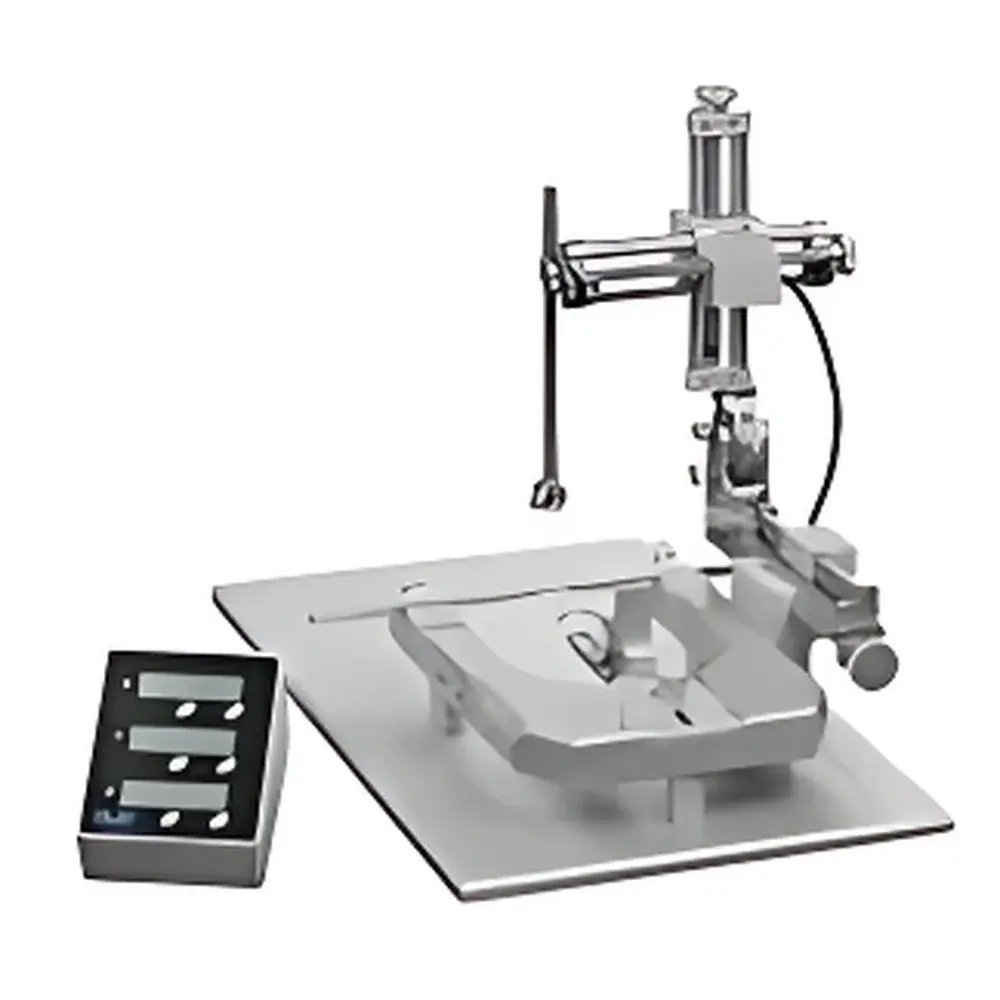
RWD 68025 Desktop Digital Stereotaxic Instrument for Rodent Neurosurgery
| Brand | RWD |
|---|---|
| Origin | Guangdong, China |
| Manufacturer Type | Direct Manufacturer |
| Regional Category | Domestic (China) |
| Model | 68025 |
| Price Range | USD 1,400 – 7,000 |
| X/Y/Z Axis Resolution | 10 µm |
| Display | LCD with Real-Time Digital Readout |
| Power Supply | AA Battery (No AC Interference) |
| Arm Mobility | ±80 mm in X/Y/Z |
| Vertical Rotation | 0–180° with Locking |
| Horizontal Rotation | 0–360° with Locking |
| Base Design | Open U-Shape with Laser-Etched Scale |
| Drive Mechanism | Dual-Head Precision Lead Screws |
| Material Surface | Chemically Resistant & Autoclavable Finish |
| Zero-Point Function | User-Defined Arbitrary Origin on All Three Axes |
| Animal Compatibility | Rat (with 18°/45° ear bars), Mouse, Guinea Pig, Cat, Lizard, Avian Species |
Overview
The RWD 68025 Desktop Digital Stereotaxic Instrument is an engineered solution for high-precision intracranial targeting in rodent neurosurgical and electrophysiological studies. Based on the classical stereotaxic coordinate system defined by the Paxinos & Watson rat brain atlas—and adaptable to mouse, guinea pig, avian, and feline models—the instrument integrates a rigid, low-noise mechanical architecture with real-time digital positional feedback. Its core measurement principle relies on calibrated micrometer-driven linear translation along orthogonal X (anterior–posterior), Y (medial–lateral), and Z (dorsal–ventral) axes, where position is continuously transduced via high-stability European-sourced displacement sensors. Unlike analog counterparts requiring manual scale reading and mental offset calculation, the 68025 embeds a battery-powered LCD module that eliminates electromagnetic interference from AC power sources—critical for stable extracellular recording, optogenetic stimulation, or patch-clamp experiments conducted in shielded Faraday cages.
Key Features
- Dual-head precision lead screws ensure smooth, backlash-free movement across all three axes with reproducible positioning repeatability ≤ ±10 µm.
- Real-time digital readout of X/Y/Z coordinates on a low-power LCD display powered exclusively by AA batteries—eliminating ground-loop noise and enabling use in electrically sensitive electrophysiology rigs.
- User-defined zero-point function allows instant re-referencing of any physical location as origin (0,0,0), bypassing manual recalibration and reducing cumulative arithmetic error during multi-target injections or electrode placements.
- Full-range articulation: vertical rotation from 0° to 180° and horizontal 360° rotation—both equipped with independent mechanical locking mechanisms for rapid repositioning without slippage.
- Open U-shaped base with laser-etched millimeter-scale graduations improves visual alignment and facilitates concurrent microscope access or surgical light integration.
- Chemically inert, non-porous surface finish withstands repeated decontamination with ethanol, hydrogen peroxide vapor, or autoclaving (up to 121°C, 20 min), ensuring compliance with GLP animal facility hygiene protocols.
- Thermally stable construction maintains dimensional fidelity across ambient lab temperatures (15–30°C), minimizing thermal drift-induced targeting deviation.
Sample Compatibility & Compliance
The RWD 68025 supports standardized stereotaxic procedures across multiple species through interchangeable adapter systems—including rat-specific 18° and 45° ear bar configurations (models 68301/68302), mouse adapters (68010), guinea pig nose clamp (68021), and custom mounts for avian or reptilian heads. All adapters conform to ISO 9001-certified manufacturing tolerances and are validated against NIST-traceable dimensional standards. The instrument’s mechanical design adheres to ASTM F2658-21 guidelines for laboratory animal surgical apparatus stability and load-bearing integrity. While not FDA-cleared (as it is a research-use-only tool), its documentation and calibration traceability support audit readiness under AAALAC-accredited IACUC protocols and GLP-compliant preclinical study reporting.
Software & Data Management
The 68025 operates as a standalone hardware platform with no embedded firmware or proprietary software dependency. Coordinate data are displayed locally only—ensuring full data sovereignty and eliminating cybersecurity risks associated with network-connected instruments. For laboratories requiring digital record retention, users may manually log readings into ELN systems (e.g., LabArchives, Benchling) or integrate third-party camera-based tracking solutions via external USB microscopes. The device supports 21 CFR Part 11-compliant workflows when paired with validated electronic lab notebooks that enforce user authentication, audit trails, and electronic signatures for experimental metadata entry.
Applications
- Intracerebral injection of viral vectors, tracers, or pharmacological agents with sub-millimeter spatial accuracy in longitudinal behavioral neuroscience studies.
- Chronic implantation of microelectrode arrays, optrodes, or fiber photometry cannulas targeting deep nuclei such as the ventral tegmental area (VTA), substantia nigra pars compacta (SNc), or hippocampal CA1.
- Lesion modeling via electrolytic or thermocoagulative probes in stroke, Parkinson’s, or epilepsy research paradigms.
- Combined optogenetics-fMRI or optogenetics-electrophysiology experiments where electromagnetic silence and mechanical rigidity are mandatory.
- Training platforms for graduate-level neurosurgical technique instruction, leveraging intuitive digital feedback to accelerate procedural competency acquisition.
FAQ
Is the RWD 68025 compatible with standard stereotaxic atlases such as Paxinos & Watson?
Yes—the instrument uses conventional AP/ML/DV coordinate referencing and is fully compatible with Paxinos & Watson (rat/mouse), Franklin & Paxinos (guinea pig), and Kuenzel & Meier (avian) brain atlases.
Can the digital display be calibrated in-house?
No—sensor modules are factory-calibrated and sealed; recalibration requires return to RWD’s Guangdong service center under ISO/IEC 17025-accredited procedures.
Does the device meet electromagnetic compatibility (EMC) requirements for use in EEG or MEG suites?
Yes—battery-only operation ensures zero conducted or radiated emissions, satisfying IEC 61326-1 Class B emission limits for laboratory equipment.
What is the maximum load capacity of the manipulator arms?
Each arm supports up to 500 g static load at full extension without measurable deflection or hysteresis, verified per ASTM E29-22 test methodology.
Are replacement parts such as ear bars or nose clamps available separately?
Yes—all accessories—including 18°/45° rat ear bars (68301/68302), mouse adapters (68010), and U-shaped base assemblies (68503)—are stocked and orderable with individual part numbers and traceable lot documentation.
Related Products



