
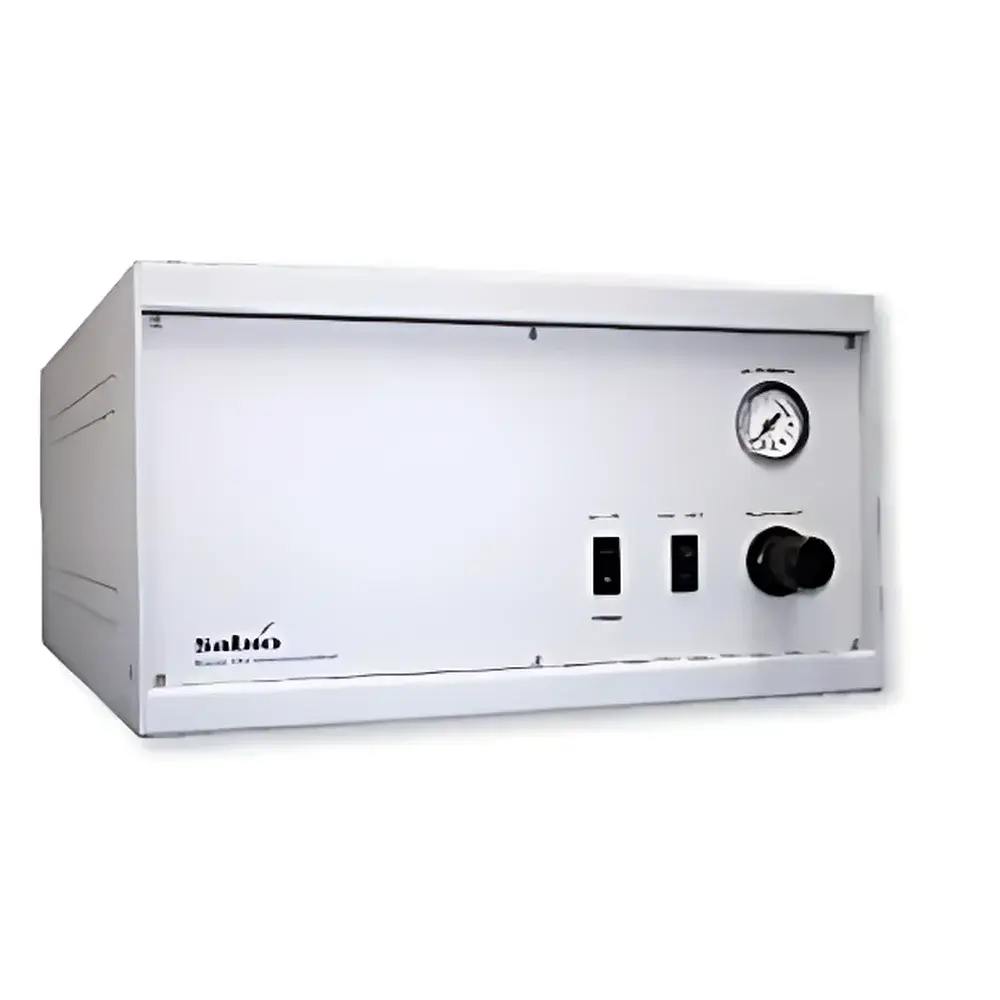
Sabio 2020 Zero-Air Generator
| Brand | Sabio |
|---|---|
| Origin | Beijing, China |
| Model | 2020 |
| Flow Rate | 10 SLPM at 20 psig |
| Purification Targets | NO, NO₂, O₃, SO₂, H₂S < 0.5 ppb (standard) |
| Dew Point | < –40 °C (via integrated permeation dryer) |
| Power Supply | 196–264 VAC, 50–60 Hz |
| Analog Output | 4–20 mA (max. load 750 Ω) |
| Dimensions | 165 mm (H) × 353 mm (W) × 381 mm (D) |
| Weight | 10.4 kg |
| Compliance | Designed for ISO 8573-1 Class 1 compressed air purity |
Overview
The Sabio 2020 Zero-Air Generator is an engineered solution for laboratories and environmental monitoring facilities requiring ultra-pure, hydrocarbon-free, reactive-gas-scrubbed air as a carrier, purge, or calibration gas. It operates on a multi-stage purification architecture: compressed ambient air is first pressure-regulated to 20 psig and delivered at a stable 10 SLPM flow rate; it then passes through a condensate separator, followed by an integrated permeation-type desiccant dryer that achieves a consistent dew point below –40 °C. Subsequent catalytic and chemisorptive beds remove trace reactive species—including nitrogen oxides (NO/NO₂), ozone (O₃), sulfur dioxide (SO₂), hydrogen sulfide (H₂S), carbon monoxide (CO), and non-methane hydrocarbons (NMHC)—to sub-part-per-trillion levels. The system’s design adheres to the physical and chemical requirements of zero-air specifications defined in EPA Compendium Method TO-14A and TO-15 for volatile organic compound (VOC) analysis, as well as ASTM D6216 for ambient air quality instrumentation calibration.
Key Features
- Stable 10 SLPM output at regulated 20 psig—engineered for compatibility with GC-FID, GC-MS, PTR-MS, and laser-based trace gas analyzers requiring constant flow and pressure
- Integrated permeation dryer ensures continuous dew point control < –40 °C without consumable desiccants or regeneration cycles
- Front-panel mounted pressure gauge, precision pressure regulator, and manual purge valve enable real-time operational monitoring and rapid system conditioning
- Automated flow-path purging sequence minimizes residual contamination during startup, shutdown, or after maintenance
- Robust mechanical construction includes reinforced carrying straps, front support feet, and ergonomic lift handles for safe repositioning within shared lab environments
- Analog 4–20 mA output supports integration into centralized facility monitoring systems (e.g., BMS or LIMS) with configurable alarm thresholds
Sample Compatibility & Compliance
The Sabio 2020 is validated for use with analytical platforms demanding Class 1 compressed air purity per ISO 8573-1:2010 (solid particles ≤ 0.1 µm, water ≤ 0.1 mg/m³, oil ≤ 0.01 mg/m³). Its purified output meets or exceeds zero-air performance criteria specified in U.S. EPA Methods TO-14A (for canister-based VOC sampling) and TO-15 (for SUMMA canister analysis), where background interference from CO, NMHC, and oxidants must remain below instrument detection limits. When equipped with the optional Sabio 2050 HC oxidation catalyst, total hydrocarbon residuals are maintained ≤ 0.2 ppb (as methane equivalent), satisfying stringent requirements for ultra-low-background atmospheric chemistry studies. The unit is suitable for GLP-compliant laboratories; its analog output and mechanical design support audit-ready documentation under FDA 21 CFR Part 11 when paired with validated data acquisition software.
Software & Data Management
While the Sabio 2020 operates as a stand-alone hardware system with no embedded microprocessor or touchscreen interface, its 4–20 mA analog output provides seamless integration with third-party data loggers, SCADA systems, or laboratory information management systems (LIMS). Users may configure external recording devices to monitor real-time pressure stability, purge cycle status, or long-term drift in output purity (when interfaced with reference analyzers). For full traceability, routine verification tests—such as periodic ozone photometer checks or GC-FID hydrocarbon scans—should be logged manually or via automated scripts aligned with internal SOPs. No proprietary firmware or cloud connectivity is included, preserving system integrity in security-restricted research or regulatory environments.
Applications
- Carrier and makeup gas supply for gas chromatography–flame ionization detection (GC-FID) and GC–mass spectrometry (GC-MS) systems performing ambient air, stack emission, or indoor air quality analysis
- Purge gas for dynamic headspace samplers, thermal desorption units, and online VOC monitors deployed in continuous emission monitoring systems (CEMS)
- Zero-air reference standard generation in photometric ozone calibrators and NOx analyzer span verification protocols
- Baseline air source for cavity ring-down spectroscopy (CRDS) and proton-transfer-reaction mass spectrometry (PTR-MS) requiring sub-ppq-level hydrocarbon suppression
- Calibration gas dilution systems where reactive impurity carryover would compromise accuracy of ppb-level standard preparation
FAQ
What is the typical service interval for the purification cartridges?
Cartridge replacement frequency depends on inlet air quality and daily runtime; under typical laboratory conditions (ISO 8573 Class 4 inlet air), reactive gas beds require replacement every 6–12 months, while the permeation dryer has a nominal service life of ≥24 months.
Can the 2020 be used outdoors or in non-climate-controlled spaces?
It is rated for indoor laboratory use only (operating ambient: 15–30 °C, relative humidity ≤ 80% non-condensing); extended exposure to temperature cycling or high particulate load will reduce cartridge longevity and dew point stability.
Is the analog output isolated and calibrated?
Yes—the 4–20 mA signal is galvanically isolated and factory-calibrated to represent outlet pressure (0–30 psig range); users may re-scale the output via external signal conditioners to match specific monitoring requirements.
Does the unit include validation documentation for GxP environments?
The 2020 ships with a Factory Acceptance Test (FAT) report detailing initial purity verification against NOx, O3, and HC; IQ/OQ protocols are available upon request and must be executed on-site using user-provided reference standards and certified metrology equipment.



