
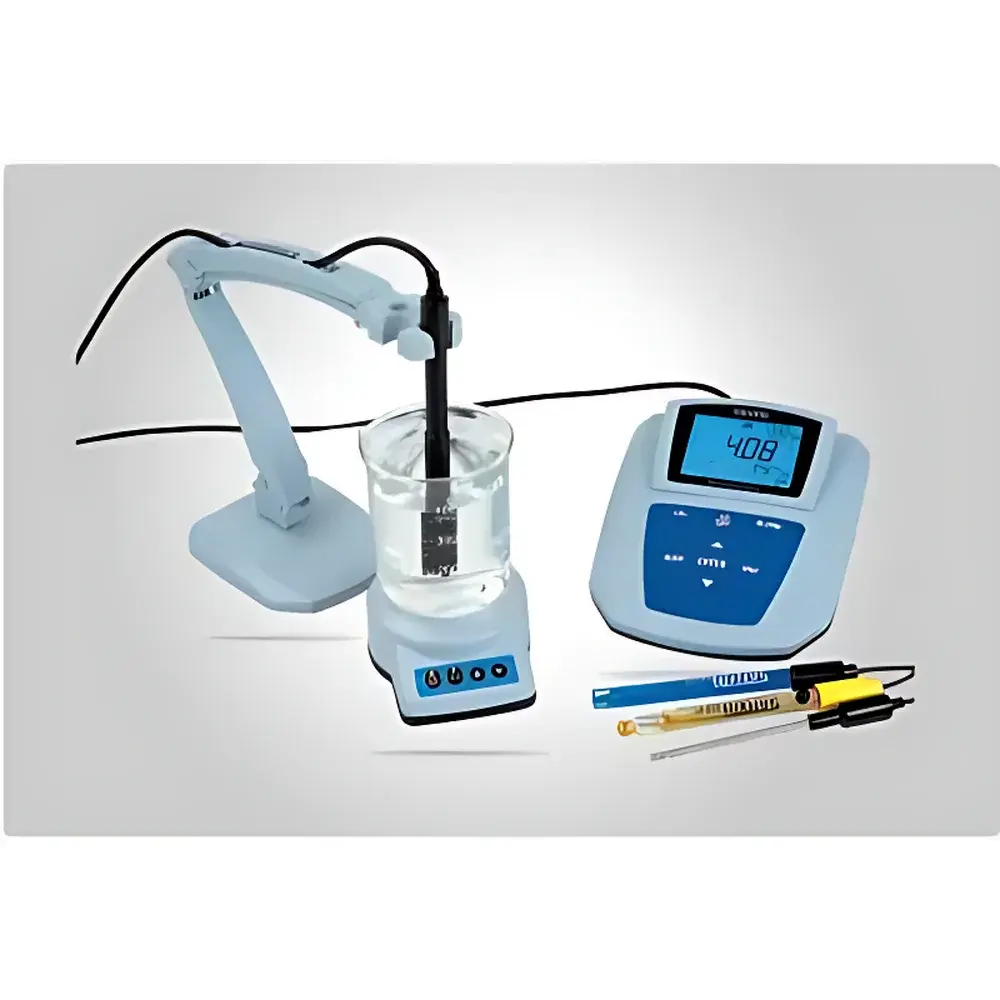
Sanxin MP525 Dual-Parameter pH and Dissolved Oxygen Meter
| Brand | Sanxin |
|---|---|
| Model | MP525 |
| Origin | Shanghai, China |
| Manufacturer Type | Direct Manufacturer |
| Category | Laboratory Water Quality Analyzer |
| pH Range | −2.000 to 19.999 |
| pH Accuracy | ±0.002 pH |
| mV Range | ±1999.9 mV |
| mV Accuracy | ±0.03% FS |
| DO Range | 0–40.00 mg/L (ppm) / 0–200.0% saturation |
| DO Accuracy | ±0.10 mg/L |
| Temperature Range | −10 to 110 °C |
| Temp Accuracy | ±0.4 °C |
| Auto Compensation | Temperature (0–100 °C for pH |
| Calibration Modes | Air-saturated water, Water-saturated air |
| Data Storage | 900 sets |
| Interface | RS232 |
| Power | DC 9 V / 300 mA |
| Dimensions | 160 × 190 × 70 mm |
| Weight | 880 g |
| IP Rating | IP54 |
| GLP Compliance | Yes |
Overview
The Sanxin MP525 Dual-Parameter pH and Dissolved Oxygen Meter is a laboratory-grade benchtop instrument engineered for high-precision, simultaneous measurement of pH and dissolved oxygen (DO) in aqueous samples across environmental monitoring, municipal water treatment, pharmaceutical process water validation, and academic research applications. It operates on two fundamental electrochemical principles: potentiometric measurement using a glass pH electrode (Nernst equation-based) and amperometric detection via a Clark-type polarographic dissolved oxygen sensor. The instrument integrates automatic temperature, salinity, and barometric pressure compensation algorithms—critical for regulatory-compliant DO reporting under variable field or lab conditions. Its dual-channel architecture enables concurrent real-time acquisition without cross-parameter interference, while the built-in ATC (Automatic Temperature Compensation) and intelligent electrode diagnostics ensure traceable, repeatable results aligned with ISO 5667-3, ASTM D888, and USP guidelines for water quality analysis.
Key Features
- Triple-compensated DO measurement: Fully automated correction for temperature (0–45 °C), salinity (0–45 ppt), and atmospheric pressure (80–105 kPa) eliminates manual recalculations and reduces operator error.
- High-stability pH sensing: Equipped with a 2503-C glass composite electrode offering ±0.002 pH accuracy over a broad range (−2.000 to 19.999), suitable for low-ionic-strength, turbid, or colloidal samples.
- Dedicated high-purity water modes: Selectable “Ultrapure Water” and “Ammoniated Pure Water” pH measurement protocols apply specialized calibration algorithms per ASTM D1125 and EP 2.2.3 standards.
- Polarographic DO sensor with rapid polarization: Achieves stable output within 3–5 minutes; includes replaceable membrane cap assembly for consistent diffusion-layer control and extended electrode life.
- GLP-compliant data integrity: Timestamped storage of 900 measurement records with electrode ID, calibration history, ambient conditions, and user-defined sample IDs—fully audit-ready for FDA 21 CFR Part 11 environments when paired with secure RS232 logging software.
- Intelligent electrode recognition: Automatically identifies and validates up to 13 standardized buffer solutions across NIST, DIN, JIS, and Chinese national series during calibration.
- Integrated 901 Smart Stirrer: Maintains defined hydrodynamic conditions during DO measurement, minimizing boundary layer effects and improving inter-laboratory reproducibility.
Sample Compatibility & Compliance
The MP525 supports routine analysis of drinking water, wastewater effluents, surface water, boiler feedwater, cooling tower fluids, and ultrapure process water (e.g., WFI, PW). Its pH electrode design accommodates samples with suspended solids and low conductivity, while the DO sensor delivers reliable performance in both freshwater and brackish matrices. The instrument meets IP54 ingress protection requirements for dust and water splashes, enabling safe operation in shared wet-lab environments. All firmware and calibration routines comply with Good Laboratory Practice (GLP) documentation standards—including full traceability of calibration dates, standards used, and pass/fail status. It satisfies functional requirements outlined in ISO/IEC 17025 for equipment verification and supports validation protocols required under EU GMP Annex 11 and USP .
Software & Data Management
Data export is facilitated via RS232 serial interface using included PC communication software, enabling direct transfer to LIMS or Excel-compatible spreadsheets. Each stored record contains: measurement timestamp, parameter values (pH, mV, DO mg/L, % sat, temperature), compensation parameters applied, electrode serial numbers, calibration verification flags, and operator ID fields. Audit trail functionality logs all configuration changes, calibration events, and firmware updates. The software supports CSV and TXT export formats with optional digital signature embedding for regulated workflows requiring electronic record integrity per 21 CFR Part 11 Subpart B.
Applications
- Environmental laboratories performing EPA Method 360.1 (DO) and Method 150.1 (pH) compliance testing.
- Pharmaceutical facilities conducting pharmacopeial water system qualification (USP , EP 2.2.3).
- Power generation plants monitoring condensate and feedwater chemistry for corrosion control.
- Academic research labs studying aerobic biodegradation kinetics, nitrification efficiency, or acid-base equilibria in natural waters.
- Municipal water utilities verifying disinfection efficacy and distribution system stability.
FAQ
Does the MP525 support automatic calibration for both pH and DO?
Yes—it supports two-point pH calibration using recognized standard buffers and dual-point DO calibration via air-saturated water and water-saturated air methods, with auto-recognition of buffer identities.
Can it measure ORP (oxidation-reduction potential)?
Yes—the instrument includes an EH mode that reports mV values referenced to the Standard Hydrogen Electrode (SHE), compliant with ASTM D1498.
Is the device compatible with external printers or networked data systems?
It features RS232 output only; Ethernet or USB connectivity is not supported. Integration with centralized data systems requires third-party serial-to-TCP/IP converters.
What is the recommended maintenance interval for the DO electrode membrane?
The DO500 electrode’s Teflon membrane should be replaced every 3–6 months under continuous use, or immediately after exposure to oils, surfactants, or heavy particulates.
Does the MP525 meet international metrological traceability requirements?
Yes—its factory calibration is traceable to NIM (National Institute of Metrology, China) standards, and all performance specifications align with JJG 919-2008 (Chinese national verification regulation for pH meters) and ISO 5725 for precision estimation.







