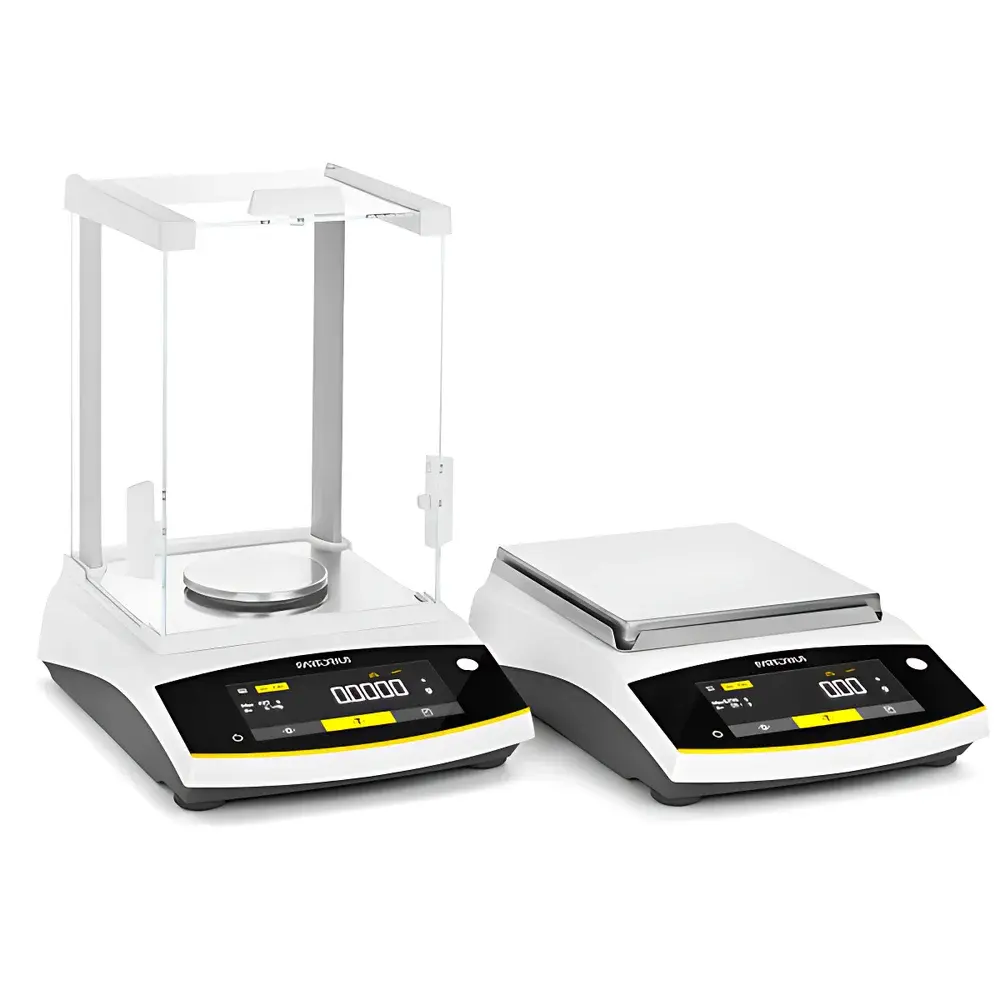
Sartorius BCE323-1CCN Precision Balance
| Brand | Sartorius |
|---|---|
| Origin | Shanghai, China |
| Model | BCE323-1CCN |
| Type | Precision Balance |
| Maximum Capacity | 320 g |
| Readability | 1 mg |
| Repeatability | ≤ ±1 mg |
| Calibration | External |
| Pan Dimensions | Rectangular |
| Connectivity | USB-C, RS232 (9-pin) |
| Compliance | GLP/GMP Data Output |
| Applications | Weighing, Counting, Percentage Weighing, Density Determination, Statistics, Checkweighing, Animal Weighing, Formulation, Peak Hold, Unit Conversion, Below-balance Weighing |
| Display | LED + Touchscreen Interface |
| Languages | 8 (English, German, French, Italian, Spanish, Portuguese, Russian, Polish) |
| Construction | Stainless Steel, PBT Polymer, Tempered Glass |
| Environmental Protection | Anti-static Coating, Full Removable Draft Shield, Overload Protection |
| Self-Test | @start Function |
| Auto-Calibration | isoCAL (Time- and Temperature-Triggered Internal Calibration) |
Overview
The Sartorius BCE323-1CCN is a high-performance precision balance engineered for routine laboratory weighing tasks requiring reliable 1 mg readability and robust repeatability (≤ ±1 mg). Designed as part of the Entris® II series, it integrates over 145 years of German metrological expertise with modern industrial design principles. Its measurement principle is based on electromagnetic force compensation (EMFC), a well-established technology delivering stable, drift-resistant results across varying ambient conditions. The balance operates within a maximum capacity of 320 g and features a rectangular weighing pan optimized for stability and sample accessibility. It is specifically intended for environments where regulatory traceability, operational consistency, and long-term reliability are critical — including QC laboratories, pharmaceutical manufacturing support areas, academic research labs, and chemical formulation units.
Key Features
- Electromagnetic force compensation (EMFC) sensor architecture ensures high linearity and minimal thermal drift.
- isoCAL internal calibration system automatically initiates calibration based on predefined time intervals or temperature fluctuations (±1.5 °C change), maintaining continuous metrological integrity without manual intervention.
- Full-removable draft shield with anti-static coated glass panels minimizes electrostatic interference and facilitates cleaning — essential for hygienic or multi-product environments.
- @start self-diagnostic function performs automatic hardware verification at power-on, confirming sensor integrity, display functionality, and key electronic subsystems prior to use.
- Dual-interface connectivity: industry-standard 9-pin RS232 port (backward compatible with legacy lab printers and LIMS) and modern USB-C interface for direct PC integration and firmware updates.
- IP54-rated housing components (stainless steel base, PBT polymer enclosure, tempered glass shield) provide resistance against common solvents, particulates, and mechanical wear.
- LED touchscreen interface supports intuitive navigation across 12 built-in applications, with tactile feedback and high-contrast rendering under variable lighting conditions.
Sample Compatibility & Compliance
The BCE323-1CCN accommodates diverse sample forms — from powders and granules to irregular solids and containers — thanks to its spacious weighing chamber and optional below-balance hook for suspended measurements. Its rectangular pan (approx. 160 × 160 mm) allows placement of standard volumetric flasks, beakers, and weighing boats without edge interference. All data outputs comply with Good Laboratory Practice (GLP) and Good Manufacturing Practice (GMP) documentation requirements: timestamps, operator ID (via password-protected login), balance ID, calibration status, and environmental metadata (if connected to optional external sensors) are embedded in printed or exported records. The device meets relevant sections of ISO/IEC 17025:2017 for testing and calibration laboratories and supports audit-ready workflows aligned with FDA 21 CFR Part 11 when integrated with compliant software platforms.
Software & Data Management
Data export is configurable via RS232 or USB-C, supporting ASCII, CSV, and Sartorius-specific .sbl formats. Output intervals can be set from 0.1 s to 600 s, enabling real-time monitoring for dynamic processes such as filling or blending. Built-in memory stores up to 999 weighing events with full metadata. All 12 preloaded applications — including statistical analysis (mean, SD, CV%), density determination (with auxiliary kit), checkweighing with configurable tolerance bands, and formulation mode with component tracking — generate structured output suitable for downstream ERP or ELN systems. Password protection (admin/user levels) restricts access to calibration, unit settings, and application configuration — ensuring SOP adherence and preventing unauthorized parameter changes.
Applications
This balance serves core functions across regulated and non-regulated settings: quantitative sample preparation in analytical chemistry; tablet counting and content uniformity checks in pharma QA; raw material verification in food and cosmetics manufacturing; density and specific gravity determinations using Archimedes’ principle; animal weighing with stabilization algorithms for live specimens; and statistical process control (SPC) sampling in production environments. Its below-balance weighing capability extends utility to magnetic susceptibility testing, filter mass gain analysis, and volatile loss studies. The combination of speed (stabilization <2 s typical), accuracy, and application versatility makes it suitable for ISO 17025-accredited testing labs performing gravimetric titrations, moisture content assays, and reference standard handling.
FAQ
Is the BCE323-1CCN compliant with FDA 21 CFR Part 11?
Yes — when used with validated Sartorius LabX software or equivalent third-party systems supporting electronic signatures, audit trails, and role-based access control.
Does it support internal calibration?
No — this model uses external calibration only; isoCAL refers to automated internal adjustment *after* user-initiated external calibration, not fully autonomous internal calibration.
Can it be connected to a networked LIMS?
Yes — via RS232-to-Ethernet converters or USB-C-to-PC interfaces using standard serial protocols (e.g., Modbus RTU, Sartorius ASCII command set).
What is the operating temperature range?
+10 °C to +40 °C, with relative humidity ≤ 80 % RH non-condensing — consistent with ISO 9001 environmental specifications for precision weighing equipment.
Is the draft shield certified for Class I Div 2 hazardous locations?
No — it is designed for general laboratory use and does not carry ATEX or UL hazardous location certifications.