
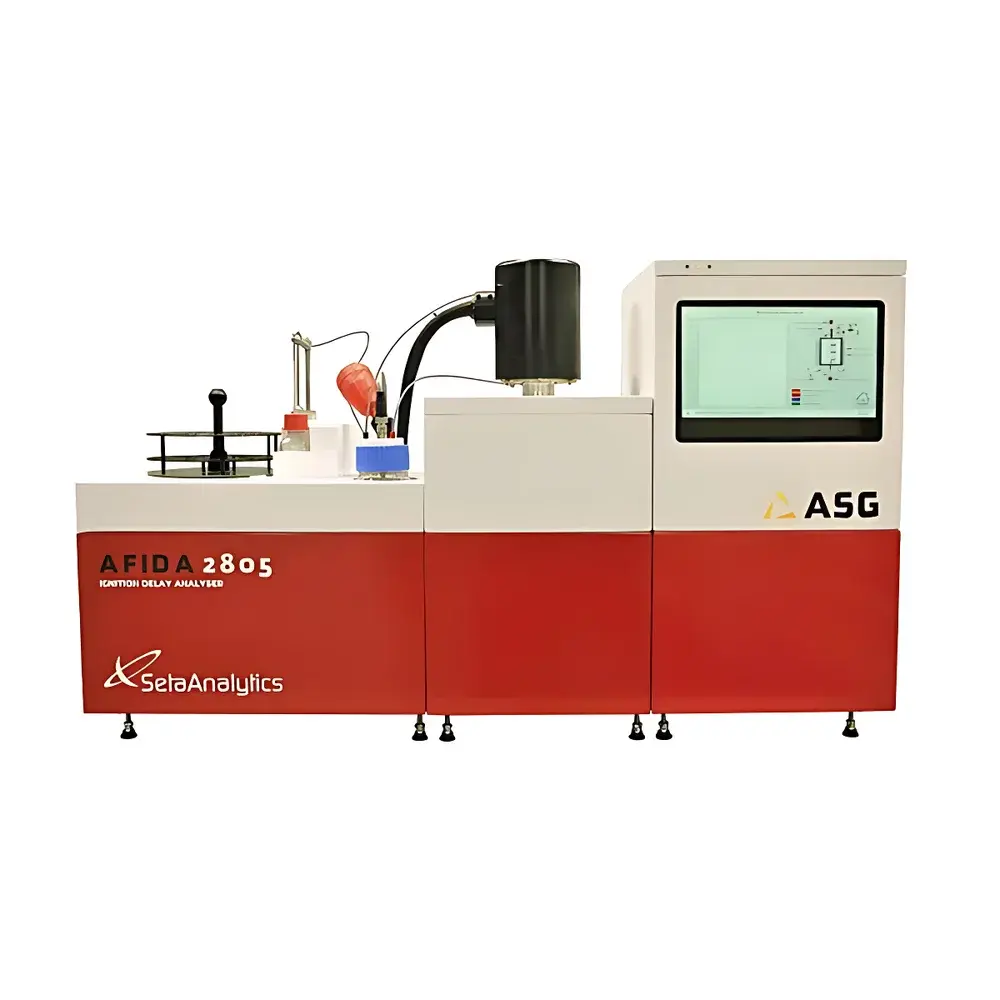
SETA AFIDA Diesel Cetane Number Analyzer SA6000-0
| Brand | SETA |
|---|---|
| Origin | United Kingdom |
| Manufacturer Type | Authorized Distributor |
| Origin Category | Imported |
| Model | SA6000-0 |
| Measurement Parameter | Diesel Cetane Number (CN) |
| Form Factor | Benchtop |
| Detection Principle | Constant-Volume Combustion Method |
| Standards Compliance | IP 617, prEN 17155, ASTM D8183, EN 590 Clause 5.7.4, ASTM D613, EN ISO 5165, DIN 51773 |
| Calibration Fuels | n-Hexadecane and 2,2,4,4,6,8,8-Heptamethylnonane (HMN) |
| Sample Volume per Test | 40 mL |
| Test Duration per Sample | ~25 min |
| Autosampler Capacity | 36 positions |
| Fuel Injection System | Piezoelectric High-Pressure Injector with Temperature-Controlled Nozzle |
Overview
The SETA AFIDA Diesel Cetane Number Analyzer SA6000-0 is a benchtop, fully automated instrument engineered for precise and reproducible determination of diesel fuel ignition quality using the constant-volume combustion method. Unlike traditional motored engine-based approaches (e.g., ASTM D613), the AFIDA system simulates the thermodynamic conditions of modern high-pressure common-rail diesel combustion chambers through a patented piezoelectric high-pressure fuel injection system. This enables generation of fine, aerodynamically consistent fuel droplets—mimicking real-world in-cylinder atomization—within a temperature- and pressure-controlled combustion chamber. The resulting ignition delay time is measured optically and thermally, then converted to an Indicated Cetane Number (ICN) via calibration against primary reference fuels (n-hexadecane and heptamethylnonane). Designed for routine laboratory use, the SA6000-0 delivers ICN values traceable to international standards including IP 617, prEN 17155, and ASTM D8183, and demonstrates strong empirical correlation with legacy methods such as EN ISO 5165 and DIN 51773.
Key Features
- Piezoelectric high-pressure fuel injector with integrated temperature control, enabling rapid valve actuation (<100 µs response), repeatable metering accuracy, and superior droplet size consistency versus solenoid or pintle-type nozzles
- 36-position automated sample carousel with integrated syringe-based aspiration and purge cycle—minimizing carryover and operator intervention
- Constant-volume combustion chamber with dual-sensor ignition detection (optical + pressure transducer) for robust delay-time measurement under controlled thermal boundary conditions
- Full automation from sample loading to report generation—including automatic calibration sequence execution using certified reference fuels
- Integrated safety architecture: real-time monitoring of chamber pressure, temperature, fuel leakage, and electrical fault conditions; emergency venting and power-fail-safe cooling retention via UPS-backed thermal management
- Stable calibration performance verified over extended operational cycles—reducing recalibration frequency and unplanned downtime
Sample Compatibility & Compliance
The SA6000-0 is validated for testing conventional diesel fuels, biodiesel blends (B5–B20), synthetic diesel (e.g., GTL, HVO), and low-sulfur diesel formulations meeting EN 590 specifications. It excludes highly volatile or oxygenated fuels outside the defined volatility and distillation range (T90 < 360 °C). All test procedures adhere strictly to the methodological requirements of IP 617 and ASTM D8183, ensuring regulatory acceptability for quality control in refineries, fuel distribution terminals, and third-party testing laboratories. Instrument output meets GLP documentation requirements, with full audit trail capability for calibration events, sample metadata, raw sensor data, and final ICN calculations. Data integrity complies with FDA 21 CFR Part 11 principles when operated with validated software configuration and user access controls.
Software & Data Management
The AFIDA Control Suite is a Windows-based application providing complete instrument orchestration, real-time diagnostics, and compliant data handling. It supports method-defined test sequences, scheduled calibration routines, and batch processing across multiple samples. All raw acquisition data—including chamber pressure waveforms, photodiode intensity traces, and injector timing logs—are stored in binary HDF5 format with embedded metadata (operator ID, timestamp, ambient conditions, calibration certificate IDs). Export options include CSV, PDF reports (with digital signature support), and direct integration into LIMS via ODBC or REST API. Audit trails record every user action, parameter change, and result modification with immutable timestamps and role-based attribution—fully satisfying ISO/IEC 17025 clause 7.9 and EU Annex 11 expectations for analytical instrument software validation.
Applications
- Refinery QC/QA: Rapid verification of cetane number compliance for finished diesel batches prior to dispatch
- Fuel formulation R&D: Screening of additive packages, bio-component blending effects, and synthetic pathway optimization
- Regulatory compliance testing: Generation of ICN data for EN 590, ASTM D975, and national fuel specifications requiring IP 617–aligned methodology
- Third-party certification labs: Accredited testing under ISO/IEC 17025 for commercial fuel certification and dispute resolution
- Engine development support: Correlation studies between ICN and cold-start behavior, NOx/soot trade-offs, and combustion noise profiles
FAQ
What is the difference between Indicated Cetane Number (ICN) and Calculated Cetane Index (CCI)?
ICN is an experimentally derived value based on actual ignition delay under controlled combustion conditions, whereas CCI is a predictive index calculated from distillation and density data—lacking sensitivity to ignition-improving additives.
Does the SA6000-0 require periodic recertification of its piezoelectric injector?
No. The injector is factory-calibrated and verified for long-term stability; only annual performance verification using reference fuels is recommended per ISO/IEC 17025.
Can the system analyze biodiesel blends containing FAME or HVO?
Yes—provided the blend meets EN 590 distillation limits and contains ≤20% bio-component by volume. Validation reports are available upon request.
Is remote monitoring or unattended overnight operation supported?
Yes. With UPS integration and network-enabled software, the system supports scheduled 24/7 operation with email alerts for completion, error, or maintenance triggers.
How is traceability maintained for calibration standards?
Each calibration run logs the lot number, certificate ID, and expiry date of reference fuels; all certificates must be NIST-traceable or issued by an ISO/IEC 17025-accredited supplier.





