
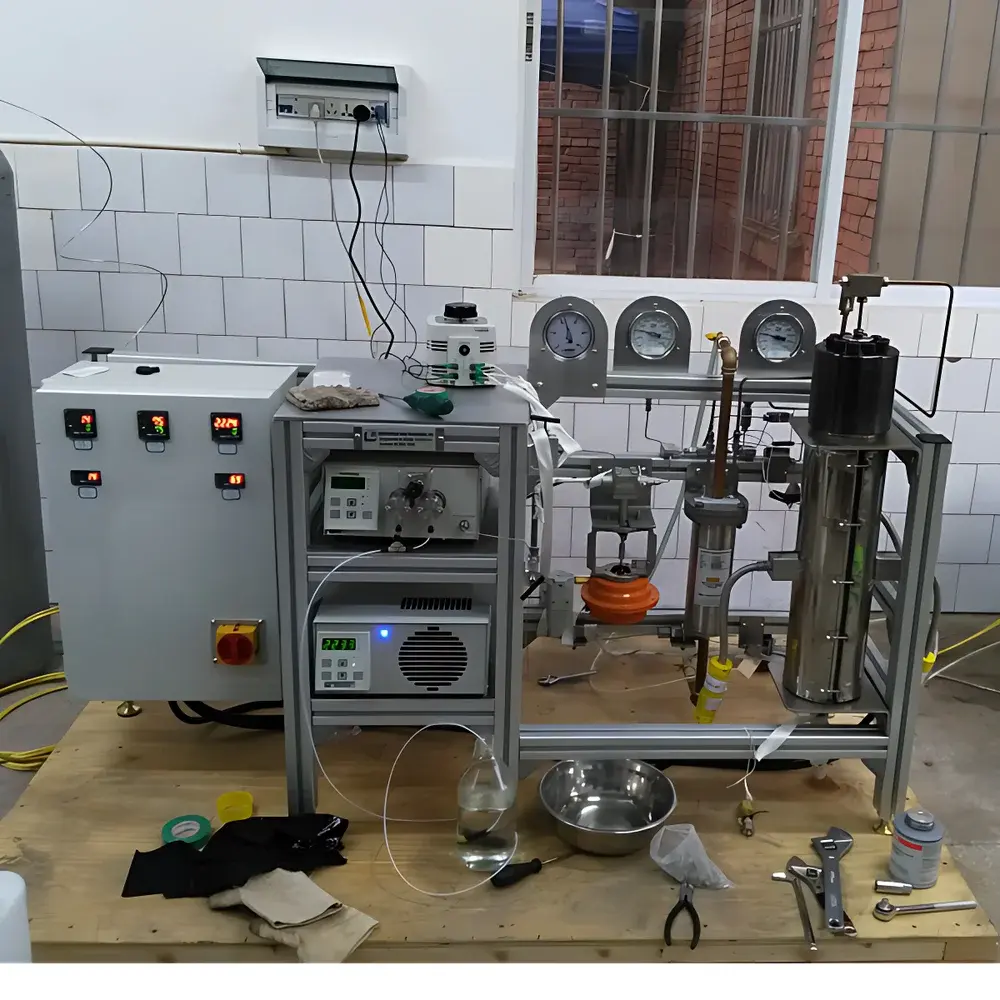
SFT SCWR Series Supercritical Water Reactor System
| Brand | SFT |
|---|---|
| Origin | USA |
| Model | SCWR Series |
| Vessel Volume | 100 mL – 8,000 mL |
| Operating Pressure | 31–35 MPa (4,500–5,000 PSI) |
| Max. Operating Temperature | 500–600 °C |
| Construction Material | Inconel 625 |
| Pump Type | Reciprocating Dual-Piston High-Pressure Water Pump |
| Temperature Control | Fully Automated PID Controller |
| Pressure Regulation | Manual Back-Pressure Valve |
| Structural Design | Compact, Mobile Floor-Standing Frame |
| Optional Components | Preheater (≤500 °C, ≤35 MPa), Post-Cooler, Air/O₂ Compressor, Air/O₂ Mass Flow Controller, H₂O₂ Dosing Pump, In-Line pH Sensor, Gas-Liquid Separator, On-Line Desalination Module, PLC/HMI Touchscreen Interface, SCADA Data Acquisition System |
| Compliance | ASME Section VIII Div. 1 (Optional Certification) |
Overview
The SFT SCWR Series Supercritical Water Reactor System is an engineered platform for conducting high-temperature, high-pressure hydrothermal chemistry under supercritical water (SCW) conditions—where water exhibits unique solvent properties above its critical point (374 °C, 22.1 MPa). Designed for rigorous laboratory-scale process development and pilot-scale validation, the system enables precise control over reaction thermodynamics and kinetics in oxidative, hydrolytic, and catalytic transformations. Its core architecture leverages Inconel 625—a nickel-based superalloy selected for exceptional resistance to chloride-induced stress corrosion cracking, oxidation, and creep deformation at sustained temperatures up to 600 °C and pressures exceeding 35 MPa. Unlike conventional batch autoclaves, the SCWR Series supports both discontinuous (batch/semi-batch) and continuous-flow operation modes, making it suitable for mechanistic studies, catalyst screening, and technology readiness level (TRL) advancement from TRL 3 to TRL 5.
Key Features
- Robust pressure containment: ASME Section VIII Division 1–certifiable reactor vessels fabricated from Inconel 625 with full radiographic weld inspection and hydrostatic test documentation available upon request
- High-fidelity fluid delivery: Dual-piston reciprocating high-pressure pump delivering stable water flow rates with minimal pulsation; compatible with co-solvent injection (e.g., H₂O₂, organic modifiers)
- Thermal integrity: Integrated fully automated PID temperature controller with dual-zone heating (preheater + reactor zone) and calibrated Class A RTD sensors traceable to NIST standards
- Modular scalability: Standard base configuration supports 100 mL–8 L vessel volumes; expandable via optional preheater, post-cooler, gas dosing modules, and phase separation units
- Operational flexibility: Manual back-pressure regulation for fine-tuned residence time control; optional PLC/HMI touchscreen interface enabling recipe-based operation, alarm logging, and real-time parameter trending
- Process safety architecture: Redundant pressure relief valves, rupture discs, thermal cut-off interlocks, and leak detection ports compliant with OSHA 1910.119 and CCPS guidelines
Sample Compatibility & Compliance
The SCWR Series accommodates a broad spectrum of feedstocks—including aqueous waste streams, biomass slurries, pharmaceutical intermediates, and metal salt solutions—without requiring organic co-solvents. Its inert Inconel 625 wetted surfaces prevent catalytic decomposition or metallic leaching during prolonged exposure to aggressive SCW environments containing Cl⁻, SO₄²⁻, or NO₃⁻ ions. The system meets material and design requirements referenced in ASTM D7506 (Standard Guide for Supercritical Water Oxidation Testing), ISO 14040 (Life Cycle Assessment), and EPA Method 8270D for organic contaminant destruction validation. Optional ASME stamping satisfies regulatory expectations for GMP-compliant process equipment used in pharmaceutical or environmental remediation applications subject to FDA 21 CFR Part 211 or EPA RCRA Subpart X oversight.
Software & Data Management
When equipped with the optional SCADA package, the SCWR Series provides time-synchronized acquisition of temperature, pressure, flow rate, pH, and gas composition (via optional mass spectrometer integration). All data are timestamped, stored in encrypted SQLite or SQL Server databases, and support audit-trail generation per FDA 21 CFR Part 11 requirements—including electronic signatures, user access controls, and immutable change logs. Export formats include CSV, MATLAB .mat, and ISA-88-compliant XML for seamless integration into LIMS or MES platforms. Calibration records, maintenance logs, and operational SOPs can be embedded directly into the HMI interface for GLP-aligned workflow execution.
Applications
- Supercritical water oxidation (SCWO) of hazardous organic waste: complete mineralization of PCBs, pesticides, nerve agents, and PFAS precursors without NOx or dioxin formation
- Hydrothermal carbonization (HTC) and hydrothermal liquefaction (HTL) of algae, sewage sludge, and food waste for biofuel precursor synthesis
- Materials synthesis: crystallization of metal oxides (e.g., TiO₂, ZnO), quantum dots, and MOFs under controlled nucleation kinetics
- Pharmaceutical process intensification: continuous hydrolysis of ester prodrugs or peptide bond cleavage under non-acidic, non-enzymatic conditions
- Corrosion and materials compatibility testing: accelerated aging studies of alloys, ceramics, and polymer composites in simulated SCW service environments
- Reaction mechanism elucidation: in situ Raman or FTIR coupling (via optional optical windows) to monitor intermediate species formation in real time
FAQ
What is the maximum allowable working pressure for the standard SCWR reactor vessel?
The standard configuration is rated for continuous operation at 35 MPa (5,000 PSI), with burst pressure exceeding 105 MPa per ASME code calculations.
Can the system handle corrosive halide-containing feedstocks?
Yes—Inconel 625 offers superior resistance to pitting and stress corrosion cracking in chloride-rich SCW media up to 600 °C, validated through ASTM G36 and G44 testing protocols.
Is third-party calibration and certification available?
SFT partners with ISO/IEC 17025-accredited metrology laboratories to provide NIST-traceable calibration certificates for all primary sensors and pressure transducers.
How is residence time controlled in continuous mode?
Residence time is governed by volumetric flow rate (via pump speed) and system dead volume; manual back-pressure valve adjustment fine-tunes system pressure and thus density-dependent reaction kinetics.
Does the system support remote monitoring and control?
With the SCADA option, secure HTTPS-based web access enables remote parameter viewing, alarm notification via email/SMS, and limited supervisory control through role-based authentication.



