
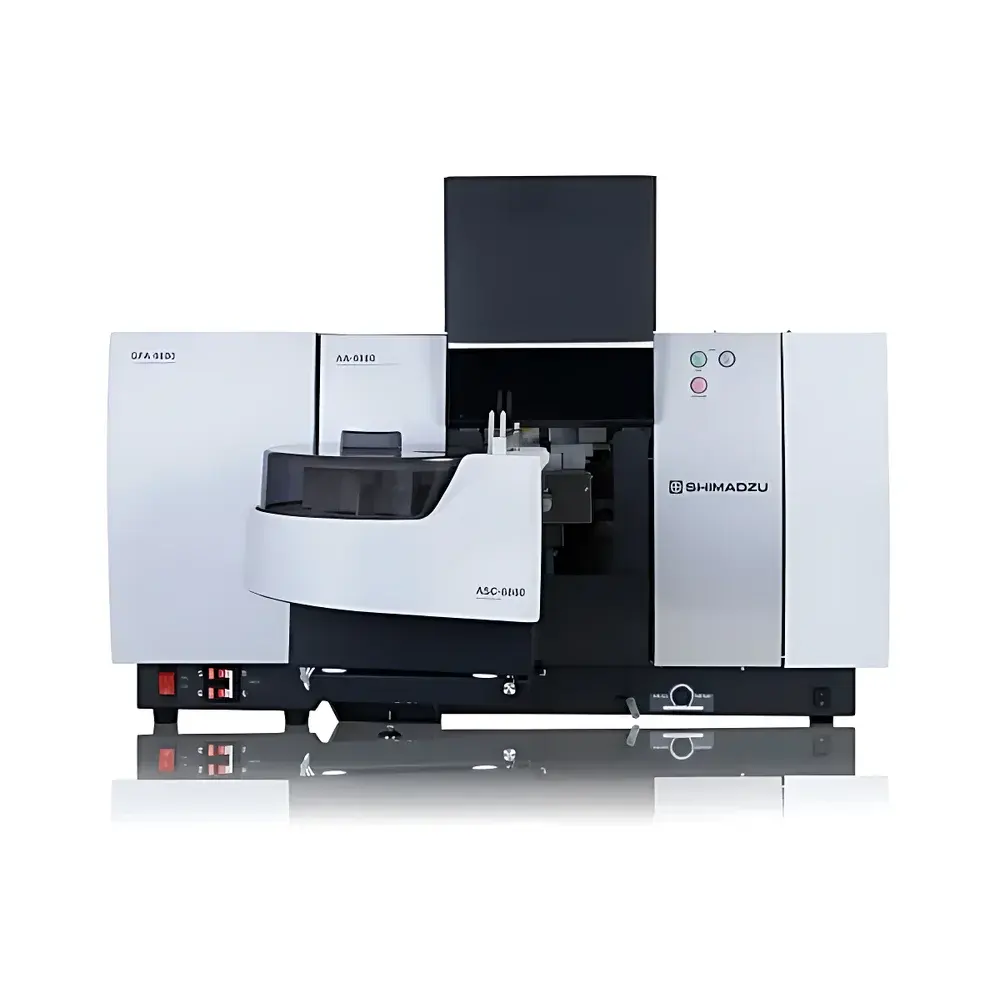
Shimadzu AA-6880 Flame and Graphite Furnace Atomic Absorption Spectrophotometer
| Brand | Shimadzu |
|---|---|
| Origin | Japan |
| Model | AA-6880 |
| Instrument Type | Flame and Graphite Furnace AAS |
| Optical System | Single-beam (automatically switches to double-beam mode for flame analysis |
| Monochromator | Grating-based, 0.3 nm spectral resolution |
| Detector | Solid-state photodiode array |
| Background Correction | Combined deuterium lamp and self-reversal (auto-absorption) method |
| Sensitivity | Flame: 0.1 µg/mL Pb |
| Graphite Furnace | 0.3 pg Pb |
| Detection Limit | Cu ≤ 0.006 mg/L (flame), sub-pg level for most elements (graphite furnace) |
| Precision (RSD) | < 0.3% for both flame and furnace modes |
| Lamp System | Integrated 8-position automatic lamp turret with dual-lamp simultaneous illumination capability |
Overview
The Shimadzu AA-6880 is a high-performance, dual-configuration atomic absorption spectrophotometer engineered for trace elemental quantification across diverse sample matrices. It operates on the fundamental principle of atomic absorption spectroscopy (AAS), where ground-state free atoms in a gaseous state absorb characteristic radiation emitted by element-specific hollow cathode lamps. The instrument supports two atomization techniques—flame nebulization (for ppm-level analysis) and electrothermal graphite furnace atomization (for sub-pg detection)—enabling laboratories to address a broad dynamic range of analytical requirements without compromising accuracy or reproducibility. Its modular architecture allows flexible deployment as a dedicated flame system (AA-6880F/F-AAC), graphite furnace-only configuration (AA-6880G), or fully integrated flame/graphite furnace platform (AA-6880FG/AFG), with manual or motorized atomizer switching. Designed and manufactured in Kyoto, Japan, the AA-6880 complies with international quality standards including ISO 9001 and conforms to key regulatory frameworks applicable to environmental, clinical, pharmaceutical, and food testing laboratories.
Key Features
- Adaptive optical architecture: Automatically configures as a double-beam system during flame analysis to correct for source intensity drift and lamp aging; switches to high-sensitivity electronic beam mode for graphite furnace measurements.
- Patented 3D optical path design enhances photon throughput in graphite furnace mode, contributing to world-class detection limits—e.g., Pb at 0.05 pg and Mn at 0.01 pg.
- Integrated 8-position lamp turret with dual-lamp illumination capability; positions 7 and 8 accommodate high-intensity HCLs optimized for volatile elements (As, Bi, Pb, Sb, Se, Zn), delivering improved emission stability, extended linear dynamic range, and reduced spectral interference.
- Digital temperature control with precision internal gas flow regulation ensures reproducible thermal programs from drying through atomization—critical for matrix-matched calibration and complex sample analysis.
- Comprehensive safety system includes multi-stage gas leak detection, micro-switch interlocks preventing accidental flame ignition during graphite furnace operation, auto-shutoff upon gas cutoff, and flame-retardant housing materials.
- Intelligent parameter optimization: Automatic adjustment of burner height, fuel/oxidant flow rates, and graphite furnace gas pressure profiles based on element-specific protocols.
Sample Compatibility & Compliance
The AA-6880 accommodates aqueous solutions, digested biological tissues, acid-leached soils, and diluted industrial effluents. Flame mode handles samples with total dissolved solids (TDS) up to 0.2%, while graphite furnace analysis supports direct injection of viscous or particulate-containing matrices following appropriate dilution or matrix modification. The system meets essential regulatory performance criteria outlined in ASTM D1688 (copper in water), ISO 11171 (trace metals in petroleum), USP (heavy metals in pharmaceuticals), and EPA Method 7000B (metals in wastewater). Data integrity features—including audit-trail-enabled method logging, user-access controls, and timestamped result storage—support compliance with FDA 21 CFR Part 11 and GLP/GMP documentation requirements.
Software & Data Management
Controlled via Shimadzu’s proprietary LabSolutions AAS software, the AA-6880 provides intuitive workflow management—from method creation and instrument calibration to QC monitoring and report generation. The software supports multi-point calibration curves with forced zero, standard addition, and internal standard correction. All analytical parameters—including lamp current, slit width, integration time, and background correction settings—are stored with each method. Raw absorbance data, peak area/height values, and diagnostic logs are exportable in CSV, PDF, or XML formats compatible with LIMS integration. Software validation packages and IQ/OQ documentation templates are available to facilitate laboratory accreditation under ISO/IEC 17025.
Applications
- Environmental monitoring: Quantification of heavy metals (Pb, Cd, Cr, Ni, As) in drinking water, surface water, and leachates per EPA and EU WFD directives.
- Clinical toxicology: Measurement of essential (Cu, Zn, Mg) and toxic (Pb, Cd, Al) elements in serum, whole blood, and urine.
- Pharmaceutical quality control: Testing for catalyst residues (Pd, Pt, Rh) and elemental impurities per ICH Q3D guidelines.
- Food safety: Screening for contamination (e.g., Cd in rice, Pb in spices) aligned with Codex Alimentarius and national MRL regulations.
- Geochemical and metallurgical analysis: Determination of base metals (Fe, Cu, Zn, Ni) and precious metals (Au, Ag) in ores and concentrates after acid digestion.
FAQ
What atomization methods does the AA-6880 support?
It supports both air-acetylene flame nebulization and electrothermal graphite furnace atomization, with optional configurations enabling either standalone or combined operation.
Can the AA-6880 meet regulatory requirements for pharmaceutical elemental impurity testing?
Yes—when operated with validated methods and calibrated using CRM-certified standards, it fulfills sensitivity and precision requirements specified in ICH Q3D and USP /.
Is the instrument compliant with 21 CFR Part 11 for electronic records?
LabSolutions AAS includes configurable audit trails, electronic signatures, and secure user authentication—fully supporting Part 11 implementation when deployed in validated environments.
How does the background correction system work?
It combines deuterium arc continuum correction for broadband absorption and self-reversal (auto-absorption) correction for narrow-line interference, providing accurate compensation across complex spectral backgrounds.
What maintenance is required for long-term stability?
Routine maintenance includes quarterly alignment verification, annual monochromator calibration, periodic graphite tube replacement (typically every 200–500 firings depending on matrix), and regular cleaning of nebulizer and burner head components.





