
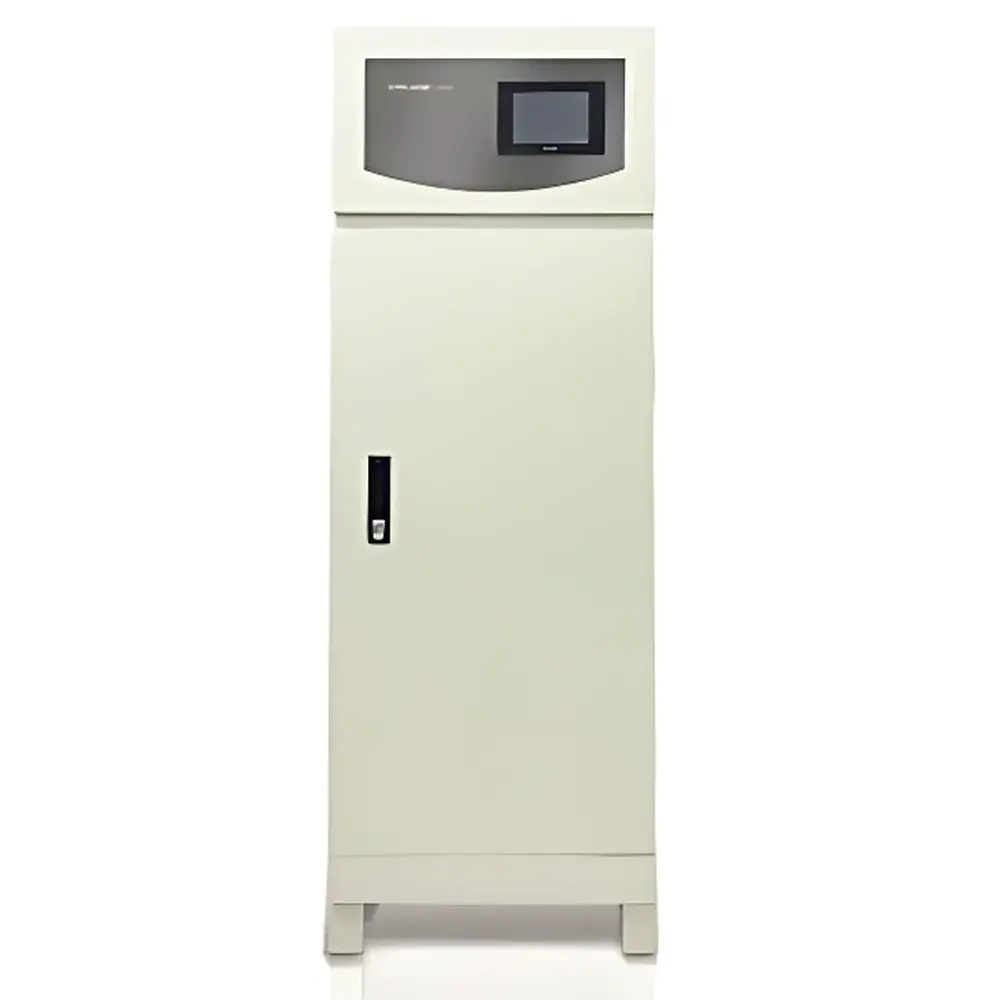
Shimadzu COD-4200 Online Chemical Oxygen Demand Analyzer
| Brand | Shimadzu |
|---|---|
| Origin | Jiangsu, China |
| Manufacturer Status | Authorized Distributor |
| Product Origin | Domestic (China) |
| Model | COD-4200 |
| Price Range | USD 21,000 – 28,000 (est.) |
| Instrument Type | Online Analyzer |
| Measurement Principle | High-Temperature Acidic Potassium Dichromate Digestion with Photometric Detection |
| Accuracy | ±10% for concentrations ≥100 mg/L |
| Minimum Measurement Cycle | 20 minutes |
| Measuring Range | 30–4000 mg/L COD (extended range available upon consultation) |
| Repeatability | ≤±5% |
| Zero Drift | ±5 mg/L |
| Span Drift | ≤±5% |
| Resolution | <1 mg/L |
| Output Signals | RS-232, 4–20 mA (bidirectional communication & remote control supported) |
| Power Supply | 220 VAC ±10%, 50 Hz ±5% |
| Power Consumption | ~100 VA |
| Dimensions | 500 × 420 × 1550 mm (W × D × H) |
| Weight | ~90 kg |
Overview
The Shimadzu COD-4200 is a fully automated online chemical oxygen demand (COD) analyzer engineered for continuous, unattended monitoring of wastewater and surface water in regulatory, municipal, and industrial applications. It employs the standardized high-temperature acidic potassium dichromate digestion method—aligned with ISO 6060 and APHA Standard Methods 5220 D—followed by precise photometric quantification of the reduced Cr3+ ion at 600 nm. Unlike spectrophotometric or electrochemical alternatives, this wet-chemistry-based approach delivers high specificity for oxidizable organic matter under real-world matrix conditions, including variable turbidity, suspended solids, and complex effluent compositions. The system integrates thermal digestion at 165 °C for 15 minutes, ensuring complete oxidation of refractory organics while minimizing chloride interference through proprietary masking reagents and optimized digestion kinetics. Designed for deployment in harsh environmental monitoring stations, wastewater treatment plants (WWTPs), and river basin surveillance networks, the COD-4200 operates reliably across ambient temperatures from 5 °C to 40 °C and relative humidity up to 85% non-condensing.
Key Features
- Automated pipeline cleaning cycle prevents biofilm formation and algal growth in sampling lines—critical for long-term stability in open-channel or reservoir installations.
- Intelligent self-diagnostic architecture continuously monitors valve actuation, heater temperature, photometer baseline, and reagent depletion; triggers configurable alarm outputs (relay + digital log) upon anomaly detection.
- Eight-port corrosion-resistant rotary valve constructed from PTFE-lined ceramic and Hastelloy components ensures >500,000 switching cycles and resistance to aggressive digestates containing Cl−, SO42−, and heavy metals.
- Power-fail recovery protocol automatically flushes residual reaction mixture, purges flow paths, and resumes scheduled measurement sequences within 90 seconds after power restoration—no manual intervention required.
- PLC-based control core (IEC 61131-3 compliant) minimizes electromagnetic susceptibility and supports deterministic timing for digestion, mixing, and measurement phases—essential for GLP/GMP-aligned operation.
- Low reagent consumption design: ≤1.2 mL per analysis for both sulfuric acid and potassium dichromate solutions, reducing operational cost and hazardous waste generation.
Sample Compatibility & Compliance
The COD-4200 accepts raw influent, secondary effluent, treated discharge, and natural surface water samples without pre-filtration (up to 200 µm particulate tolerance). It meets performance criteria specified in China’s HJ 377-2019 standard for online COD analyzers and demonstrates compatibility with international QA/QC frameworks including ISO/IEC 17025 method validation requirements. Its measurement uncertainty profile satisfies reporting thresholds for national pollutant discharge permits (NPDP) and EU Urban Wastewater Treatment Directive (91/271/EEC) compliance monitoring. All firmware logs—including calibration events, error codes, and maintenance timestamps—are time-stamped and stored with write-once-read-many (WORM) integrity, supporting audit readiness for EPA 40 CFR Part 136 and FDA 21 CFR Part 11 data governance expectations.
Software & Data Management
The embedded web server enables secure HTTP(S) access for configuration, real-time trend visualization, and event log review via standard browsers—no proprietary client software required. Data export supports CSV and Modbus TCP protocols for integration into SCADA, EMS, or LIMS platforms. Automatic calibration verification using certified reference materials (CRMs) at user-defined intervals (e.g., daily or per 10th measurement) generates traceable calibration reports compliant with ISO Guide 34 and ISO/IEC 17034. Audit trails record all parameter changes, user logins, and firmware updates with SHA-256 hashing to prevent tampering—fully aligned with ALCOA+ (Attributable, Legible, Contemporaneous, Original, Accurate, Complete, Consistent, Enduring, Available) data integrity principles.
Applications
- Continuous emission monitoring (CEM) at industrial outfalls subject to local environmental protection bureau (EPB) reporting mandates.
- Influent/effluent COD profiling in activated sludge, MBR, and SBR wastewater treatment facilities for process optimization and energy efficiency assessment.
- Early-warning detection of organic loading shocks in riverine systems—integrated with hydrological telemetry for dynamic load modeling.
- Validation of advanced oxidation process (AOP) or ozonation efficiency in pilot-scale water reuse studies.
- Long-term trend analysis for climate-resilient watershed management under ISO 5667-3 and GB/T 14848 groundwater quality assessment protocols.
FAQ
What digestion method does the COD-4200 use, and how is it standardized?
It implements the high-temperature (165 °C), closed-vessel potassium dichromate digestion method per ISO 6060 and APHA 5220 D, with integrated spectral correction for chloride interference.
Can the instrument operate outside its 30–4000 mg/L range?
Yes—custom dilution modules and alternate digestion protocols are available for extended ranges (e.g., 5–10,000 mg/L); contact Shimadzu Technical Support for application-specific validation.
Is remote diagnostics and firmware update capability supported?
Yes—via encrypted HTTPS session with role-based access control (RBAC); firmware updates require dual-signature authentication and rollback capability.
How often does the system require preventive maintenance?
Recommended quarterly maintenance includes optical window cleaning, valve lubrication, and pump tubing replacement—average mean time between failures (MTBF) exceeds 12,000 hours.
Does the COD-4200 support integration with third-party data platforms?
Yes—native Modbus TCP, OPC UA, and MQTT v3.1.1 drivers are included; custom API wrappers available for cloud ingestion (AWS IoT Core, Azure IoT Hub).
Related Products







