
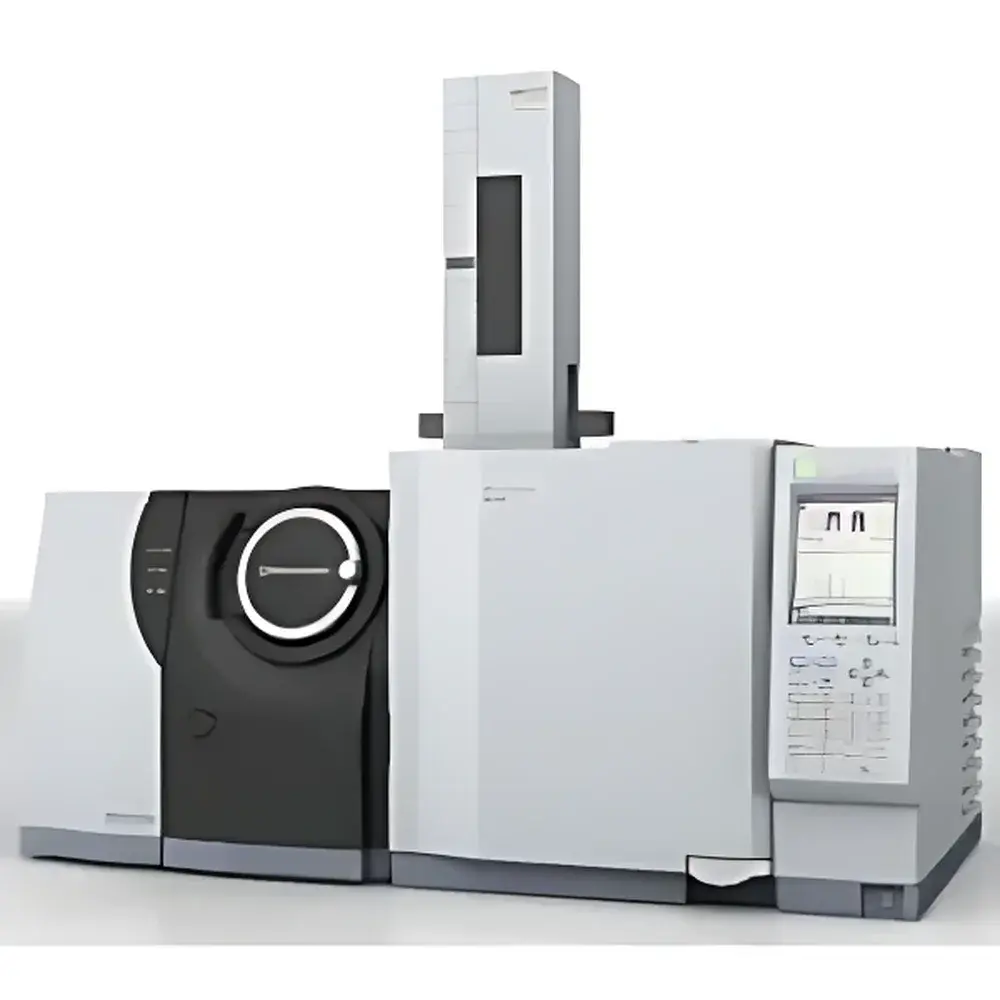
Shimadzu GCMS-TQ8040X Triple Quadrupole Gas Chromatography Mass Spectrometer
| Brand | Shimadzu |
|---|---|
| Origin | Japan |
| Manufacturer Authorization | Authorized Distributor |
| Instrument Type | Triple Quadrupole Mass Spectrometer |
| GC Configuration | Conventional Gas Chromatograph |
| Model | GCMS-TQ8040X |
| Regulatory Compliance | Designed for GLP/GMP and FDA 21 CFR Part 11–compliant laboratories |
Overview
The Shimadzu GCMS-TQ8040X is a high-performance triple quadrupole gas chromatography mass spectrometry (GC-MS/MS) system engineered for rigorous quantitative analysis in regulated and research environments. It operates on the fundamental principle of selective reaction monitoring (SRM), where the first quadrupole (Q1) isolates a precursor ion, the second quadrupole (q2) serves as a collision cell for controlled fragmentation via collision-induced dissociation (CID), and the third quadrupole (Q3) transmits a specific product ion for detection. This architecture delivers exceptional specificity, sensitivity, and dynamic range—critical for trace-level quantitation of target analytes in complex matrices such as environmental extracts, food residues, clinical biosamples, and pharmaceutical impurities.
Key Features
- Smart MRM Technology: Fully automated method setup for multiple reaction monitoring (MRM), supporting up to 32,768 transitions per acquisition method—enabling comprehensive multi-analyte quantitation without compromising dwell time or sensitivity.
- High-Efficiency Ion Source: Patented heated ion source with optimized electron emission and reduced surface adsorption ensures stable, high-intensity ion currents across extended run times and diverse compound classes.
- Advanced Collision Cell (UFsweeper™): Ultra-fast collision gas control and optimized RF/DC fields minimize cross-talk between adjacent MRM transitions and maximize transmission efficiency for low-abundance product ions.
- ASSP (Active Scan Speed Protocol): Real-time scan speed adjustment dynamically balances spectral acquisition rate and signal-to-noise ratio—enabling simultaneous full-scan (EI or CI) and MRM acquisition within a single run.
- Robust Hardware Architecture: Integrated GC oven with precise temperature ramping (0.01 °C/min resolution), split/splitless injector with electronic pressure control (EPC), and dual-vacuum turbomolecular pumping system ensure long-term operational stability and reproducibility.
Sample Compatibility & Compliance
The GCMS-TQ8040X accommodates a broad range of volatile and semi-volatile organic compounds—including pesticides, polycyclic aromatic hydrocarbons (PAHs), endocrine disruptors, residual solvents, and legacy pollutants—when coupled with standard capillary columns (e.g., 5% phenyl methylpolysiloxane, DB-5ms, Rxi-5Sil MS). It supports both electron ionization (EI) and chemical ionization (CI) modes for structural confirmation and soft ionization applications. The system is fully compatible with ISO/IEC 17025, ASTM D5845/D6091, USP , and EPA Methods 8270/1613/525.3 workflows. Audit trail, electronic signature, and user-access controls are implemented in accordance with FDA 21 CFR Part 11 requirements for data integrity in regulated QA/QC and contract testing laboratories.
Software & Data Management
GCMSsolution software provides an integrated platform for instrument control, method development, data acquisition, and quantitative reporting. Its Smart MRM module auto-generates optimal MRM parameters—including Q1/Q3 m/z values, collision energies (CE), and dwell times—based on compound databases (e.g., NIST, Wiley, Shimadzu Pesticide Database) and empirical retention indices. Batch processing supports scheduled calibration, QC checks, and report generation with customizable templates. All raw data files (.qgd) are stored in vendor-neutral formats compliant with ASAM OASIS standards. Data export supports CSV, XML, and CDF for integration with LIMS and enterprise analytics platforms.
Applications
- Residue analysis in food safety testing (e.g., multi-pesticide screening per EU SANTE/11312/2021)
- Environmental monitoring of persistent organic pollutants (POPs) in soil, water, and air particulates
- Pharmaceutical impurity profiling and genotoxic impurity quantitation per ICH M7 guidelines
- Clinical toxicology screening for drugs of abuse and metabolites in urine and blood
- Forensic chemistry for fire debris analysis and explosive residue identification
FAQ
What regulatory standards does the GCMS-TQ8040X support for data integrity?
It complies with FDA 21 CFR Part 11, EU Annex 11, and ISO/IEC 17025 requirements through built-in audit trail, role-based access control, electronic signatures, and immutable raw data storage.
Can the system perform both qualitative and quantitative analysis in one run?
Yes—via ASSP-enabled simultaneous Scan/MRM acquisition, allowing library-searchable full-scan spectra alongside high-sensitivity MRM quantitation.
Is method transfer possible from other Shimadzu GC-MS systems?
Methods developed on GCMS-QP2020, GCMS-TQ8030, or GCMS-TQ8050 platforms can be migrated with minimal re-optimization due to consistent ion optics and software architecture.
What maintenance intervals are recommended for routine operation?
Ion source cleaning every 2–4 weeks (depending on sample load), column trimming every 50–100 injections, and vacuum pump oil replacement every 6 months—aligned with Shimadzu’s Preventive Maintenance Schedule (PMS-003).
Does the system support unattended operation for overnight batches?
Yes—integrated autosampler (AOC-20i or AOC-6000 Plus) with 108-position vial capacity and real-time system health monitoring enable fully automated 24/7 operation under validated conditions.





