
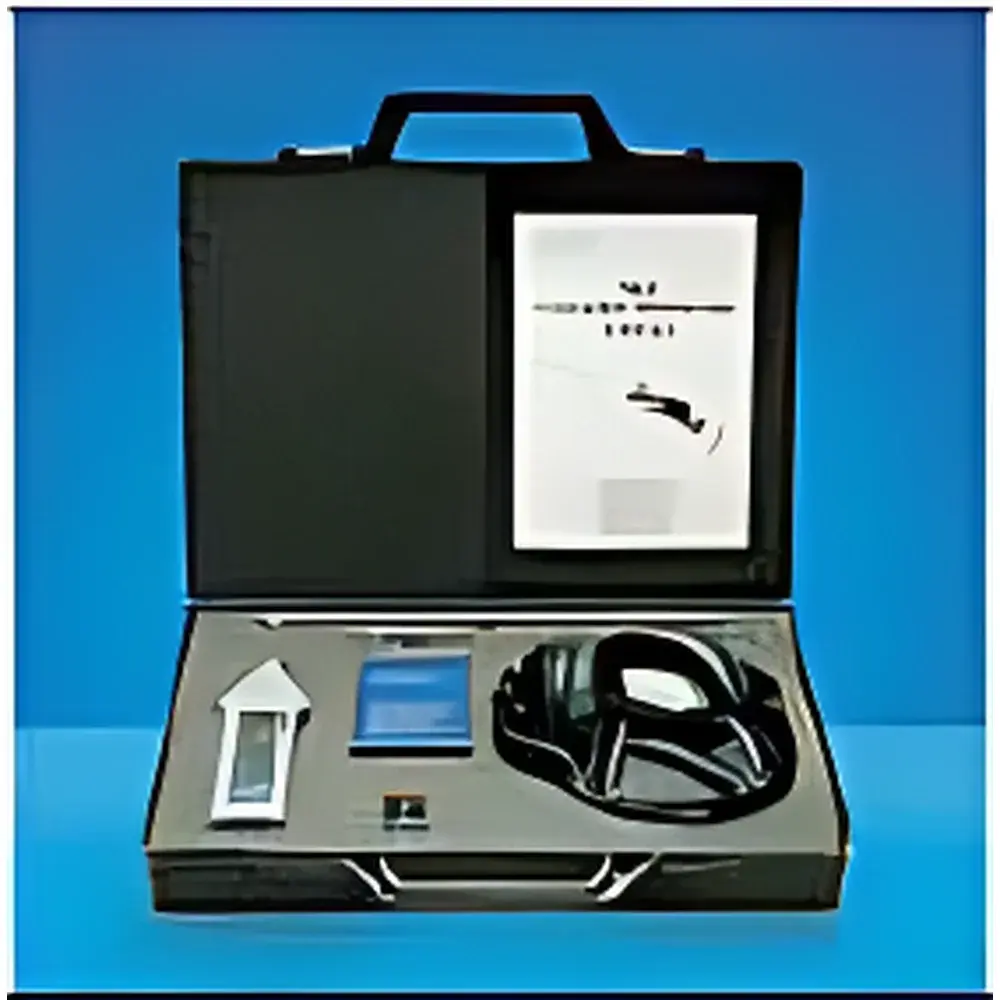
SKF TMST 3 Electronic Stethoscope
| Origin | Imported |
|---|---|
| Manufacturer Type | Distributor |
| Model | TMST 3 |
| Price | Upon Request |
| Frequency Response | 30 Hz – 15 kHz |
| Power Supply | 4 × AAA (R03) batteries, up to 30 hours continuous operation |
| Operating Temperature | −10 °C to +45 °C |
| Maximum Audio Output | 250 mV |
| Headset Dimensions | 220 × 40 × 40 mm |
| Probe Lengths | 70 mm and 220 mm |
| Total Weight | 1560 g |
| Handheld Sensor Weight | 162 g |
| Headset Weight | 250 g |
Overview
The SKF TMST 3 Electronic Stethoscope is a precision-engineered diagnostic tool designed for condition-based monitoring of rotating machinery through acoustic emission analysis. Unlike conventional mechanical stethoscopes, the TMST 3 employs high-fidelity piezoelectric sensing coupled with real-time digital signal processing (DSP) to isolate, amplify, and clarify structure-borne vibration signals transmitted through machine casings, shafts, or bearing housings. Its operational principle relies on detecting subtle changes in acoustic signatures—such as impacts, modulation sidebands, or broadband noise increases—that correlate with early-stage bearing degradation, misalignment, lubrication deficiency, or gear tooth damage. Engineered for industrial field use, it bridges the gap between qualitative auditory assessment and quantitative trend analysis, serving as a frontline triage instrument in predictive maintenance programs across power generation, manufacturing, petrochemical, and transportation sectors.
Key Features
- Wideband frequency response (30 Hz – 15 kHz) optimized for capturing both low-frequency mechanical impacts and high-frequency bearing defect harmonics;
- Dual-probe configuration (70 mm rigid probe and 220 mm flexible probe) enabling access to confined, elevated, or thermally sensitive components without compromising signal integrity;
- Integrated LED status indicators for power-on confirmation, real-time volume level feedback, and low-battery warning—ensuring uninterrupted operation during extended inspection rounds;
- Active noise-rejecting headset with passive attenuation exceeding 25 dB(A), functioning simultaneously as a diagnostic listening device and certified hearing protection in environments exceeding OSHA permissible exposure limits;
- DSP-enhanced audio path delivering improved signal-to-noise ratio, dynamic range compression, and harmonic enhancement for clearer differentiation between normal operational tones and incipient fault signatures;
- Analog audio output (250 mV nominal) compatible with external recorders, spectrum analyzers, or data acquisition systems for archival, comparative analysis, or integration into CMMS platforms;
- Auto-power-off function after 10 minutes of inactivity, conserving battery life while maintaining readiness for immediate deployment;
- Ruggedized ABS housing rated IP54 for dust and splash resistance, tested per IEC 60529 standards for durability under typical plant-floor conditions.
Sample Compatibility & Compliance
The TMST 3 is compatible with all metallic and composite-cased rotating equipment—including electric motors, gearboxes, pumps, compressors, fans, and conveyor drives—where surface-accessible vibration transmission paths exist. It does not require coupling agents or surface preparation. The device complies with electromagnetic compatibility requirements per EN 61326-1:2013 (industrial environment) and meets essential safety requirements under EN 61010-1:2010 for electrical equipment used in measurement, control, and laboratory applications. While not a certified Class I medical device, its acoustic output adheres to IEC 60645-1:2013 limits for diagnostic audiometers, ensuring safe and repeatable operator exposure during routine inspections.
Software & Data Management
The TMST 3 includes a reference audio CD containing standardized acoustic templates of common bearing failure modes—e.g., inner race defects (BPFI), outer race faults (BPFO), cage resonance, and lubrication starvation—as defined in ISO 10816-3 and ANSI/HI 9.6.4. These recordings support rapid operator training and comparative listening protocols. Although the unit itself operates as a standalone analog-DSP hybrid with no onboard storage or Bluetooth connectivity, its analog output enables seamless integration with third-party software such as SKF @ptitude Observer, MATLAB Signal Processing Toolbox, or open-source tools like Audacity for time-domain waveform capture, FFT spectral analysis, and baseline signature archiving. Audit trails, calibration logs, and inspection records can be maintained externally in accordance with ISO 17025 or internal GLP/GMP documentation frameworks.
Applications
- Routine巡检 (route-based inspection) of critical assets in preventive maintenance schedules;
- Troubleshooting abnormal noise reports prior to scheduled downtime;
- Verification of bearing replacement effectiveness post-maintenance;
- Lubrication optimization by distinguishing between over-greased, under-greased, and contaminated states via acoustic damping characteristics;
- Training new reliability technicians in fault-sound recognition using standardized reference libraries;
- Supporting root cause analysis (RCA) teams by providing corroborating acoustic evidence alongside vibration, thermographic, or oil analysis data.
FAQ
Does the TMST 3 require calibration before use?
No formal recalibration is required during service life; however, users should perform daily functional verification using the built-in test tone and reference probe contact on a known-clean bearing housing.
Can the TMST 3 detect electrical faults such as partial discharge?
No—it is not designed for airborne ultrasonic detection (20–100 kHz); it targets structure-borne mid-to-high-frequency mechanical emissions only.
Is the headset compatible with hearing protection standards such as ANSI S3.19 or EN 352?
Yes—the headset meets EN 352-1:2019 Class 3 passive attenuation specifications when worn correctly, and may be used as dual-purpose PPE in accordance with site-specific hearing conservation programs.
What is the expected battery life under typical field usage patterns?
With intermittent use (approx. 2–3 hours/day), battery life exceeds 6 weeks; continuous monitoring reduces this to ~30 hours per set, consistent with IEC 60086-2 alkaline battery performance curves.
Are replacement probes and headset cushions available as spare parts?
Yes—SKF offers genuine OEM spare kits (TMST-PROBE-KIT and TMST-HEADSET-CUSHION-SET) with traceable part numbers and documented shelf-life compliance.
Related Products



