
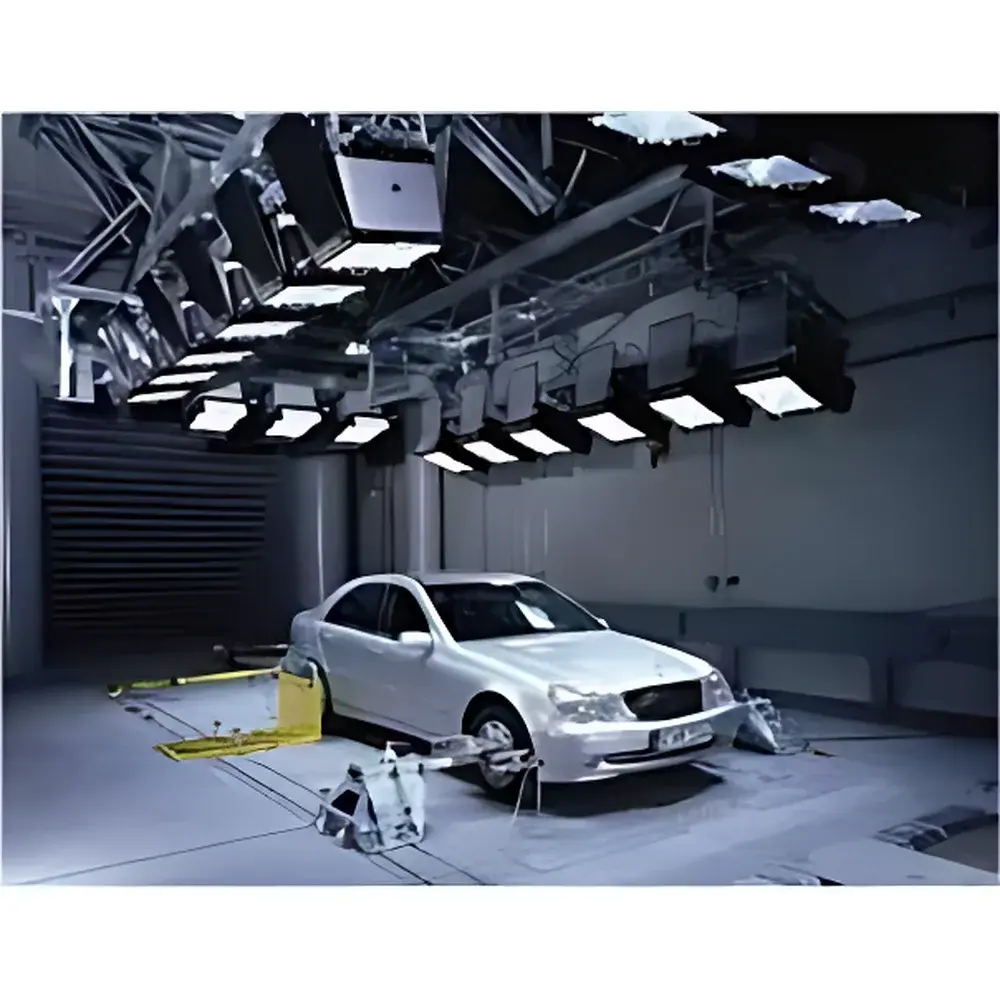
Solar Light LAL Large-Area Solar Simulator
| Brand | Solar Light |
|---|---|
| Origin | USA |
| Model | LAL |
| Radiation Source | Metal Halide Lamp with CIE 85 Spectral Match |
| Power Supply | Electronic Power Supply (EPS-Modul) with Square-Wave Current Drive |
| Spectral Range | 280–4000 nm (UV–NIR), UV-A/UV-B selectable via filters |
| Irradiance Uniformity | ±5% over defined test area |
| Control Interface | PC-based menu-driven software with programmable test sequences |
| Positioning System | Motorized 2-axis mechanical tracking mount (optional) |
| Compliance | DIN 75220, SAE J2527/J2412, MIL-STD-810G Method 505.6, EPA Protocol 40 CFR Part 1065 |
| Modular Design | Configurable radiation unit size, mounting system, and filter sets |
| Lamp Lifetime | >1,500 hours under EPS-controlled operation |
Overview
The Solar Light LAL Large-Area Solar Simulator is an engineered solution for high-fidelity solar spectral simulation in accelerated environmental aging studies. Designed around the fundamental principles of radiometric traceability and spectral fidelity, the system employs a stabilized metal halide lamp coupled with precision optical filtering to replicate the global solar irradiance spectrum as defined by CIE Publication 85 (1989). Unlike broadband UV-only chambers, the LAL delivers continuous spectral output from 280 nm to 4000 nm—covering UV-A, UV-B, visible, and near-infrared regions—enabling realistic photodegradation, thermal loading, and photochemical response assessment across material systems. Its core architecture follows a three-tier modular framework: a calibrated radiation unit, a low-drift electronic power supply (EPS-Modul), and a deterministic control layer—ensuring repeatability across inter-laboratory campaigns and long-term stability monitoring per ISO/IEC 17025 requirements.
Key Features
- Spectral Accuracy: Achieves CIE 85 spectral match (AM1.5G equivalent) through proprietary multi-layer interference filters and ellipsoidal reflector optics—validated against NIST-traceable spectroradiometers.
- Irradiance Stability: EPS-Modul delivers square-wave current regulation, maintaining irradiance drift ≤ ±1% despite line voltage fluctuations or thermal load shifts—critical for ISO 4892-2 and ASTM G155 compliance.
- Uniformity Engineering: Optical homogenization via secondary reflector arrays and diffuser plates ensures ±5% spatial irradiance uniformity over test areas up to 1.2 m × 1.2 m (customizable).
- Modular Scalability: Radiation units, mounting frames, and filter kits are independently specifiable—supporting configurations from benchtop (0.3 m²) to full-vehicle exposure (≥3 m²).
- Dynamic Positioning: Optional motorized 2-axis goniometer enables automated solar angle simulation (azimuth/elevation), replicating diurnal cycles per IEC 61215-2 MQT10 for PV module qualification.
- Lamp Longevity Management: EPS-Modul’s soft-start protocol and thermal feedback loop extend metal halide lamp service life beyond 1,500 hours—reducing calibration frequency and operational cost.
Sample Compatibility & Compliance
The LAL accommodates flat-panel, curved, and three-dimensional specimens—including automotive trim, architectural coatings, polymer films, photovoltaic modules, and textile laminates—without requiring sample reorientation during exposure. Its open-chamber configuration permits real-time in-situ monitoring (e.g., gloss, colorimetry, FTIR) via external ports. The system is pre-validated against major international standards: DIN 75220 for automotive interior components; SAE J2527 (2022) and J2412 (2021) for exterior materials; MIL-STD-810G Method 505.6 for defense-grade polymers; and EPA Protocol 40 CFR Part 1065 Annex D for emission-relevant material screening. All spectral and irradiance calibrations are performed in accordance with ISO/IEC 17025-accredited procedures, with full audit trails supporting GLP and FDA 21 CFR Part 11 data integrity requirements.
Software & Data Management
Control is executed via Solar Light’s proprietary SimuLab Suite, a Windows-based application compliant with IEC 62443-3-3 cybersecurity guidelines. The interface provides hierarchical user roles (operator, engineer, administrator), password-protected parameter locking, and electronic signature support for 21 CFR Part 11 compliance. Test protocols—including irradiance ramping, spectral filter sequencing, and positional sweeps—are stored as XML-based templates with version control. Real-time irradiance logging (1 Hz resolution), thermal sensor integration (up to 8 channels), and automatic calibration certificate linking ensure full traceability. Export formats include CSV, HDF5, and ASTM E2912-compliant .sdt files for third-party analysis in MATLAB or Python environments.
Applications
- Accelerated weathering of automotive clearcoats, sealants, and interior plastics per GMW14124 and Ford CETP 00.00-L-467.
- UV-induced degradation kinetics of organic photovoltaics and perovskite solar cells under ISOS-L-1 illumination conditions.
- Photostability validation of pharmaceutical packaging films (USP and ICH Q1B).
- Colorfastness testing of marine textiles per ISO 105-B02 and AATCC TM16-2021.
- Thermo-optical coupling analysis in aerospace composites exposed to combined UV/thermal cycling (MIL-HDBK-344).
- Calibration reference source for field-deployable UV radiometers used in atmospheric monitoring networks.
FAQ
What spectral standard does the LAL simulate?
The LAL reproduces the CIE 85 global solar spectrum (AM1.5G), with optional UV-A/UV-B bandpass filters aligned to ISO 4892-2 and ASTM G154 specifications.
Can the system be integrated into an existing environmental chamber?
Yes—the LAL radiation unit is designed for drop-in installation into custom or commercial climate chambers, with I/O signals compatible with Modbus TCP and analog 0–10 V interfaces.
Is spectral recalibration required between lamp replacements?
Yes—each new lamp requires full spectral irradiance characterization using a NIST-traceable spectroradiometer; calibration certificates are generated per ISO/IEC 17025 and archived within SimuLab Suite.
Does the system support automated diurnal cycle simulation?
With the optional motorized positioning system, users can program azimuth/elevation trajectories matching any geographic location and date via built-in NOAA solar position algorithms.
What maintenance intervals are recommended for the EPS-Modul?
Annual verification of current regulation accuracy and thermal management performance is advised; no consumables are required beyond scheduled lamp replacement.



