k-Space Associates kSA XRF Online X-ray Fluorescence Thin Film Thickness Metrology System
| Brand | k-Space Associates |
|---|---|
| Origin | USA |
| Manufacturer Status | Authorized Distributor |
| Origin Category | Imported |
| Model | kSA XRF |
| Price Range | USD $50,000 – $500,000 |
Overview
The k-Space Associates kSA XRF Online X-ray Fluorescence Thin Film Thickness Metrology System is an industrial-grade, in-line elemental analysis and thickness measurement platform engineered for precision metrology of ultra-thin metallic and dielectric films on rigid substrates—including float glass, solar photovoltaic (PV) modules, flat-panel display substrates, and semiconductor wafers. Unlike optical techniques (e.g., ellipsometry or interferometry), which suffer from low contrast, substrate interference, or insufficient sensitivity below ~100 nm, the kSA XRF system leverages fundamental X-ray fluorescence (XRF) physics to quantify film mass per unit area—converted to thickness via stoichiometric density assumptions. It operates on the principle that primary X-rays from a high-voltage microfocus tube excite characteristic fluorescent X-rays from atoms in the film; the intensity of element-specific emission peaks (measured via solid-state Si(Li) or SDD detector, pulse-height analyzer, and multichannel analyzer) is directly proportional to areal density. This enables robust, non-contact, non-destructive quantification of single- or multi-layer stacks—even on highly scattering or absorbing substrates—without reliance on optical constants or modeling assumptions.
Key Features
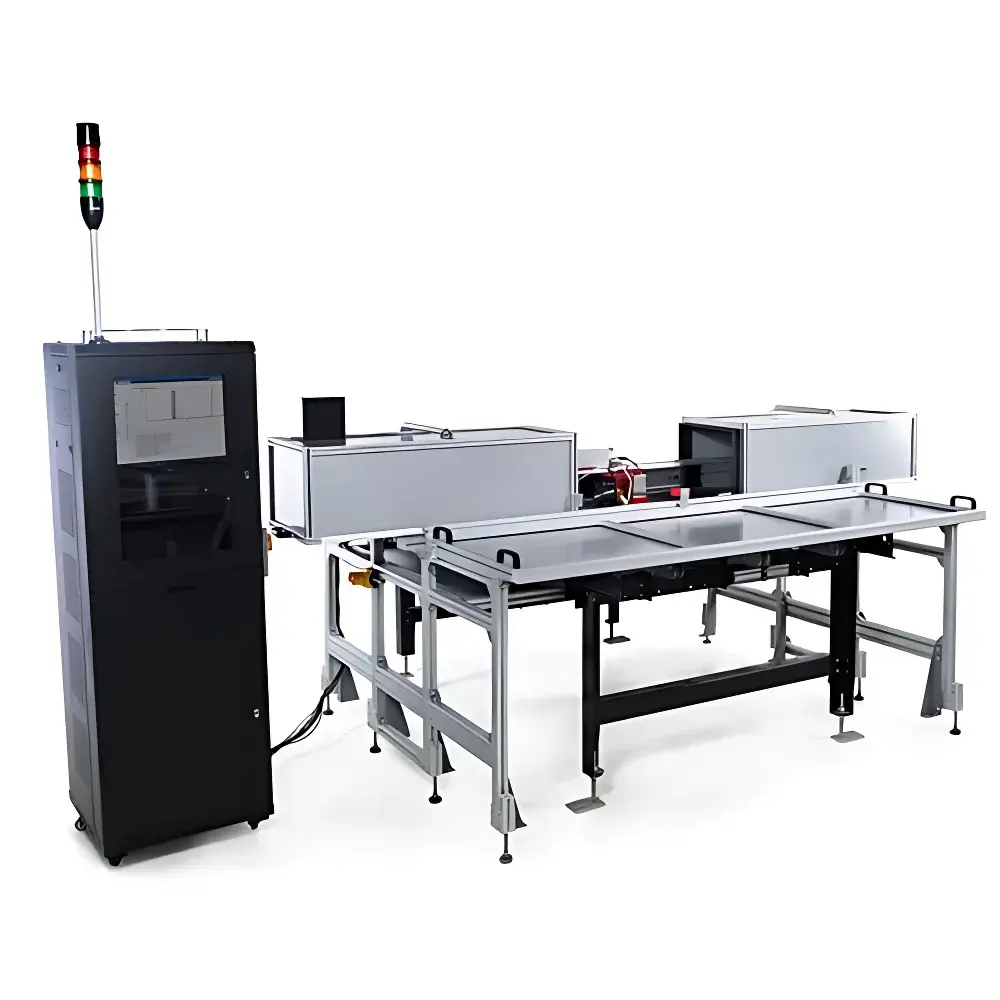
- Fully automated, conveyor-integrated design with bridge-mount mechanical architecture for seamless integration into glass tempering lines, PV module laminators, or display coating production lines.
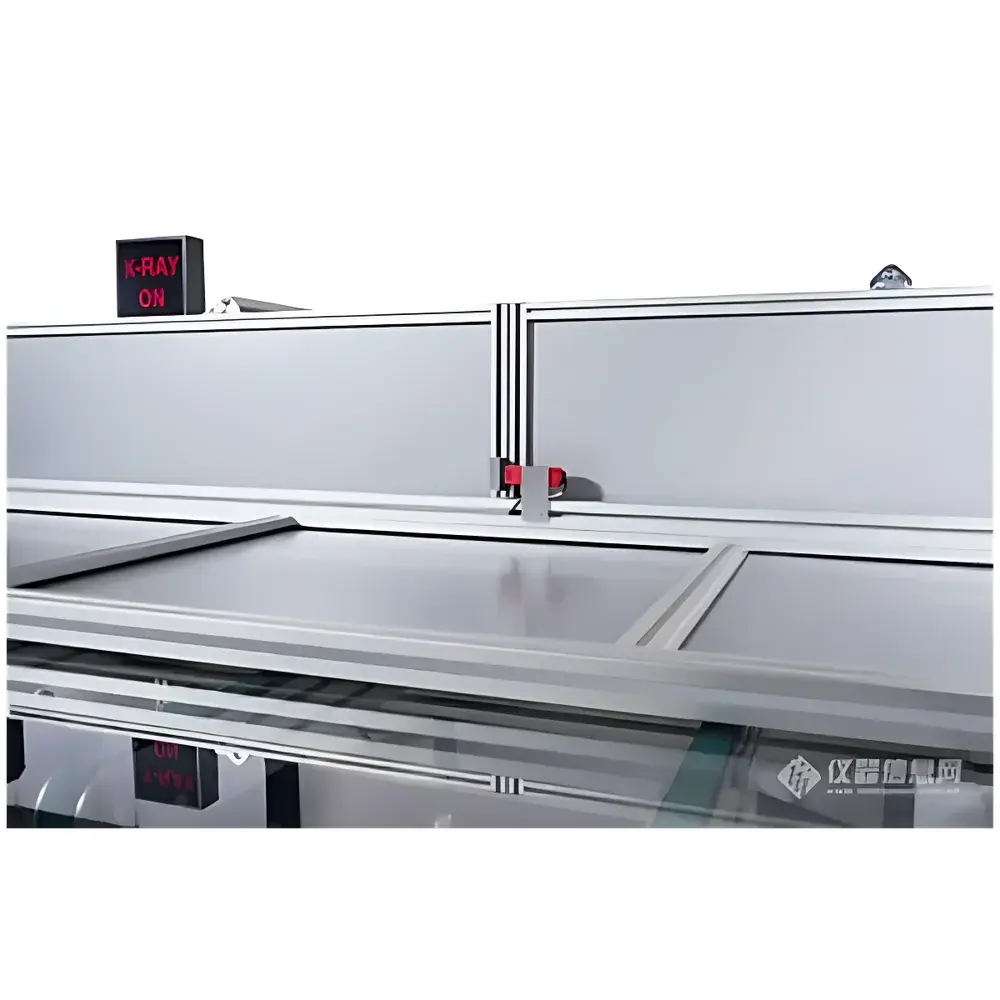
- Integrated safety-compliant enclosure housing X-ray source and detector, equipped with active interlock circuitry, status beacon (rotating tower light), and flashing warning indicator during beam-on operation.
- Edge-triggered acquisition using front/rear photoelectric sensors—ensuring precise synchronization with substrate motion and eliminating idle-time data collection.
- Modular detection head configuration: single-head standard; optional multi-head deployment for width-wise profiling or redundancy-critical applications.
- Industrial-grade cabinet controller with embedded real-time data processing engine, local storage (SSD-based), and dual Ethernet ports for factory network connectivity.
- Factory automation interface supporting Modbus TCP, OPC UA, and discrete I/O signals—enabling direct integration with PLCs, MES, SCADA, and alarm management systems (email/SMS alerts, HMI visualization, and fault logging).
Sample Compatibility & Compliance
The kSA XRF system accommodates planar substrates up to 3.2 m wide and 19 mm thick, including soda-lime glass, borosilicate glass, tempered glass, silicon wafers (up to 300 mm), and encapsulated PV modules. It measures films composed of elements with atomic number Z ≥ 11 (Na) through Z ≤ 92 (U), including but not limited to Al, Ti, Cr, Fe, Ni, Cu, Zn, Sn, Ag, In, Sb, Ta, W, Pt, and Au—either as pure metals, alloys, or compound layers (e.g., ITO, AZO, SiNx, Al2O3). The system complies with ANSI N43.3 (USA), IEC 61000-6-2/6-4 (EMC), and meets Class 1 laser product requirements per FDA 21 CFR Part 1040.10 when used with optional alignment lasers. All firmware and software modules support audit trail functionality and user access control per FDA 21 CFR Part 11 and ISO/IEC 17025 quality management requirements.
Software & Data Management
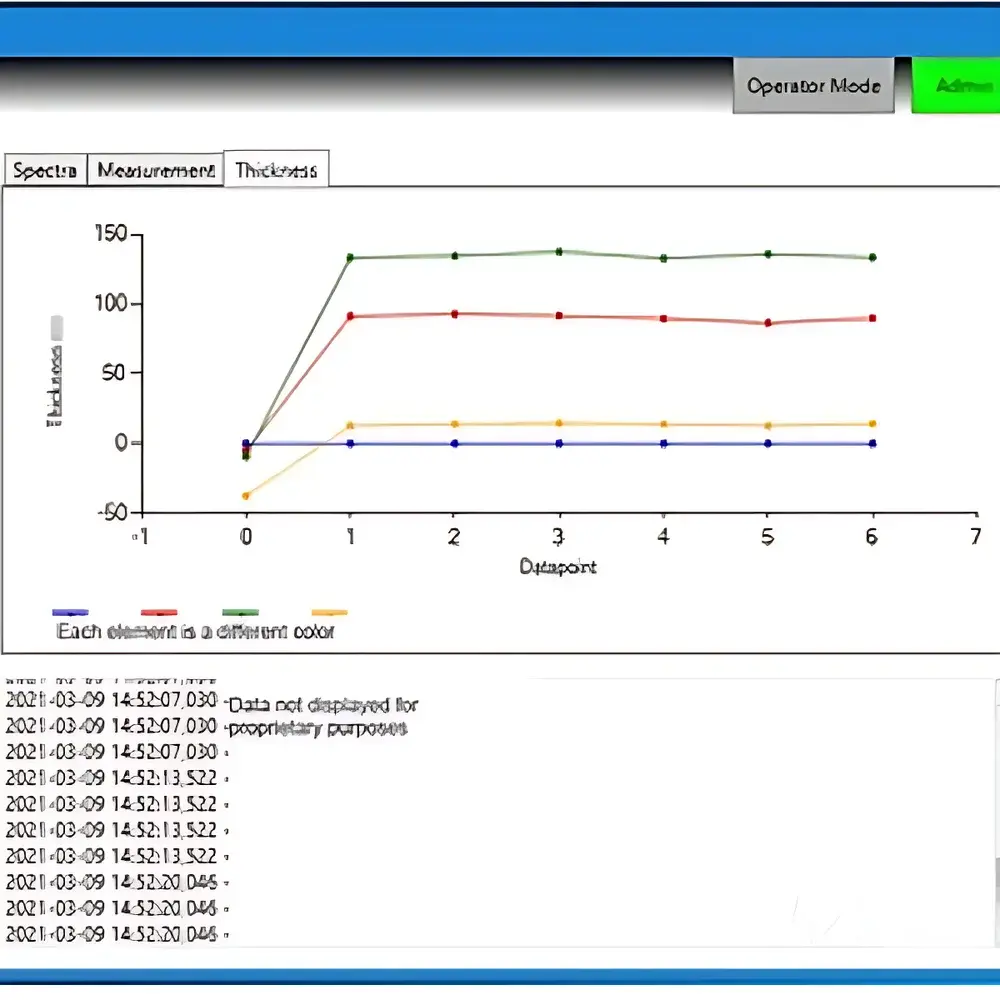
The proprietary k-Space Metrology Suite provides full control over acquisition parameters (tube voltage/current, dwell time, energy windowing), spectral deconvolution (peak fitting using Gaussian-Lorentzian models), calibration management (empirical or fundamental parameter methods), and statistical process control (SPC) charting. Data is stored in vendor-neutral HDF5 format with embedded metadata (timestamp, substrate ID, recipe name, operator ID, environmental conditions). The software supports batch calibration import/export, recipe-driven measurement sequencing, and configurable pass/fail logic with dynamic tolerance bands. Integration APIs (RESTful JSON endpoints and DLL libraries) allow bidirectional communication with third-party QMS platforms such as InfinityQS, Minitab Workspace, or custom MES solutions. Raw spectra and processed results are exportable in CSV, XML, and PDF report formats compliant with internal QA documentation standards.
Applications
- Real-time monitoring of sputtered or evaporated metal layers (e.g., Ag reflector stacks, NiCr heater traces) on architectural or automotive glass.
- In-line verification of transparent conductive oxide (TCO) thickness uniformity (e.g., ITO, FTO, AZO) across large-area solar cells prior to lamination.
- Quantitative analysis of barrier layer integrity (e.g., Al2O3, SiOx) in flexible OLED encapsulation processes.
- Process validation and drift detection during roll-to-roll ALD or PECVD deposition of functional thin films.
- Final inspection of coated optics and IR filters where optical methods fail due to low refractive index contrast or sub-5 nm thickness regimes.
FAQ
What is the minimum measurable thickness for a typical metal film such as Ag or Al?
For Ag on glass, the practical lower limit is ~0.3 nm (3 Å) at 1σ confidence level; for Al, it is ~0.8 nm under identical acquisition conditions. Absolute detection limits depend on film composition, substrate background, and counting statistics.
Does the system require periodic recalibration with certified reference standards?
Yes—calibration traceability is maintained using NIST-traceable thin-film standards (e.g., NIST SRM 2136). Recommended recalibration interval is every 72 operational hours or per shift change in high-precision environments.
Can the kSA XRF measure multi-layer stacks?
Yes—provided constituent elements have resolvable characteristic X-ray energies (e.g., Ti/W/Ni stack) and sufficient signal-to-background ratio. Layer sequence must be known a priori for quantitative deconvolution.
Is radiation shielding certification included with installation?
Yes—the system ships with full radiological safety documentation, including dose rate maps, interlock test reports, and site-specific shielding assessment templates compliant with state radiation control programs.
What is the maximum line speed supported for reliable measurement?
Up to 15 m/min for 100-mm-wide measurement zone at 1 nm thickness resolution; performance scales inversely with required precision and element sensitivity.