
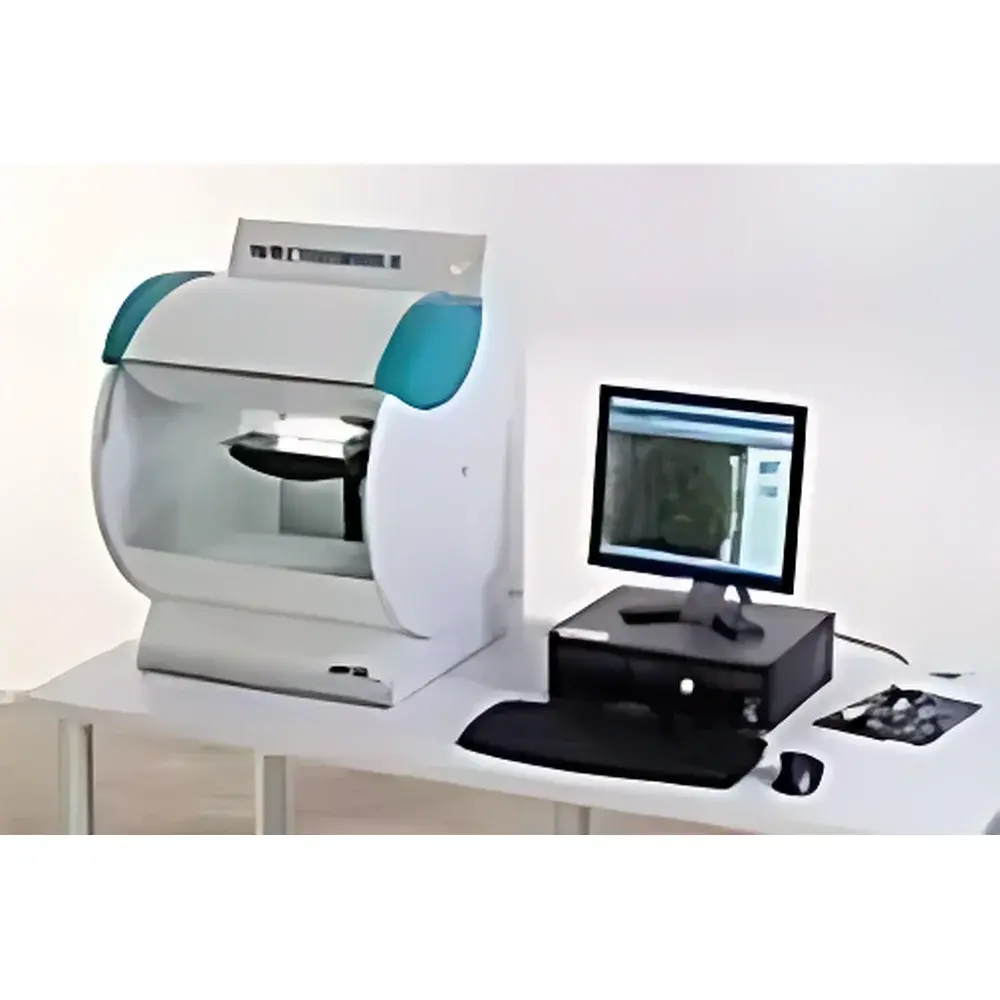
SPECTRO MIDEX Energy Dispersive X-Ray Fluorescence Micro-Analyzer
| Brand | SPECTRO |
|---|---|
| Origin | Germany |
| Model | MIDEX |
| Configuration | Benchtop / Floor-Standing |
| Excitation Source | Mo-target X-ray tube (max. 48 kV, 30 W) |
| Measurement Spot Size | 0.2–3.3 mm (optional collimator exchange) |
| Standard Spot | 0.7 mm (Midex SD) / 1.0 mm (Midex LD) |
| Detector | Peltier-cooled Si drift detector (SDD), 10 mm² (SD) / 30 mm² (LD) |
| Energy Resolution | FWHM < 160 eV at Mn Kα (10,000 cps) |
| Max. Count Rate | 250,000 cps |
| Sample Chamber Dimensions | 520 × 310 × 160 mm (L×W×H) |
| XYZ Motorized Stage | 240 × 178 × 160 mm travel, 3 kg max load |
| Operating Temp. | 5–30 °C |
| Relative Humidity | 10–80 % RH (non-condensing) |
| Power Supply | 95–240 V AC, 50/60 Hz, 200 W |
| Instrument Weight | 55–70 kg |
| Software | FP-based quantification (alloys, RoHS, halogen-free polymers), real-time spectral evaluation, spatial mapping, GLP-compliant reporting |
Overview
The SPECTRO MIDEX Energy Dispersive X-Ray Fluorescence (ED-XRF) Micro-Analyzer is a high-precision, non-destructive elemental analysis system engineered for micro-regional characterization of solid materials. Utilizing fundamental principles of X-ray fluorescence—where primary X-rays from a Mo-target tube excite characteristic secondary (fluorescent) X-rays from sample atoms—the instrument delivers quantitative and semi-quantitative composition data across the elemental range from sodium (Na, Z=11) to uranium (U, Z=92). Its core innovation lies in integrated micro-focusing optics, motorized XYZ stage control, and a high-resolution, high-throughput silicon drift detector (SDD), enabling spatially resolved analysis down to a 0.2 mm measurement spot. Designed for trace-level sensitivity and high reproducibility in constrained geometries, the MIDEX meets stringent requirements in regulated environments—including RoHS compliance verification, precious metal assay (e.g., Au in jewelry or dental alloys), and electronic component screening—without sample preparation or material removal.
Key Features
- Micro-focusing excitation optics with interchangeable collimators (0.2–3.3 mm spot size), enabling targeted analysis of sub-millimeter features such as solder joints, plating layers, or inclusion phases.
- Peltier-cooled Si drift detector (SDD) with active area options (10 mm² or 30 mm²), delivering <160 eV energy resolution at Mn Kα under standard counting conditions and sustained count rates up to 250,000 cps—eliminating reliance on liquid nitrogen while ensuring long-term thermal stability.
- Integrated 20× zoom optical camera with laser crosshair overlay for real-time visual alignment; measurement position confirmed via live CCD imaging and exportable screenshot annotation for audit-ready reporting.
- Motorized XYZ stage with 240 × 178 × 160 mm travel range and micrometer-level repeatability, supporting point analysis, line scans, and full-area elemental mapping of samples up to 300 × 200 × 150 mm (L×W×H).
- Broad-chamber design (520 × 310 × 160 mm) accommodating oversized PCBs (up to 2× EC standard size), irregular industrial parts, and multi-sample trays—without compromising beam collimation or detector geometry.
- Pre-calibrated, application-specific fundamental parameter (FP) algorithms validated against certified reference materials for alloys (including Au, Pt, Pd), RoHS-relevant elements (Pb, Cd, Hg, Cr, Br), and halogen-free polymer screening (Cl, Br).
Sample Compatibility & Compliance
The SPECTRO MIDEX supports heterogeneous solid samples—including metals, ceramics, polymers, coated substrates, and electronic assemblies—without dissolution, sectioning, or conductive coating. Its non-destructive nature preserves sample integrity for subsequent testing or archival. The system complies with ISO 17025 laboratory accreditation requirements for analytical instrumentation and supports audit trails aligned with FDA 21 CFR Part 11 when configured with appropriate software controls. Method validation documentation—including detection limits (e.g., <2 ppm for Pb in plastics), precision (RSD <1.5% for Au in 18K alloy), and accuracy against NIST SRMs—is provided per application module. It fulfills EN 62321-5:2014 for RoHS screening and ASTM E1621 for ED-XRF elemental analysis of metals.
Software & Data Management
Controlled via Windows-based SPECTRO XEPOS software, the MIDEX provides intuitive workflow navigation—from method selection and parameter optimization to automated report generation. Spectral acquisition, background subtraction, peak deconvolution, and matrix correction are performed in real time using physics-based FP models. Quantitative results include elemental weight percentages, K-gold values (for jewelry), and spatial distribution heatmaps. All raw spectra, acquisition metadata (voltage, current, live time, collimator ID), and operator logs are stored in a structured SQLite database. Export formats include CSV, PDF (with embedded measurement images), and XML for LIMS integration. Audit trail functionality records user actions, parameter changes, and calibration events with timestamps and digital signatures where enabled.
Applications
- Jewelry & Precious Metals: Rapid Au/Pt/Pd content verification in finished articles, hallmarking support, and karat determination with ±0.15% absolute accuracy on certified alloys.
- Electronics Manufacturing: Lead-free solder validation, plating thickness estimation (Ni, Sn, Ag), and contaminant screening (Br, Cl) in PCBs and connectors.
- Regulatory Compliance: RoHS, WEEE, and China RoHS enforcement testing for restricted substances in consumer goods and packaging materials.
- Recycling & Sorting: On-line identification of high-value scrap alloys (e.g., stainless steels, Ni-based superalloys) and segregation of halogen-containing plastics.
- Research & Failure Analysis: Corrosion product identification, intermetallic phase mapping, and thin-film composition profiling in R&D labs.
FAQ
What is the smallest measurable feature size?
The standard configuration achieves a 0.7 mm measurement spot; optional collimators allow reduction to 0.2 mm for high-resolution micro-analysis.
Does the system require liquid nitrogen cooling?
No—detector cooling is achieved exclusively via thermoelectric (Peltier) modules, ensuring continuous operation without cryogen handling or refills.
Can the MIDEX perform depth-profiling?
While not a true depth-profiling technique like SIMS or GDOES, variable voltage excitation (up to 48 kV) enables selective excitation of deeper atomic shells, providing limited stratigraphic insight in layered systems.
Is GLP/GMP compliance supported?
Yes—software-configurable user access levels, electronic signatures, and full audit trail logging meet GLP and GMP documentation requirements when deployed in regulated QC environments.
What sample types require no preparation?
Flat, homogeneous solids (metals, glass, ceramics) and rigid polymers may be analyzed directly; irregular or porous samples benefit from standardized holders or vacuum-assisted stabilization.







