
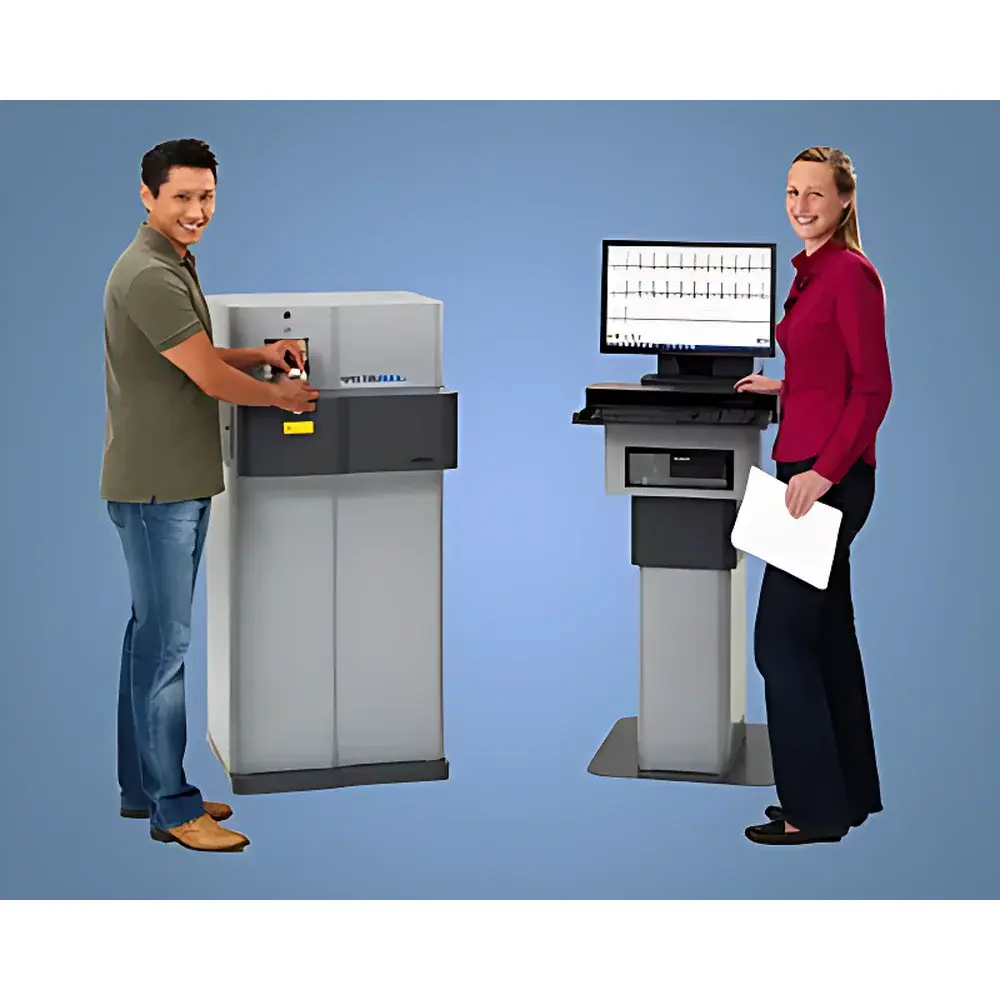
SPECTRO SPECTROMAXx Spark Optical Emission Spectrometer
| Brand | SPECTRO |
|---|---|
| Origin | Germany |
| Model | SPECTROMAXx |
| Instrument Type | Floor-standing |
| Excitation Source | Spark Discharge |
| Detector | Charge-Coupled Device (CCD) |
| Focal Length | 400 mm |
| Grating Groove Density | 3600 lines/mm |
| Wavelength Range | User-configurable |
| Number of Channels | User-configurable |
Overview
The SPECTRO SPECTROMAXx is a floor-standing spark optical emission spectrometer (OES) engineered for high-precision, routine elemental analysis of metallic alloys in foundries, metal production facilities, and quality control laboratories. Based on the principle of spark-induced plasma excitation and wavelength-dispersive detection, the instrument atomizes and excites solid metal samples under controlled argon atmosphere, generating element-specific atomic emission lines. These spectral lines are dispersed via a high-resolution Paschen–Runge optical layout and simultaneously detected across the full UV-VIS range (140–670 nm) using a sealed, temperature- and pressure-stabilized CCD-based readout system. As the fifth-generation evolution of SPECTRO’s most widely deployed OES platform, the SPECTROMAXx integrates robust mechanical architecture, intelligent calibration logic, and gas optimization strategies to deliver long-term analytical stability, minimal operational intervention, and compliance-ready data integrity.
Key Features
- Sealed, thermally and barometrically stabilized optical chamber pre-filled with high-purity argon—ensures consistent transmission in the far-UV region (down to 140 nm), critical for accurate quantification of C, P, S, and N.
- Paschen–Runge mount with 400 mm focal length and 3600 lines/mm holographic grating—delivers high spectral resolution and low stray light, enabling reliable separation of adjacent emission lines in complex matrices.
- Dual-optical-path design extends effective wavelength coverage to 140–670 nm without mechanical reconfiguration, supporting comprehensive multi-element analysis across Fe-, Al-, Cu-, Ni-, Co-, Ti-, Mg-, Zn-, Sn-, and Pb-based alloys.
- Intelligent Calibration (ICAL) 2.0—replaces conventional multi-standard recalibration with single-reference standardization, reducing daily setup time by ≥30 minutes while maintaining traceable accuracy per ISO/IEC 17025 requirements.
- Optimized spark stand with reduced internal volume and dynamic argon flow control—cuts argon consumption by up to 50% versus prior generations; “Zero-Argon Standby” mode fully shuts off gas during idle periods and initiates automatic purging upon restart.
- Tool-free optical lens replacement and modular sample clamping system—supports rapid maintenance and accommodates irregular, oversized, or miniature specimens (with optional micro-sample calibration packages).
- Full-spectrum acquisition architecture—records complete spectral data within user-defined ranges, enabling retrospective re-evaluation, interference correction, and method expansion without hardware modification.
Sample Compatibility & Compliance
The SPECTROMAXx accepts solid conductive metal samples conforming to ASTM E415, ISO 11577, and EN 10315 standards. Up to ten independent base-material calibrations (e.g., cast iron, aluminum die-cast, stainless steel, nickel superalloys) can be stored and recalled. Each calibration includes validated working curves for major, minor, and trace elements—including non-metals (C, S, P, N, B, O) at sub-100 ppm levels—verified against certified reference materials (CRMs) traceable to NIST, BAM, or IRMM. The system supports GLP/GMP-aligned operation through audit-trail-enabled software, electronic signatures, and configurable user access levels compliant with FDA 21 CFR Part 11.
Software & Data Management
SPECTRO’s proprietary Spark Analyzer software provides intuitive method creation, real-time spectral visualization, automated drift correction, and statistical process control (SPC) reporting. All raw spectra, calibration logs, QC results, and instrument status events are timestamped and stored in an encrypted relational database. Export formats include CSV, XML, and ASTM E1382-compliant ASCII for LIMS integration. Remote diagnostics, firmware updates, and method validation reports are generated directly from the software interface—no third-party tools required.
Applications
- Routine grade identification and scrap sorting in recycling centers
- In-process verification of melt composition in primary and secondary metal production
- Final product certification for automotive, aerospace, and energy-sector components
- Failure analysis and inclusion characterization in metallurgical laboratories
- Supplier qualification and incoming material inspection per AS9100, IATF 16949, or ISO 9001 requirements
FAQ
What is the typical detection limit for carbon in low-alloy steel using the SPECTROMAXx?
Detection limits are matrix- and condition-dependent; for C in Fe-based alloys under optimized spark parameters and extended integration times, typical values range from 10–30 ppm (3σ).
Can the instrument be upgraded to support additional elements or base materials after installation?
Yes—new calibrations and spectral channels can be added via software license and CRM-based validation without hardware modification.
Is remote support and software update capability available?
Yes—SPECTRO offers secure remote access for troubleshooting, performance optimization, and version-controlled software/firmware deployment.
How does the ICAL system ensure long-term measurement stability?
ICAL continuously monitors reference line intensities and applies physics-based correction factors to compensate for source drift, detector aging, and environmental fluctuations—maintaining calibration validity over weeks without manual intervention.
Does the system comply with regulatory requirements for auditable analytical records?
Yes—the software enforces ALCOA+ principles (Attributable, Legible, Contemporaneous, Original, Accurate, Complete, Consistent, Enduring, Available) and supports full 21 CFR Part 11 compliance when configured with appropriate IT infrastructure and procedural controls.
Related Products




