
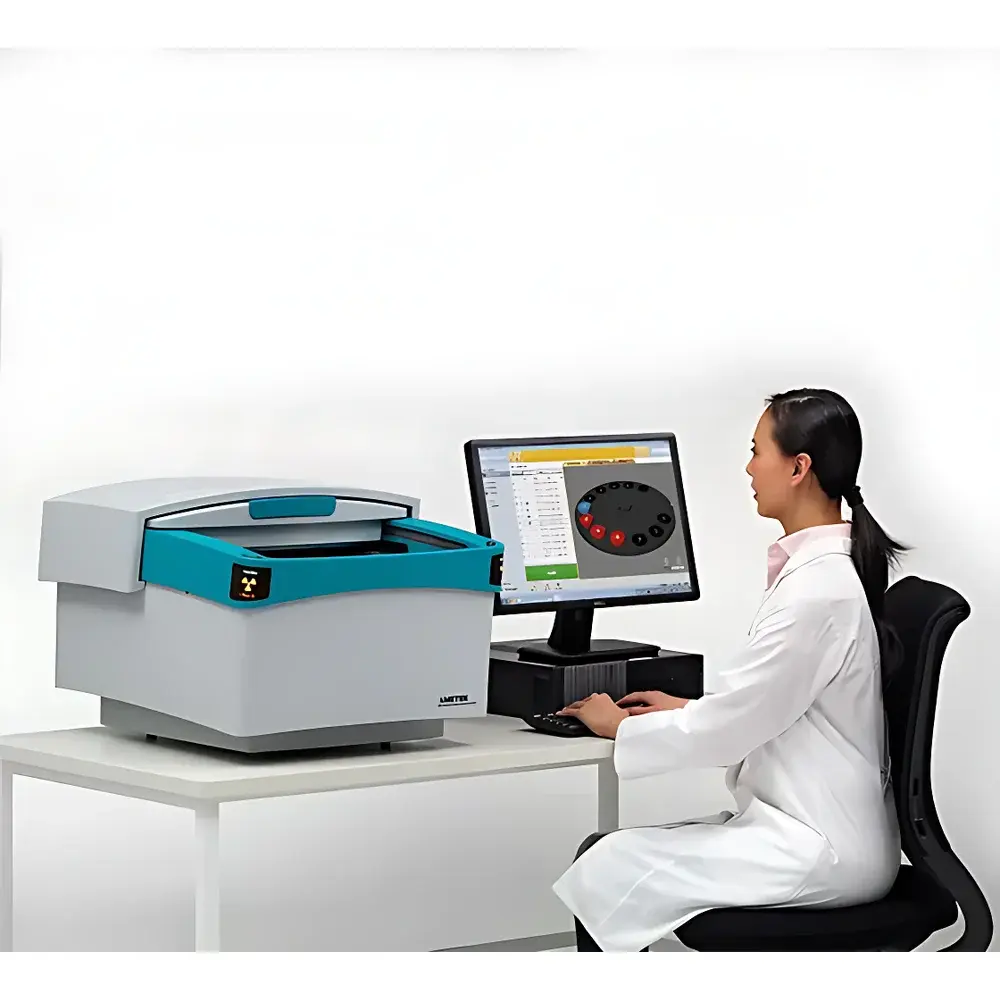
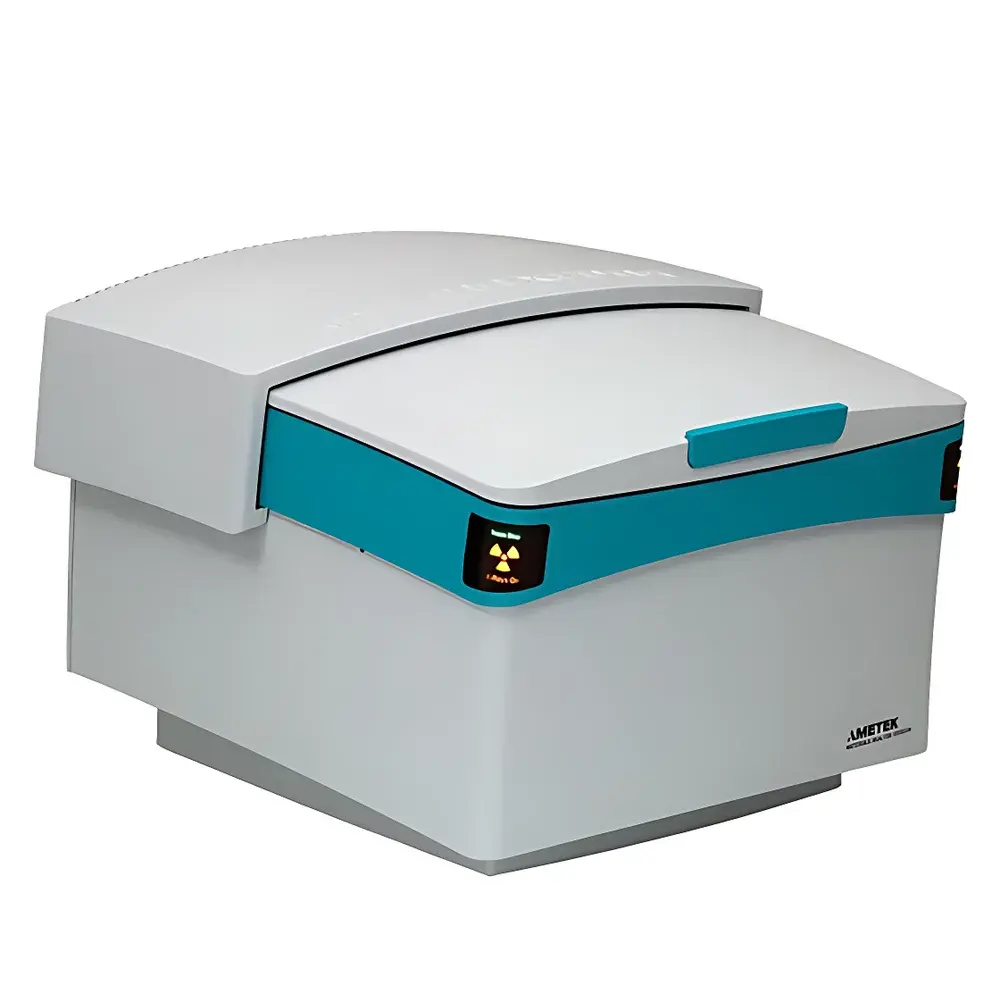
SPECTRO XEPOS Polarized Energy Dispersive X-Ray Fluorescence Spectrometer
| Brand | SPECTRO |
|---|---|
| Origin | Germany |
| Model | SPECTRO XEPOS |
| Configuration | Benchtop/Floor-standing |
| Application Scope | Universal |
| Elemental Range | Na to U (11–92) |
| Quantification Range | 0.1 ppm – 100 wt% |
| Energy Resolution | <130 eV (Mn Kα) |
| Detector | High-resolution Peltier-cooled Silicon Drift Detector (SDD) |
| Maximum Count Rate | 1,000,000 cps |
| Coating Analysis | Up to 8 layers, down to 1 nm thickness, 55 elements supported |
| Software Platform | Windows-based SPECTRO XRF Suite with TURBOQUANT, FP, Compton Normalization, Lucas-Tooth, α-empirical, MAC, and Average Atomic Number correction models |
Overview
The SPECTRO XEPOS Polarized Energy Dispersive X-Ray Fluorescence (ED-XRF) Spectrometer represents a paradigm shift in benchtop elemental analysis. Engineered for precision, reproducibility, and operational flexibility, it leverages polarized primary beam excitation—a fundamental advancement over conventional ED-XRF—enabling ultra-low background spectra and superior peak-to-background ratios. This architecture is based on monochromatic secondary excitation using polarized X-rays generated via Bragg reflection from high-purity crystal optics, minimizing scattered radiation and enhancing signal fidelity across the full analytical range (Na–U). Unlike traditional tube-based excitation systems, the SPECTRO XEPOS employs a dual-anode Pd/Co X-ray source combined with dynamically switchable excitation paths, allowing optimal excitation energy selection per element group—critical for achieving sub-ppm detection limits without matrix-dependent calibration drift. Its design complies with ISO 21043 (XRF performance verification), ASTM E1621 (standard guide for ED-XRF), and supports traceability under GLP/GMP frameworks through full audit trail logging.
Key Features
- Polarized excitation geometry delivering lowest instrumental background in commercial ED-XRF—directly improving minimum detection limits (MDLs) by up to 3× compared to non-polarized systems.
- Dual-target (Pd/Co) X-ray tube with programmable excitation path selection, enabling optimized sensitivity across light (Na–Ca), mid-Z (Ti–Zr), and heavy elements (Sn–U).
- Peltier-cooled Silicon Drift Detector (SDD) with <130 eV Mn Kα resolution at 0°C and sustained 1,000,000 cps throughput—eliminating liquid nitrogen dependency while maintaining spectral integrity under high-flux conditions.
- Integrated coating analysis module supporting quantitative depth profiling of up to eight discrete layers with thickness resolution down to 1 nm; validated for Au, Ag, Ni, Cr, Zn, Sn, Pb, and other electroplated or PVD/CVD coatings.
- Multi-model quantification engine including Fundamental Parameters (FP), Compton-normalized FP, Lucas-Tooth matrix correction, α-empirical coefficient method, mass absorption coefficient (MAC)-based corrections, and average atomic number approaches—all selectable per application or sample class.
- Hardware-level spectral stabilization via real-time detector temperature control and pulse processing electronics calibrated to NIST-traceable reference sources.
Sample Compatibility & Compliance
The SPECTRO XEPOS accommodates solid, powdered, pressed pellet, fused bead, and liquid samples (in sealed cells) with automated sample positioning and optional vacuum/helium purge for light-element enhancement (F–Na). It meets IEC 61000-6-3 (EMC emissions) and IEC 61000-6-2 (immunity), and conforms to RoHS Directive 2011/65/EU Annex II substance screening protocols. All software workflows support 21 CFR Part 11-compliant electronic signatures, audit trails, and user role-based access control (Level 1–4 password hierarchy). Method validation documentation aligns with ISO/IEC 17025 requirements for accredited testing laboratories.
Software & Data Management
Controlled by the SPECTRO XRF Suite v5.x (Windows 10/11 64-bit), the system provides intuitive workflow-driven operation—from rapid TURBOQUANT semi-quantitative survey (using >40 certified reference materials embedded in its calibration library) to fully validated quantitative methods. Spectral deconvolution employs iterative least-squares fitting with interference correction for overlapping peaks (e.g., S Kα/Pb Mα, As Kα/Pb Lα). Data export supports ASTM E1343-compliant .csv, .xlsx, and .trc formats; raw spectra are stored in vendor-neutral .spc format. Full instrument diagnostics, detector health monitoring, and automatic recalibration prompts ensure long-term measurement stability.
Applications
The SPECTRO XEPOS serves as a primary analytical platform in quality assurance laboratories across metallurgy (alloy grade verification, inclusion analysis), electronics (PCB solder composition, plating bath control), environmental testing (soil heavy metal screening per EPA Method 6200), geosciences (multi-element rock geochemistry), recycling (WEEE/ELV sorting), and academic research (nanomaterial characterization, catalyst composition mapping). Its ability to quantify both major constituents (>1 wt%) and trace contaminants (<1 ppm) within a single acquisition makes it ideal for regulatory compliance workflows requiring multi-tier reporting thresholds.
FAQ
Does the SPECTRO XEPOS require liquid nitrogen cooling?
No—it uses a thermoelectrically cooled SDD detector, eliminating cryogenic infrastructure and associated maintenance.
Can it analyze light elements such as sodium or magnesium reliably?
Yes, when operated under vacuum or helium purge mode, with optimized excitation and detector window selection.
Is TURBOQUANT suitable for regulatory reporting?
TURBOQUANT is intended for rapid screening and method development; final compliance reporting requires fully validated FP or empirical calibrations.
How many calibration standards are needed for a custom quantitative method?
Minimum of three matrix-matched standards are recommended for robust FP-based quantification; more are required for complex multi-phase or heterogeneous samples.
What safety certifications does the instrument hold?
CE marking per EU Machinery Directive 2006/42/EC and Radiation Protection Directive 2013/59/Euratom; full interlock and beam-shutter compliance verified per IEC 62495.




