
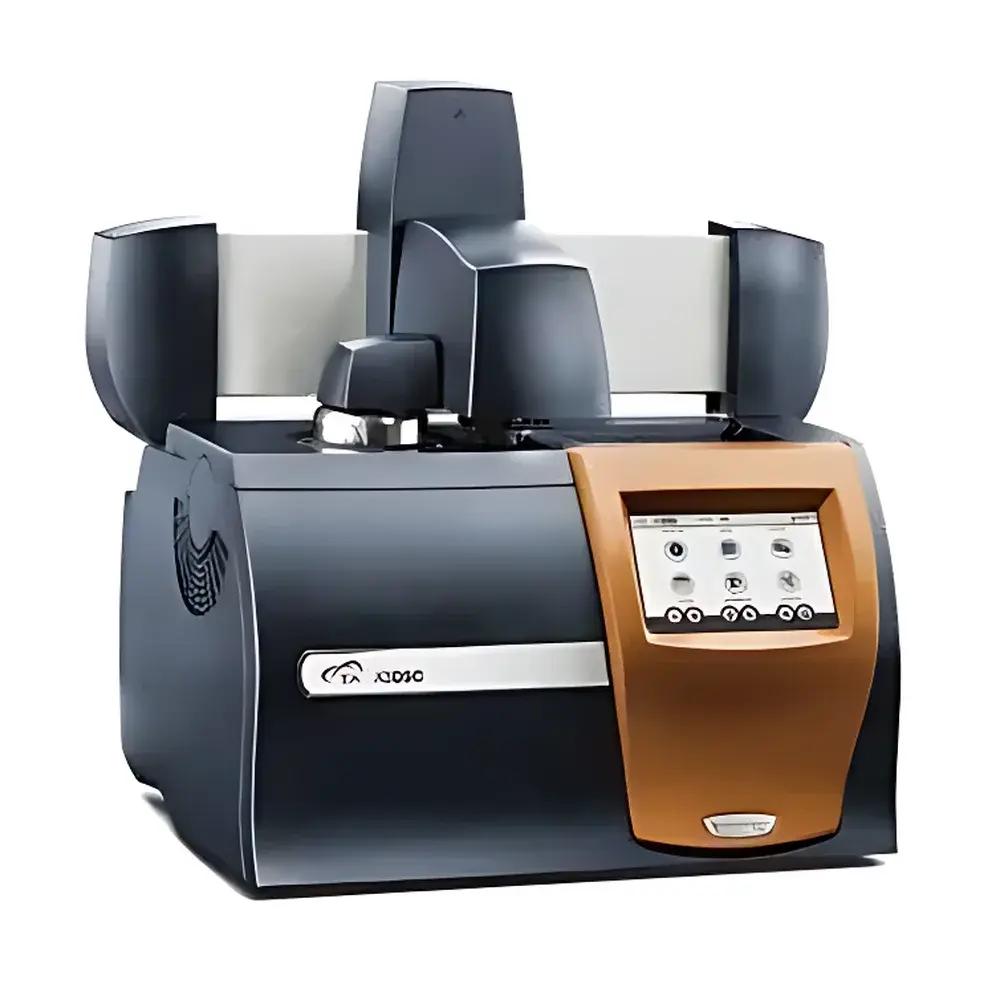
TA Instruments Discovery X3 Differential Scanning Calorimeter
| Brand | TA Instruments |
|---|---|
| Origin | USA |
| Model | Discovery X3 DSC |
| Sample Capacity | Up to 3 simultaneous samples |
| Instrument Type | Heat-Flow DSC |
| Temperature Range | –180 °C to 550 °C |
| Temperature Accuracy | ±0.025 °C |
Overview
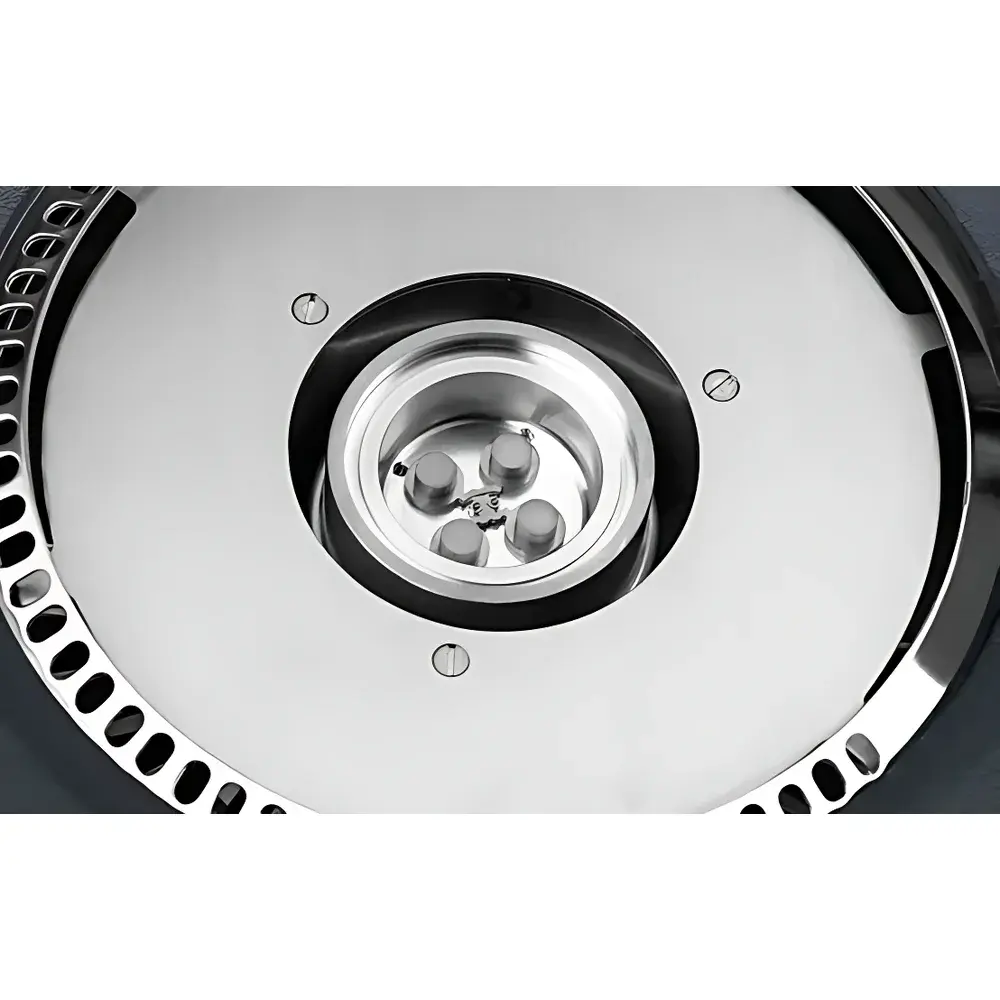
The TA Instruments Discovery X3 Differential Scanning Calorimeter is an advanced, multi-sample heat-flow DSC engineered for precision thermal characterization across academic research, pharmaceutical development, polymer science, and quality control laboratories. Based on the fundamental principle of measuring differential heat flow between a sample and inert reference as both are subjected to identical, controlled temperature programs, the X3 delivers high-fidelity thermodynamic data—including glass transitions (Tg), melting points (Tm), crystallization onset, enthalpy of fusion (ΔHfus), specific heat capacity (Cp), and oxidative induction time (OIT). Its integrated Fusion Cell™ calorimetric sensor—designed using patented dual-sensor architecture—ensures exceptional baseline flatness, signal-to-noise ratio, and thermal resolution, enabling reliable detection of weak transitions down to sub-millijoule energy levels. The instrument operates within a certified temperature range of –180 °C to 550 °C, supported by high-stability platinum resistance thermometry and active furnace temperature control with real-time feedback compensation.
Key Features
- Fusion Cell™ calorimeter: Proprietary dual-sensor design delivering industry-leading baseline stability (<0.01 µW drift over 60 min), sensitivity (<0.02 µW), and reproducibility (RSD < 0.2% for ΔHfus of indium).
- X3 Enhanced Tzero™ technology: Simultaneously corrects for thermal lag and heat capacity effects across all three sample positions—ensuring traceable temperature accuracy (±0.025 °C) and quantitative enthalpy accuracy (±0.1%) without manual calibration per run.
- Triple-sample capability: Independent, identically conditioned measurement zones enable statistically robust replicate analysis, reference-standard verification, or parallel screening of formulation variants under identical thermal history.
- Modulated DSC™ (MDSC®): Separates reversing (e.g., Tg, Cp) and non-reversing (e.g., cold crystallization, decomposition) thermal events via periodic temperature modulation—critical for complex amorphous systems and curing kinetics studies.
- 54-position linear autosampler: Precision-engineered stainless-steel carousel with programmable tray mapping, automated lid actuation, and motorized sample insertion—validated for unattended operation over 72+ hours.
- Mechanical refrigeration option: Integrated single-stage Stirling cooler eliminates liquid nitrogen dependency while maintaining stable sub-ambient operation down to –180 °C—ideal for extended auto-sampling sequences requiring cryogenic stability.
- Tzero™ sample preparation system: Includes standardized aluminum pans, hermetic crimping tools, and pressure-controlled Tzero™ press—ensuring consistent sample mass, geometry, and thermal contact for inter-laboratory comparability.
Sample Compatibility & Compliance
The Discovery X3 accommodates standard 40 µL aluminum, gold-plated aluminum, and high-pressure stainless-steel crucibles—compatible with solids, powders, films, gels, and viscous liquids. All hardware and firmware comply with ISO 11357-1–7, ASTM E794, E1269, E1965, and USP <1163> for thermal analysis validation. Data acquisition and processing meet FDA 21 CFR Part 11 requirements when operated with TRIOS software in audit-trail-enabled mode—including electronic signatures, user access controls, and immutable method/data archiving. Full GLP/GMP documentation packages—including IQ/OQ/PQ protocols, calibration certificates, and uncertainty budgets—are available upon request.
Software & Data Management
TRIOS software serves as the unified platform for instrument control, real-time data visualization, advanced curve fitting (e.g., kinetic modeling via ASTM E698 or Friedman analysis), and automated reporting. Key capabilities include: one-click method templating with parameter inheritance; live baseline correction during acquisition; embedded Cp calibration routines using sapphire and synthetic ruby standards; customizable report generation compliant with internal SOPs or regulatory submission formats (PDF, CSV, XML); and secure networked deployment supporting multi-user role-based permissions. All raw data files (.dsc) are stored in open binary format with metadata headers—including instrument ID, operator, timestamp, calibration history, and environmental logs—for full traceability.
Applications
- Pharmaceutical solid-state characterization: Polymorph screening, hydrate/anhydrate stability, excipient compatibility, and amorphous content quantification via step-change Cp.
- Polymers & composites: Crystallinity determination, crosslink density estimation, thermal aging behavior, and nanofiller dispersion effects on Tg.
- Battery materials: Solid-electrolyte interphase (SEI) formation enthalpy, cathode thermal runaway onset, and electrolyte decomposition pathways.
- Food science: Fat crystallization kinetics, starch gelatinization profiles, and moisture-induced phase transitions.
- Metals & alloys: Precipitation heat treatment optimization, eutectic melting verification, and residual stress relaxation analysis.
FAQ
What is the maximum number of samples that can be loaded and analyzed unattended?
Up to 54 samples using the linear autosampler—with up to three samples actively measured in parallel per thermal cycle.
Does the Discovery X3 support Cp measurement without external calibration standards?
Yes—via built-in Tzero™ Cp calibration using pre-characterized sapphire reference, traceable to NIST SRM 720.
Can MDSC® data be reprocessed to extract reversing/non-reversing components after acquisition?
Yes—TRIOS software allows retrospective Fourier deconvolution of raw MDSC® data without re-running experiments.
Is mechanical refrigeration compatible with all temperature ranges, including –180 °C?
The optional Stirling cooler achieves stable operation from –180 °C to 150 °C; above 150 °C, resistive heating remains active with seamless transition.
What warranty coverage applies to the calorimeter sensor and furnace assembly?
TA Instruments provides a limited 5-year warranty on the Fusion Cell™ sensor and furnace core—covering material defects and performance degradation under normal laboratory use.



