
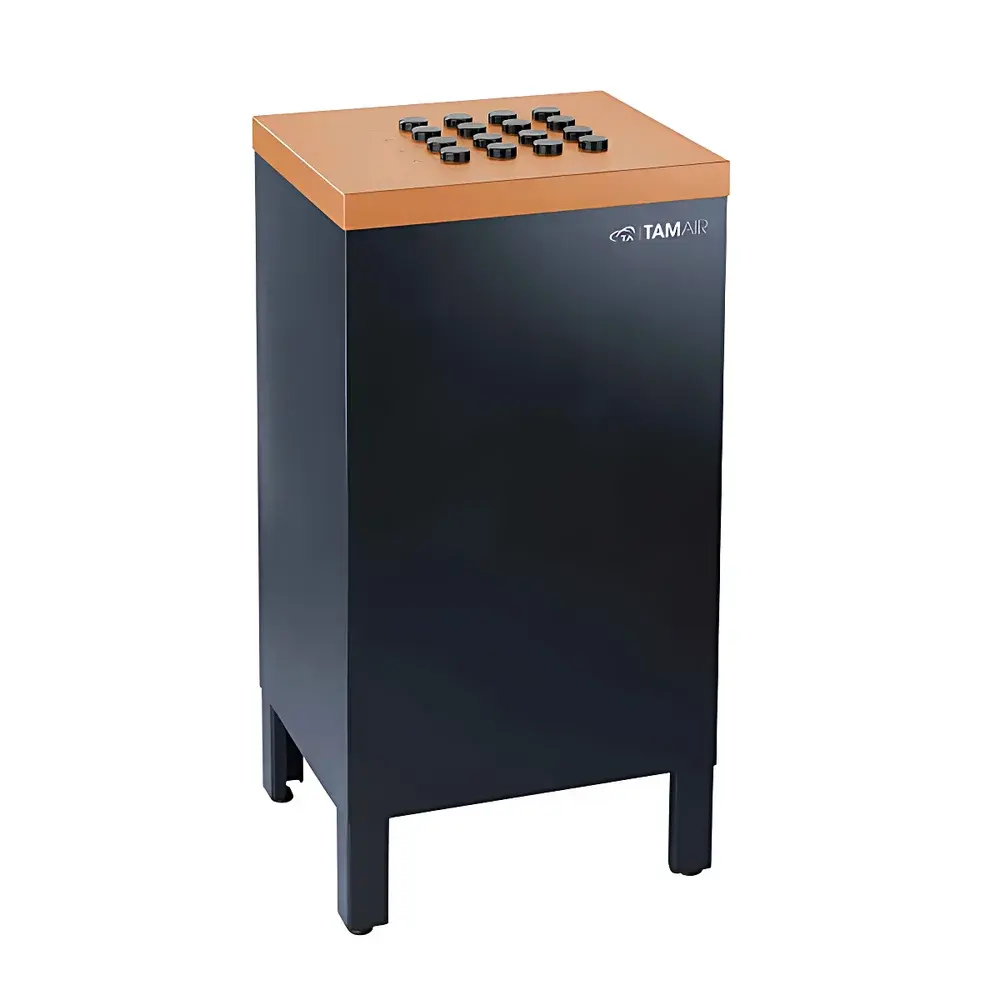
TA Instruments TAM Air Isothermal Microcalorimeter
| Brand | TA Instruments |
|---|---|
| Origin | USA |
| Model | TAM Air |
| Temperature Range | 5°C to 90°C |
Overview
The TA Instruments TAM Air Isothermal Microcalorimeter is an engineered solution for high-sensitivity, long-term heat flow measurement under precisely controlled isothermal conditions. Unlike differential scanning calorimeters (DSC) that operate under dynamic temperature ramps, the TAM Air employs thermopile-based detection to quantify minute heat fluxes (down to 1 µW) from chemical or physical processes—including cement hydration, polymer curing, protein folding, and battery electrode reactions—at constant temperature. Its core principle relies on null-balance isothermal microcalorimetry: the sample and reference cells are maintained at identical setpoints via independent Peltier elements, and any deviation in thermal output is compensated by feedback-controlled heating/cooling, enabling direct quantification of heat flow with exceptional baseline stability and low drift over days or weeks. This makes it uniquely suited for studying slow, exothermic processes such as Portland cement hydration kinetics—where heat evolution spans hours to months—and aligns with ASTM C1702 for isothermal conduction calorimetry of hydraulic cement.
Key Features
- High-resolution isothermal operation across a wide, stable temperature range (5°C to 90°C), programmable in 0.01°C increments for precise process simulation (e.g., ambient curing, accelerated warm-ageing, or low-temperature setting scenarios)
- Thermopile sensor architecture delivering sub-microwatt sensitivity (typical noise level 99.5% thermal coupling efficiency between sample vial and detector
- Multi-channel capability: up to 8 parallel channels (depending on configuration), each independently controlled, enabling comparative studies of admixture effects, slag/limestone filler substitutions, or multi-blend formulations
- Robust mechanical design with active vibration damping and electromagnetic shielding to ensure signal integrity in standard laboratory environments—no dedicated seismic isolation required
- Integrated environmental monitoring: real-time logging of chamber humidity and ambient pressure to support data contextualization per ASTM C1702 Annex A3 guidelines
Sample Compatibility & Compliance
The TAM Air accommodates a broad spectrum of sample formats relevant to construction materials science: paste (cement + water), mortar (paste + sand), and concrete (paste + aggregate), with standard vial volumes ranging from 1 mL to 20 mL. Its open-vial geometry allows direct testing of fresh, unsealed mixtures—critical for capturing early-age hydration without artificial confinement artifacts. The system complies with ASTM C1702–22 “Standard Test Method for Measuring Heat of Hydration of Hydraulic Cementitious Materials Using Isothermal Conduction Calorimetry”, and supports traceable calibration per NIST-traceable standards (e.g., KCl dissolution). Data acquisition and reporting workflows are compatible with GLP/GMP-aligned environments; audit trails, user access control, and electronic signature support can be enabled via optional software modules compliant with FDA 21 CFR Part 11 requirements.
Software & Data Management
TAM Assistant Software provides full instrument control, real-time visualization, and advanced kinetic analysis. Raw heat flow (µW) and cumulative heat (J/g) are exported in ASCII or Excel-compatible formats. Built-in models include the Avrami equation for nucleation-growth fitting, modified Borchardt–Daniels analysis for activation energy estimation, and time–temperature–transformation (TTT) mapping. All data files contain embedded metadata (operator ID, calibration timestamp, vial ID, ambient conditions), ensuring FAIR (Findable, Accessible, Interoperable, Reusable) principles. Backups are automated to network drives or cloud storage (AWS S3 or Azure Blob), and raw datasets retain native binary integrity for retrospective reprocessing.
Applications
- Quantitative assessment of cement hydration kinetics: induction period duration, acceleration peak magnitude/timing, deceleration slope, and dormant phase heat evolution
- Evaluation of supplementary cementitious materials (SCMs)—fly ash, slag, silica fume—on reaction onset and synergy with clinker phases
- Admixture screening: impact of retarders, accelerators, and superplasticizers on heat evolution profiles and setting behavior
- Prediction of early-age autogenous shrinkage and thermal cracking risk via integrated heat–strain correlation protocols
- Long-term durability studies: sulfate attack, alkali–silica reaction (ASR), and carbonation progression monitored through secondary exothermic signatures
FAQ
What sample volume is recommended for cement paste testing?
For optimal signal-to-noise ratio and thermal equilibration, 5–10 mL of well-mixed paste (water-to-cement ratio = 0.40–0.50) is standard; smaller volumes (<2 mL) may be used for screening but require extended baseline stabilization.
Can TAM Air measure heat flow from sealed concrete specimens?
Yes—custom-sealed vials with gas-permeable membranes or pressure-compensated lids are available for long-term concrete testing while preventing moisture loss and accommodating expansion.
How does TAM Air differ from conventional DSC in cement analysis?
DSC measures enthalpy changes during temperature sweeps and is unsuitable for slow, low-power hydration events; TAM Air operates isothermally with microcalorimetric sensitivity, capturing kinetics over hours to weeks at engineering-relevant temperatures.
Is calibration traceable to national standards?
Yes—electrical calibration uses NIST-traceable joule heating, and chemical validation employs certified KCl dissolution enthalpy standards per ASTM E698.
Does the system support remote monitoring and alarm notifications?
Yes—via TAM Assistant’s web interface and optional SNMP integration, users receive email/SMS alerts for temperature deviation, vial lid lift, or power interruption events.



