
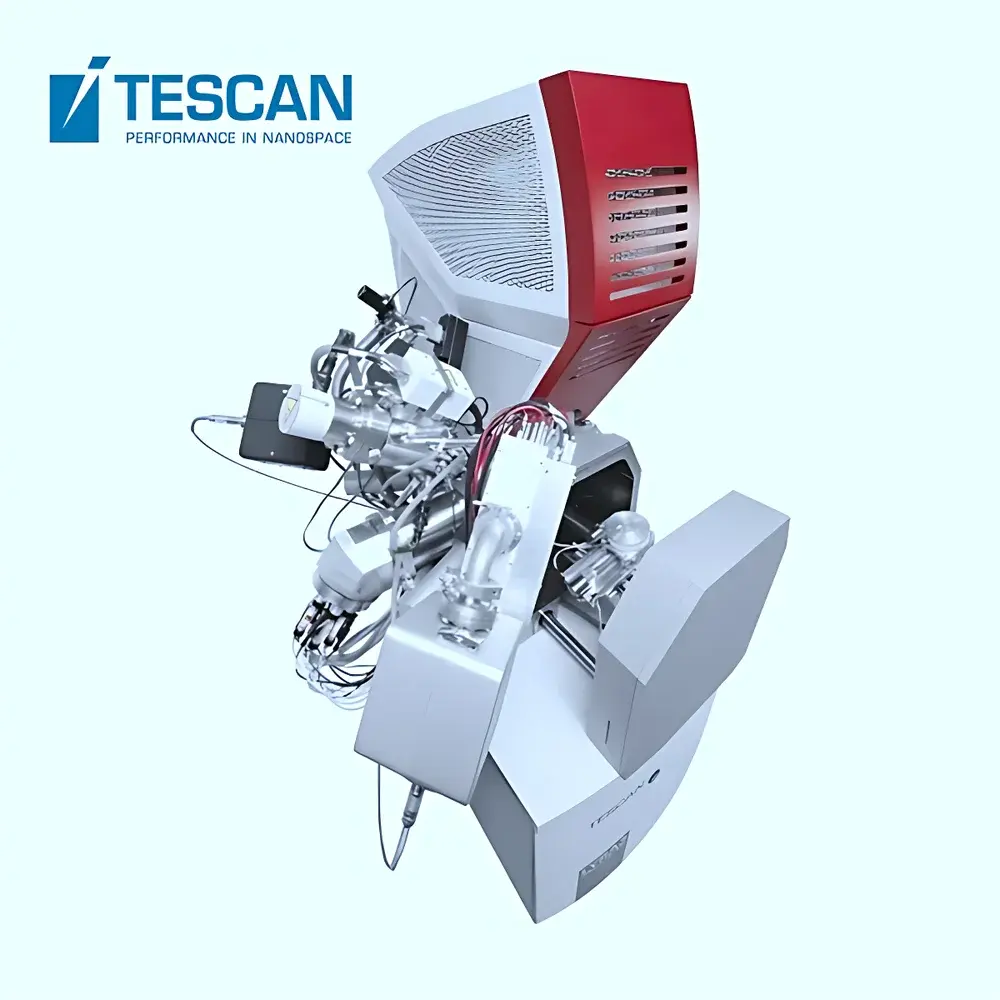
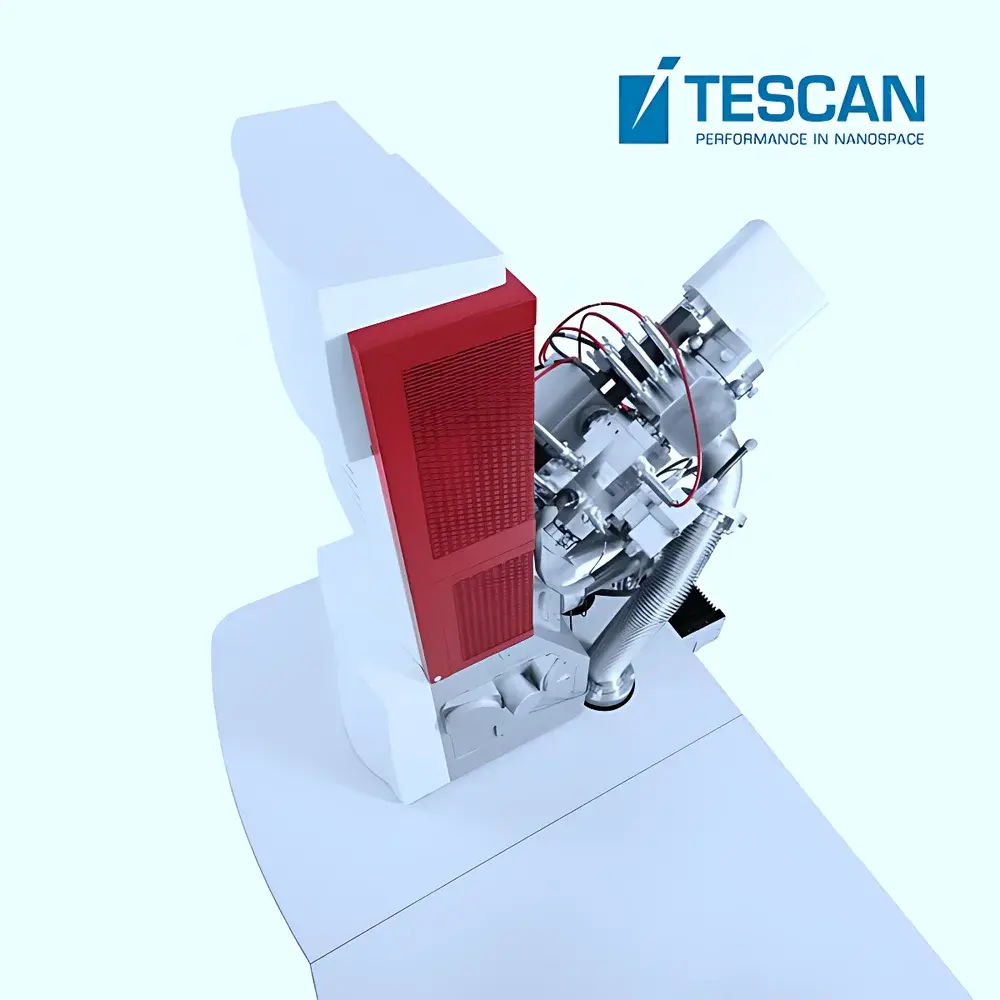
TESCAN FIB-SEM-TOF-SIMS Integrated Multimodal Analytical Platform
| Brand | TESCAN |
|---|---|
| Origin | Czech Republic |
| Manufacturer Type | Original Equipment Manufacturer (OEM) |
| Origin Category | Imported Instrument |
| Model | FIB-SEM-TOF-SIMS |
| Price Range | USD 1.3M–2.6M (FOB Europe) |
| Mass Analyzer Type | Time-of-Flight (TOF) |
| Primary Ion Beam Energy | 30 kV |
| Mass Range | 1–2500 Da |
| Mass Resolution (M/ΔM) | >800 (at 10% valley definition) |
Overview
The TESCAN FIB-SEM-TOF-SIMS Integrated Multimodal Analytical Platform is a high-precision, correlative instrumentation system engineered for nanoscale 3D chemical and molecular characterization of solid-state materials. It unifies three complementary analytical modalities—focused ion beam (FIB) milling, scanning electron microscopy (SEM), and time-of-flight secondary ion mass spectrometry (TOF-SIMS)—within a single ultra-high vacuum (UHV) chamber architecture. This integration enables synchronized structural imaging, topographic mapping, and quantitative surface/subsurface molecular speciation with sub-40 nm lateral resolution and <15 nm depth resolution. Unlike conventional energy-dispersive X-ray spectroscopy (EDS) or wavelength-dispersive spectroscopy (WDS), TOF-SIMS operates on the principle of pulsed primary ion bombardment (e.g., Bi+, Ga+, or C60+) to sputter secondary ions from the top 1–3 monolayers of a sample; these ions are accelerated into a field-free drift tube where mass separation is achieved via time-of-flight discrimination. The resulting mass spectra provide isotopic fidelity, elemental quantification (ppm-level detection for Li, Be, B), and molecular fragment identification—including intact organic species and inorganic clusters—without requiring matrix-assisted enhancement.
Key Features
- Co-registered FIB-SEM-TOF-SIMS operation within a shared UHV environment (<1×10⁻⁹ mbar base pressure), eliminating sample transfer artifacts and enabling true in situ depth profiling.
- High-brightness liquid metal ion source (LMIS) delivering stable 30 kV primary ion beams with spot sizes down to 7 nm for precision FIB sectioning and SIMS analysis.
- Reflectron-based TOF mass analyzer with >800 mass resolution (M/ΔM, 10% valley definition) across the full 1–2500 Da range, supporting isotopic separation (e.g., 235U/238U, 12C/13C).
- Dual-polarity detection (positive/negative mode) with parallel acquisition of elemental, cluster, and molecular secondary ions—critical for redox-sensitive or low-ionization-potential species.
- Automated coordinate referencing system ensuring sub-micron positional repeatability between SEM imaging, FIB milling, and SIMS rastering—essential for multi-instrument correlation in failure analysis and device metrology.
- Integrated high-sensitivity microchannel plate (MCP) detector with delay-line anode for time-resolved ion counting and pixel-by-pixel spectral reconstruction.
Sample Compatibility & Compliance
The platform accommodates conductive and non-conductive solid samples up to 50 mm in diameter, including battery cathodes/anodes, semiconductor heterostructures, geological thin sections, metallurgical cross-sections, and cryo-fixed biological tissues (when prepared under controlled UHV conditions). All hardware and software modules comply with ISO/IEC 17025:2017 requirements for testing laboratories, and data acquisition workflows support audit trails aligned with FDA 21 CFR Part 11 for regulated environments. Instrument control firmware and spectral processing algorithms are validated per ASTM E1817–22 (Standard Practice for TOF-SIMS Depth Profiling) and ISO 18115-2:2013 (Surface Chemical Analysis — Vocabulary — Part 2: Terms Used in Secondary Ion Mass Spectrometry).
Software & Data Management
TESCAN’s Unified Platform Software (UPS) provides a single GUI for instrument orchestration, real-time spectral visualization, and multidimensional data fusion. Raw TOF-SIMS datasets (including transient ion signals, mass spectra, and hyperspectral images) are stored in vendor-neutral HDF5 format with embedded metadata (beam parameters, vacuum status, stage coordinates). Quantitative analysis leverages internal standard calibration and relative sensitivity factor (RSF) libraries traceable to NIST SRM standards. Advanced post-processing includes multivariate statistical analysis (PCA, MCR-ALS), 3D volume reconstruction from sequential FIB-SIMS slices, and overlay registration with SEM backscattered electron (BSE) and secondary electron (SE) maps. Data export supports ASCII, mzML, and IMS formats for interoperability with third-party chemometric tools (e.g., MATLAB, Python scikit-learn, OpenMS).
Applications
- 3D compositional mapping of Li-ion battery electrodes: spatially resolved quantification of Li+, transition metals, and SEI components at grain boundaries and particle interfaces.
- Nanoscale dopant profiling in III-V semiconductors: depth-resolved detection of In incorporation gradients in GaN layers as thin as 2.5 nm, with isotopic distinction of 115In/113In.
- Grain boundary segregation analysis in Ni-based superalloys: ppm-level detection of B, P, and S enrichment at intergranular fracture sites correlated with EBSD crystallographic orientation maps.
- Uranium isotope ratio imaging in nuclear forensics: rapid, high-fidelity 235U/238U distribution mapping without chemical dissolution or TIMS sample preparation.
- Molecular layer characterization of organic photovoltaic devices: identification of donor/acceptor phase separation, interfacial degradation products, and vertical composition gradients in bulk heterojunction films.
FAQ
What vacuum level is required for optimal TOF-SIMS performance?
The system maintains a base pressure ≤1×10⁻⁹ mbar in the analysis chamber during SIMS acquisition to minimize background hydrocarbon interference and ensure secondary ion transmission stability.
Can the system perform simultaneous SEM imaging and TOF-SIMS analysis?
Yes—real-time SEM monitoring is fully compatible with pulsed TOF-SIMS acquisition; beam blanking and detector gating are synchronized to prevent signal crosstalk while preserving spatial registration.
Is cryogenic sample handling supported?
Optional cryo-transfer and in-chamber cooling stages (down to 100 K) are available for volatile or beam-sensitive materials, including hydrated polymers and frozen-hydrated biological specimens.
How is quantitative accuracy ensured across different sample matrices?
Quantification relies on matrix-matched reference standards, RSF databases calibrated against certified reference materials (CRMs), and iterative peak fitting using isotopic natural abundance constraints.
What maintenance protocols are recommended for long-term mass resolution stability?
Daily pump-down verification, quarterly reflectron voltage calibration, and annual MCP gain validation against Au+/Au− reference peaks are documented in the TESCAN Preventive Maintenance Manual (PMM-TOF-03).
Related Products




