
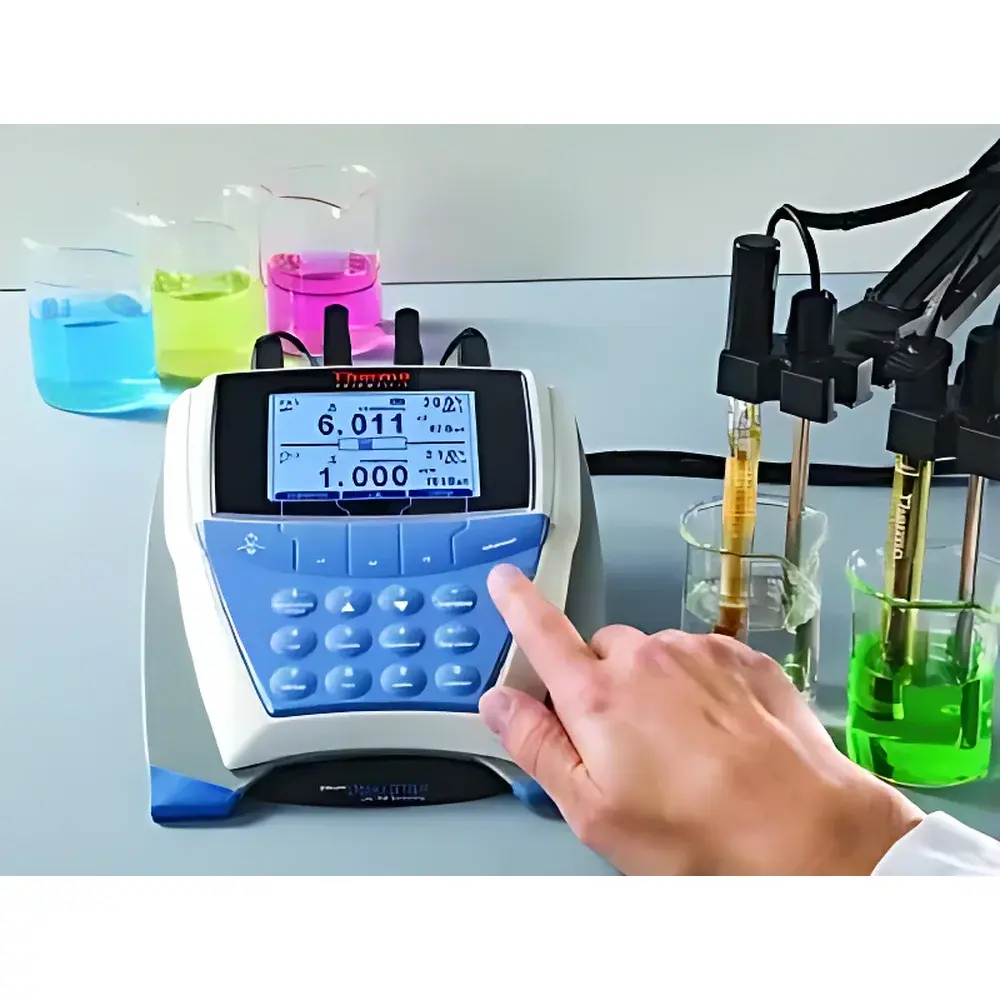
Thermo Fisher Orion Dual Star D10P-16 Silver Ion Analyzer
| Brand | Thermo Fisher |
|---|---|
| Origin | USA |
| Manufacturer | Thermo Fisher Scientific |
| Product Category | Imported Instrument |
| Model | D10P-16 |
| Pricing | Upon Request |
| Electrode | 9616BNWP Ag⁺/S²⁻ Combination Electrode |
| Measurement Range (Ag⁺) | 0.003–32,100 ppm |
| pH Range | 2–12 |
| Temperature Range | 0–80°C (continuous), 80–100°C (intermittent) |
| Reproducibility | ±2% for Ag⁺, ±4% for S²⁻ |
| Electrode Dimensions | 110 mm length, 13 mm body diameter, 16 mm cap diameter, 1 m cable |
| Main Unit | Dual-channel pH/Ion Meter with GLP compliance, RS232 & USB connectivity, IP54 rating, 1000-data storage, 20 method memories |
Overview
The Thermo Fisher Orion Dual Star D10P-16 Silver Ion Analyzer is a high-precision, dual-channel potentiometric measurement system engineered for trace-level quantification of silver ions (Ag⁺) and sulfide ions (S²⁻) in aqueous environmental and industrial samples. It operates on the principle of ion-selective electrode (ISE) potentiometry—measuring the potential difference between a selective sensing membrane (Ag₂S-based for the 9616BNWP electrode) and a stable reference system, which correlates logarithmically to the activity of target ions per the Nernst equation. Due to the extremely low solubility product (Ksp ≈ 6.3 × 10−50) of silver sulfide, Ag⁺ and S²⁻ cannot coexist at measurable concentrations in solution; thus, the instrument supports discrete, matrix-optimized analysis for either species—enabling regulatory monitoring of silver in wastewater discharge, reclaimed water, or electroplating effluents, and sulfide in anaerobic digesters, groundwater, or pulp/paper process streams. The system integrates seamlessly into laboratories adhering to EPA Method 370.1 (silver), ASTM D3371 (sulfide), and ISO 10523 (pH and ISE fundamentals), and meets core requirements for data integrity under FDA 21 CFR Part 11 when configured with password-protected methods and audit-trail-enabled software.
Key Features
- Dual-channel architecture with independent BNC inputs, reference electrode ports, and MiniDIN temperature interfaces—enabling simultaneous measurement of Ag⁺ (or S²⁻) and pH, ORP, or a second ion (e.g., Cl⁻, F⁻, NO₃⁻) without manual reconfiguration.
- 9616BNWP silver/sulfide combination electrode featuring a solid-state Ag₂S sensing membrane, integrated double-junction reference system, and optimized liquid junction design for reduced clogging in turbid or particulate-laden samples.
- Advanced calibration flexibility: 2–6 point calibration with single/dual standard addition or subtraction modes—critical for low-concentration Ag⁺ analysis (<1 ppm) where matrix effects dominate.
- GLP-compliant operation: Password-protected method editing, user-defined method naming, automatic timestamped data logging (1000 entries), and electronic signature support for audit-ready records.
- On-screen graphical calibration curve display with residual error reporting—facilitating rapid verification of electrode performance and Nernstian slope (typically −59.2 mV/decade at 25°C for Ag⁺).
- Temperature compensation via integrated 927007MD thermistor probe (±0.1°C accuracy), supporting both automatic and manual ATC, plus optional isothermal point setting for kinetic studies.
- Robust physical design: IP54-rated enclosure, CE/CSA/UL/TÜV/FCC Class A certification, and operational stability across 5–45°C ambient and 5–85% non-condensing RH.
Sample Compatibility & Compliance
The D10P-16 is validated for use with natural waters (surface, groundwater, seawater-diluted), municipal and industrial wastewater, leachates, and process liquors—provided samples are filtered (≤0.45 µm) and adjusted to pH 2–12 using appropriate buffers. For sulfide analysis, immediate preservation with SAOB II (941609) is required to prevent oxidation. Silver measurements demand rigorous blank control and use of 5 M NaNO₃ ionic strength adjuster (940011) to minimize activity coefficient variation. The system complies with ISO/IEC 17025 documentation requirements for testing laboratories and supports full traceability per ASTM D2777 (precision and bias statements). All firmware and method configurations adhere to Thermo Fisher’s internal quality management system aligned with ISO 9001:2015.
Software & Data Management
Data acquisition and reporting are managed through the instrument’s embedded firmware, supporting bidirectional RS232 communication (with optional USB adapter) for integration into LIMS or custom SCADA environments. Each stored measurement includes ion name, concentration (ppm, mg/L, or mol/L), mV reading, temperature, date/time stamp, operator ID, and active calibration curve ID. Twenty preconfigured or user-defined methods can be saved—each with unique electrode IDs, calibration points, units, and tolerance thresholds. Firmware updates are performed via USB flash drive, ensuring long-term compatibility with evolving regulatory reporting formats. Exported CSV files include GLP headers (method version, calibration validity window, electrode status flags), satisfying internal QA audits and external accreditation reviews.
Applications
- Regulatory compliance testing for Ag⁺ in EPA NPDES permits and EU WFD priority substance monitoring.
- Sulfide speciation in biogas scrubber solutions and sulfate-reducing bacterium (SRB) activity assessment in oilfield injection water.
- Cyanide titration endpoints (via Ag⁺ precipitation) per ASTM D4377 and ISO 6703-1.
- Halide interference studies in silver recovery circuits using chloride/bromide-selective electrodes on the second channel.
- Method development for ultra-trace Ag⁺ detection in semiconductor rinse water (LOQ < 0.01 ppm achievable with standard addition).
- Educational use in analytical chemistry labs for teaching ISE theory, Nernst behavior, and multi-parameter environmental analysis.
FAQ
Can the 9616BNWP electrode measure both Ag⁺ and S²⁻ in the same sample solution?
No—due to instantaneous precipitation of Ag₂S (Ksp = 6.3 × 10−50), Ag⁺ and S²⁻ cannot coexist at detectable levels. Separate, matrix-matched analyses are required.
What is the minimum detectable concentration for silver using standard calibration?
The practical limit of quantitation (LOQ) is 0.003 ppm Ag⁺ when using high-purity standards and ionic strength adjustment—verified per IUPAC guidelines for ISE performance validation.
Is the D10P-16 compliant with FDA 21 CFR Part 11 for electronic records?
Yes—when operated with password-enabled methods, timestamped data logging, and audit-trail-capable software (v3.2+), it satisfies Part 11 requirements for closed systems.
How often should the 9616BNWP electrode be recalibrated?
Daily calibration is recommended for routine QC; however, stability verification using a mid-range check standard every 2–4 hours is acceptable for high-throughput labs following ISO 17025 Clause 7.7.
Can the instrument perform titrations automatically?
No—the D10P-16 is a potentiometric endpoint detector only. Manual titration with AgNO₃ or I₂ is supported; for automated titration, pairing with a compatible burette controller (e.g., Thermo Fisher Titralab series) is required.
Related Products







