
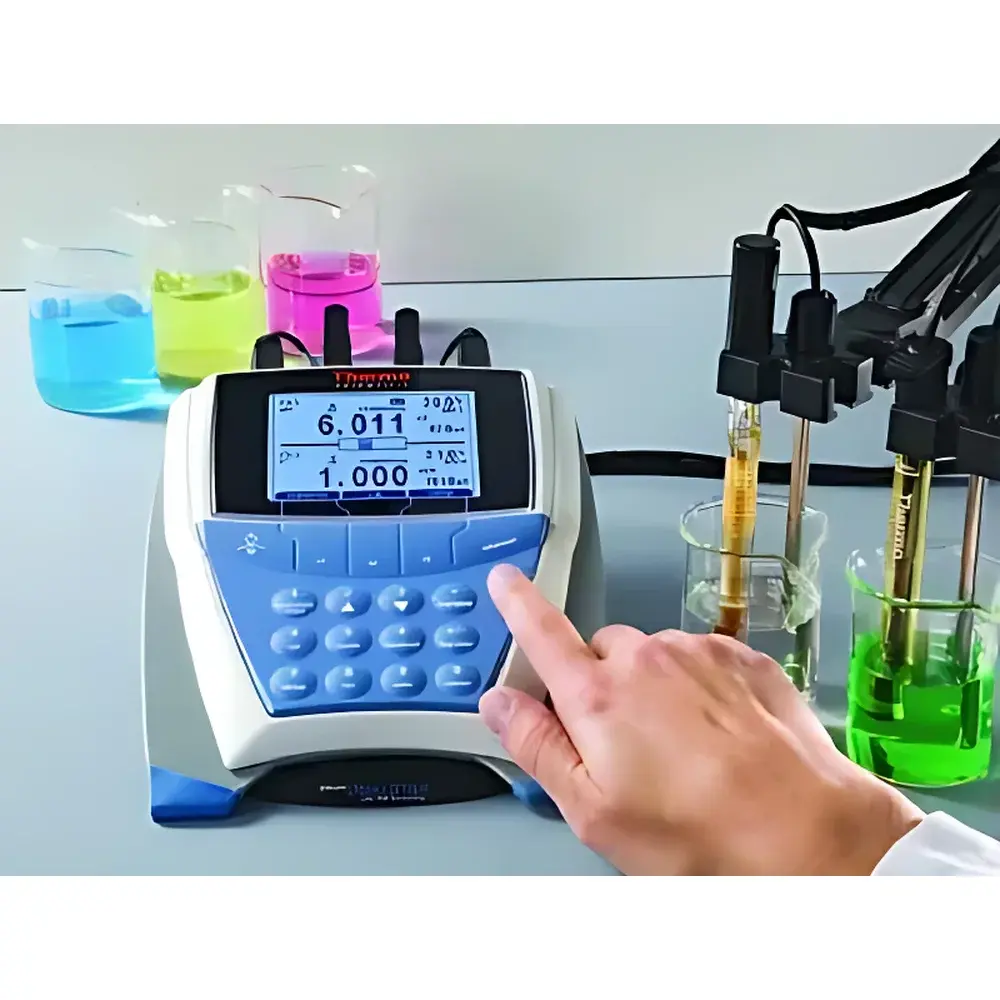
Thermo Fisher Orion Dual Star D10P-53 Iodide Ion Selective Electrode Meter
| Brand | Thermo Fisher |
|---|---|
| Origin | USA |
| Manufacturer Type | Original Equipment Manufacturer (OEM) |
| Import Category | Imported Instrument |
| Model | D10P-53 |
| Pricing | Upon Request |
| ISE Electrode | 9653BNWP |
| Iodide Measurement Range | 0.005–127,000 ppm |
| pH Range | 0–14 |
| Temperature Range | 0–80 °C |
| Reproducibility | ±2% |
| Electrode Dimensions | 110 mm length × 13 mm body diameter × 16 mm cap diameter |
| Cable Length | 1 m |
| Dual-Channel Meter Resolution | 1–3 significant digits |
| Relative Accuracy (Ion) | ±0.1 mV or ±0.05% (whichever is greater) |
| Ion Units | ppm, mg/L, M, %, or unitless |
| Calibration Points | 2–6 |
| pH Range | −2.000 to 19.999 |
| pH Resolution | 0.1 / 0.01 / 0.001 |
| pH Accuracy | ±0.001 |
| ORP Range | ±1999.9 mV |
| ORP Resolution | 0.1 mV |
| Temperature Range | −5 to 105 °C |
| Temp Accuracy | ±0.1 °C |
| Data Storage | 1000 sets with timestamp |
| GLP Compliance | Yes |
| Connectivity | RS232 (bidirectional), optional USB |
| Enclosure Rating | IP54 |
| Certifications | CE, CSA, UL, TÜV, FCC Class A |
| Power | 4×AA batteries or universal AC adapter |
Overview
The Thermo Fisher Orion Dual Star D10P-53 Iodide Ion Selective Electrode (ISE) Meter is a laboratory-grade, dual-channel potentiometric analyzer engineered for precise, trace-level quantification of iodide (I⁻) in aqueous environmental, industrial, and regulatory-compliant water quality applications. It operates on the principle of ion-selective membrane potential measurement—where the 9653BNWP solid-state iodide-selective electrode generates a Nernstian response proportional to the logarithm of free iodide activity in solution. Coupled with a reference electrode and temperature compensation via the 927007MD thermistor probe, the system delivers thermodynamically grounded concentration values across a wide dynamic range (0.005–127,000 ppm). Unlike optical or colorimetric methods, this electrochemical approach eliminates interferences from turbidity, color, or complexing agents common in wastewater, seawater, pharmaceutical effluents, and iodized salt leachates. The meter’s dual-channel architecture enables concurrent monitoring of iodide and pH—or two independent ISEs—supporting method validation, matrix effect assessment, and real-time correction per ISO 10523 and ASTM D1293 guidelines.
Key Features
- Dual-channel design with independent BNC inputs, reference electrode ports, and MiniDIN temperature interfaces—enabling simultaneous iodide and pH measurement or parallel analysis using two ISEs (e.g., iodide + nitrate).
- Integrated support for standardized ISE methodologies: single and double standard addition/subtraction, blank auto-calibration, and user-defined isothermal point control.
- High-resolution LCD display showing iodide concentration (ppm/mg/L), mV potential, sample temperature, and ion name—all simultaneously and in real time.
- GLP-compliant data handling: password-protected method storage (up to 20 protocols), per-method access control, audit-trail-ready timestamps, and 1000-point internal memory with date/time stamping.
- Graphical calibration curve visualization directly on instrument display—facilitating immediate verification of linearity, slope (−57–−61 mV/decade at 25 °C), and electrode performance per ISO 17025 requirements.
- Rugged IP54-rated enclosure with CE, UL, CSA, TÜV, and FCC Class A certification—suitable for controlled lab environments and field-deployable mobile labs operating within 5–45 °C and 5–85% RH (non-condensing).
- Firmware upgradability via USB interface; bidirectional RS232 communication for integration into LIMS or automated sampling workflows (e.g., with AS-50 autosamplers).
Sample Compatibility & Compliance
The D10P-53 system is validated for direct measurement in clarified aqueous matrices including drinking water, surface water, groundwater, seawater dilutions, brine solutions, and treated wastewater. For high-ionic-strength or complex samples (e.g., iodized table salt extracts or pharmaceutical rinse waters), inclusion of 940011 Ionic Strength Adjuster (ISA) ensures constant background electrolyte activity—critical for Nernstian response fidelity. The 9653BNWP electrode exhibits negligible interference from chloride, bromide, and nitrate below 1000:1 molar ratios (per manufacturer specification), making it suitable for coastal monitoring where halide competition is prevalent. All operational procedures align with EPA Method 300.1 (for anions), ISO 10304-1 (ion chromatography cross-validation), and USP dissolution testing requirements where iodide serves as a release marker. Full GLP documentation—including electrode lot traceability, calibration logs, and user authentication records—is exportable for FDA 21 CFR Part 11–compliant environments.
Software & Data Management
Data acquisition and reporting are governed by Thermo Fisher’s Orion Star Com software (optional), which enables remote configuration, batch calibration management, statistical trend analysis (RSD, confidence intervals), and PDF report generation compliant with ISO/IEC 17025 clause 7.7. Internal firmware enforces electronic signatures, method locking, and change history logging—meeting ALCOA+ principles (Attributable, Legible, Contemporaneous, Original, Accurate). Raw mV and temperature readings are stored alongside metadata (operator ID, electrode serial number, ISA lot code), enabling full forensic reconstruction during regulatory audits. Export formats include CSV and XML for seamless ingestion into ELN platforms or enterprise QA/QC databases.
Applications
- Regulatory compliance monitoring of iodide in public drinking water per WHO guideline values (0.1–0.3 mg/L) and EU Directive 98/83/EC parametric limits.
- Environmental fate studies tracking iodide migration in soil leachate and aquifer recharge systems.
- Pharmaceutical manufacturing: quantification of residual iodide in active pharmaceutical ingredient (API) synthesis intermediates and final product stability batches.
- Nuclear industry coolant loop surveillance—iodide serves as a fission product surrogate in pressurized water reactor (PWR) chemistry control.
- Food safety laboratories verifying iodine fortification levels in dairy, bread, and dietary supplements per Codex Alimentarius STAN 1-1985.
- Academic research on iodine biogeochemistry in marine sediments and kelp forest ecosystems.
FAQ
What sample preparation is required prior to iodide measurement?
Minimal preparation is needed for clear aqueous samples. Turbid or particulate-laden samples must be filtered (0.45 µm) and pH-adjusted to 5–8 if outside the 0–14 range. Use 940011 ISA to maintain ionic strength ≥0.1 M.
Can the 9653BNWP electrode measure iodide in seawater without dilution?
Direct measurement is not recommended due to extreme ionic strength and bromide interference. Dilute 1:100–1:1000 with deionized water and apply standard addition for accuracy.
How often should the electrode be recalibrated?
Calibrate before each analytical session and after every 10–15 samples when measuring at low concentrations (<1 ppm); verify slope daily in multi-shift operations.
Is the D10P-53 compatible with non-Thermo ISEs?
Yes—any millivolt-output ISE with BNC termination and compatible reference junction (e.g., double-junction Ag/AgCl) can be connected, though performance validation is user-responsible.
Does the meter support automatic temperature compensation for all ISE measurements?
Yes—via the 927007MD temperature probe connected to either channel’s MiniDIN port; ATC applies to both ion and pH modes per NIST SRM 1692 traceability.
Related Products







