
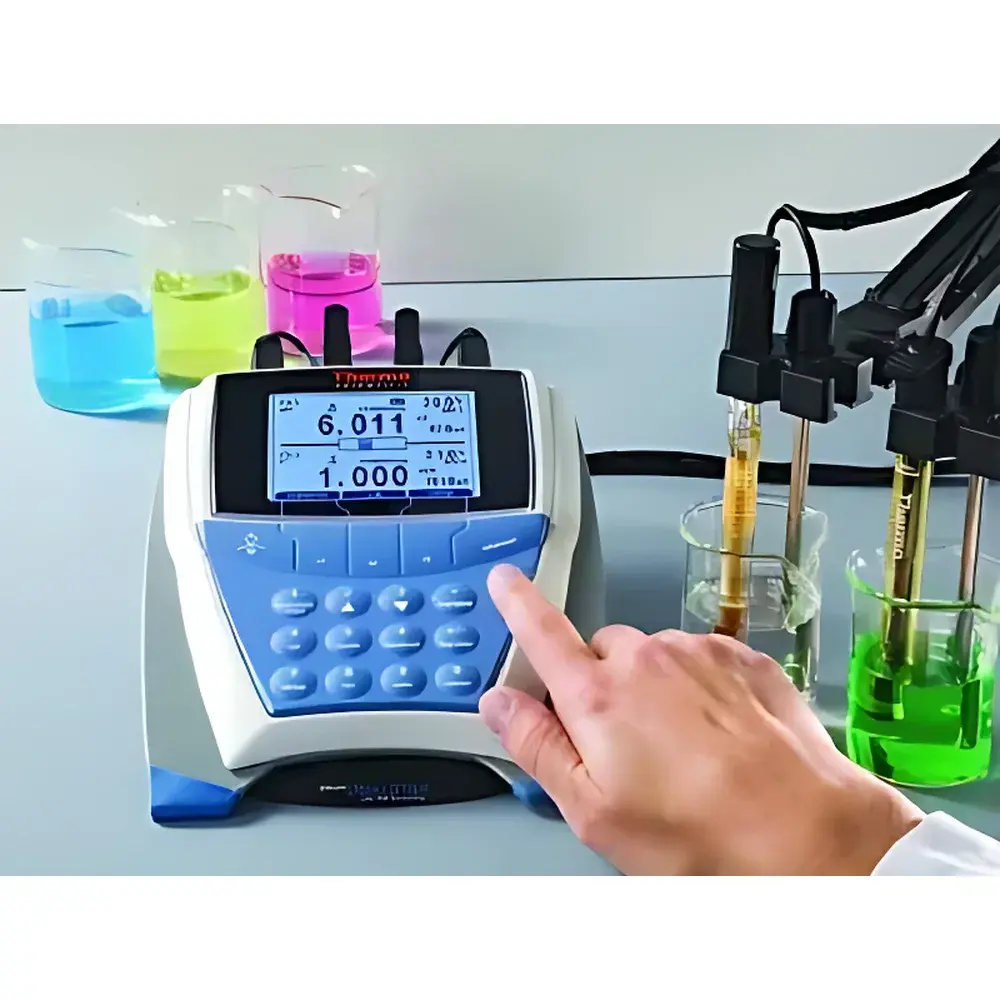
Thermo Fisher Orion Dual Star D10P-82 Lead Ion Analyzer
| Brand | Thermo Fisher |
|---|---|
| Origin | USA |
| Manufacturer | Thermo Fisher Scientific |
| Product Type | Imported Instrument |
| Model | D10P-82 |
| Price | Upon Request |
| Electrode | 9682BNWP Lead Ion-Selective Electrode |
| Measurement Range (Electrode) | 0.2–20,700 ppm Pb²⁺ |
| pH Range | 4–7 |
| Temperature Range | 0–80°C (continuous), 80–100°C (intermittent) |
| Repeatability | ±4% |
| Sample Type | Aqueous solutions |
| Electrode Dimensions | 110 mm length, 13 mm body diameter, 16 mm cap diameter |
| Cable Length | 1 m |
| Instrument Resolution (Ion Mode) | 1–3 significant digits |
| Ion Accuracy | ±0.1 mV or ±0.05% (whichever is greater) |
| Ion Units | ppm, mg/L, M, %, or unitless |
| Calibration Points | 2–6 |
| pH Range | −2.000 to 19.999 |
| pH Resolution | 0.1 / 0.01 / 0.001 |
| pH Accuracy | ±0.001 |
| ORP Range | ±1999.9 mV |
| ORP Resolution | 0.1 mV |
| Temperature Range | −5 to 105°C |
| Temp. Accuracy | ±0.1°C |
| Display | Dual-channel LCD |
| Inputs | Two BNC, two reference electrode, two MiniDIN (for ATC probes) |
| Method Storage | 20 methods |
| Password Protection | Yes |
| Data Storage | 1000 data sets with timestamp |
| GLP Compliance | Yes (audit trail, user ID, calibration history) |
| Connectivity | RS232 (bidirectional), optional USB cable |
| Enclosure Rating | IP54 |
| Certifications | CE, CSA, UL, TÜV, FCC Class A |
| Operating Environment | 5–45°C, 5–85% RH (non-condensing) |
| Power | 4×AA batteries or universal AC adapter |
| Dimensions | 9.4 × 17.0 × 22.4 cm (H×W×L) |
Overview
The Thermo Fisher Orion Dual Star D10P-82 Lead Ion Analyzer is a benchtop dual-channel potentiometric measurement system engineered for precise, trace-level quantification of lead ions (Pb²⁺) in aqueous environmental and regulatory compliance samples. It operates on the principle of ion-selective potentiometry, utilizing the 9682BNWP solid-contact lead-selective electrode — a polyvinyl chloride (PVC)-based membrane sensor with a lead-specific ionophore that delivers Nernstian response (≈29.5 mV/decade at 25°C) across a wide concentration range. The instrument integrates thermometric compensation via a built-in ATC (Automatic Temperature Compensation) interface and supports rigorous method validation under GLP and ISO/IEC 17025 frameworks. Designed for wastewater discharge monitoring, drinking water testing, soil leachate analysis, and EPA-regulated sample screening (e.g., EPA Method 9035, 9040), the D10P-82 provides laboratory-grade reproducibility without requiring chromatographic infrastructure.
Key Features
- Dual-channel architecture with independent BNC, reference electrode, and MiniDIN ATC inputs — enables simultaneous measurement of Pb²⁺ concentration and pH or ORP in the same sample matrix.
- Pre-configured lead-specific method library including single- and double-standard addition/subtraction protocols compliant with ASTM D3557 and ISO 10566 for low-conductivity or high-interference samples (e.g., rainwater, groundwater).
- Graphical calibration curve display with real-time slope calculation, detection limit estimation, and residual error mapping per calibration point.
- GLP-compliant data management: full audit trail with user ID, date/time stamp, electrode serial number, calibration parameters, and method versioning — fully traceable for FDA 21 CFR Part 11–aligned workflows when paired with Orion Star™ Com software.
- Onboard password protection with hierarchical access control: administrator-level method editing, operator-level measurement execution, and read-only review mode.
- Robust physical design rated IP54 for resistance to dust ingress and water splashing — suitable for shared analytical labs, field-deployable mobile labs, and regulated QC environments.
- Flexible unit output: automatic conversion between ppm, mg/L, mol/L, and percentage — configurable per method to align with regional reporting requirements (e.g., EU Drinking Water Directive limits: 10 µg/L).
Sample Compatibility & Compliance
The D10P-82 is validated for direct potentiometric measurement in clarified aqueous matrices including surface water, treated effluent, potable water, acid-digested soil extracts (per EPA SW-846 Method 3050B), and industrial process streams. The 9682BNWP electrode exhibits minimal interference from common cations (Ca²⁺, Mg²⁺, Na⁺, K⁺) below 1000:1 molar ratio and is tolerant of moderate chloride concentrations (<0.1 M). For complex matrices (e.g., wastewater sludge filtrates), standard addition methodology compensates for ionic strength variations and junction potential drift. The system meets performance criteria outlined in ISO 10304-1 (determination of dissolved metals by ISE), ASTM D3557 (lead in water), and supports documentation required for ISO/IEC 17025 accreditation — including calibration certificate traceability to NIST SRMs and documented uncertainty budgets.
Software & Data Management
Data acquisition, method deployment, and report generation are supported via Orion Star™ Com PC software (Windows-compatible, USB or RS232), enabling automated export to CSV, PDF, or LIMS-ready XML formats. The instrument logs all measurements with embedded metadata: operator ID, electrode serial number, ambient temperature, calibration slope (%Nernst), and deviation from ideal response. Audit trail records include timestamps for every calibration event, method modification, and data deletion — satisfying ALCOA+ principles (Attributable, Legible, Contemporaneous, Original, Accurate, Complete, Consistent, Enduring, Available). Firmware updates are delivered via secure USB transfer; no internet connectivity is required during operation — preserving network integrity in air-gapped analytical facilities.
Applications
- Regulatory compliance testing for Pb²⁺ in municipal drinking water per US EPA Lead and Copper Rule (LCR) action level verification (15 ppb).
- Leachate monitoring from landfill containment systems per TCLP (Toxicity Characteristic Leaching Procedure) protocols.
- Process control of electroplating rinse baths and metal finishing effluents.
- Research-scale speciation studies where rapid Pb²⁺ screening precedes ICP-MS confirmation.
- Educational laboratories conducting quantitative electroanalytical chemistry experiments on selectivity coefficients and membrane response kinetics.
FAQ
What is the lower detection limit for Pb²⁺ using the 9682BNWP electrode?
The practical quantitation limit is approximately 0.2 ppm (200 µg/L) under optimized conditions (pH 5.0–6.5, ionic strength ≥0.1 M NaNO₃); sub-ppm measurements require standard addition and matrix-matched calibration.
Can the D10P-82 measure Pb²⁺ in acidic digests without dilution?
Yes — the electrode tolerates pH down to 4.0; however, samples below pH 4.0 must be buffered with acetate or MES buffer prior to measurement to prevent membrane degradation and H⁺ interference.
Is the instrument compatible with automated sample changers?
Yes — RS232 command protocol supports integration with Thermo Fisher Auto-Sampler AS-600 or third-party XYZ robotic platforms via ASCII-based SCPI-like instructions.
How often must the 9682BNWP electrode be reconditioned?
Polishing with 948201 abrasive strip is recommended after every 50 measurements in turbid or organic-rich samples; routine storage in 0.1 M Pb(ClO₄)₂ solution preserves membrane potential stability between uses.
Does the system support multi-point calibration with non-linear fitting?
No — calibration follows strict linearized log-concentration vs. mV transformation per IUPAC guidelines; curvature outside ±2 mV deviation from linearity indicates electrode fouling or reference junction blockage.







