
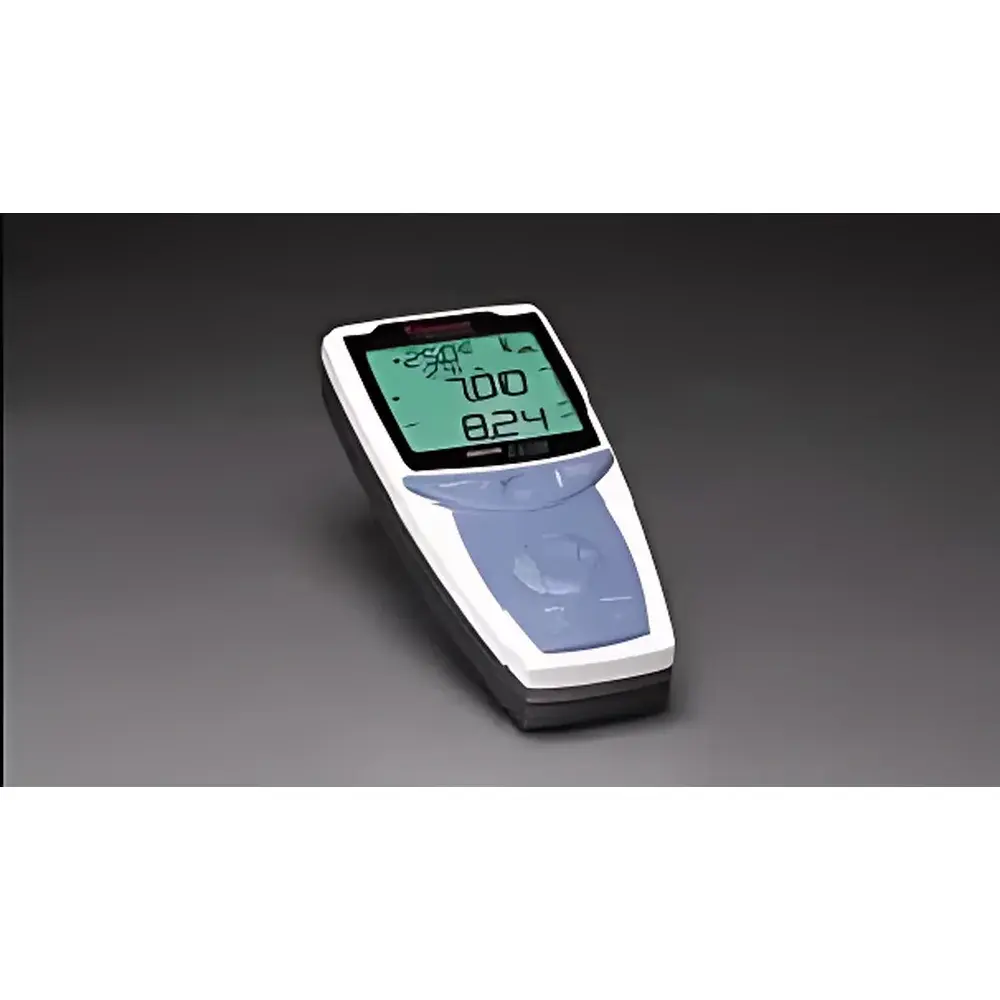
Thermo Scientific Orion Star A320C-06 Precision Portable Pure Water Conductivity/TDS/Salinity Meter
| [Origin | USA |
|---|---|
| Manufacturer Type | Authorized Distributor |
| Origin Category | Imported |
| Model | 320C-06 |
| Price | Upon Request |
| Conductivity Range | 0.000–3000 mS/cm |
| Resolution | Up to 4 significant digits, down to 0.001 µS/cm |
| Conductivity Accuracy | ±0.5% of reading or ±0.01 µS/cm (whichever is greater) |
| Resistivity Range | 0.0001–100 MΩ·cm |
| Salinity Range | 0.01–80.0 ppt NaCl |
| TDS Range | 0–19,999 mg/L |
| Cell Constant Range | 0.001–199.9 cm⁻¹ |
| Reference Temperatures | 15°C, 20°C, or 25°C |
| Electrode Compatibility | Two-electrode, four-electrode, and planar conductivity cells |
| Calibration Points | 1–5 points |
| Temperature Range | −5°C to 105°C |
| Temperature Resolution | 0.1°C (−5°C to 99.9°C), 1.0°C (>99.9°C) |
| Temperature Accuracy | ±0.1°C |
| Temperature Compensation | Automatic or manual |
| Display | Backlit LCD |
| Connectivity | Mini-DIN conductivity sensor port |
| Data Logging | 200 entries |
| Calibration History | Last 10 calibrations stored |
| Method Storage | 10 user-defined methods |
| Self-Test | Yes |
| Password Protection | Yes |
| Firmware Update | Network-enabled via PC software |
| Power | 4×AA batteries |
| Certifications | CE, CSA, UL, TÜV, FCC Class A |
| Operating Environment | 5–45°C, 5–85% RH |
| Ingress Protection | IP67 (portable unit), IP54 (benchtop variant)] |
Overview
The Thermo Scientific Orion Star A320C-06 is a high-precision, portable conductivity meter engineered for rigorous measurement of ultra-pure water in regulated industrial and laboratory environments. Designed around the fundamental principle of conductance measurement—where electrical current flow between electrodes immersed in solution is inversely proportional to resistivity—the A320C-06 delivers trace-level resolution essential for pharmaceutical water systems (PW, WFI), power plant boiler feedwater, semiconductor rinse water, and bioprocess monitoring. Its architecture supports three distinct electrode configurations (two-electrode, four-electrode, and planar cells), enabling accurate compensation for polarization effects and cable capacitance—critical when measuring sub-µS/cm conductivities where stray currents and surface contamination significantly impact reproducibility. The instrument operates with configurable reference temperatures (15°C, 20°C, or 25°C) and implements linear or non-linear (NaCl-based) temperature compensation algorithms compliant with ASTM D1125 and ISO 7888 standards.
Key Features
- Smart Stability™ algorithm dynamically adjusts response time based on signal noise level, reducing stabilization delay without sacrificing accuracy—particularly beneficial during rapid sequential measurements of low-conductivity samples.
- Smart Averaging™ mode calculates weighted moving averages over user-defined intervals (1–60 seconds), suppressing transient spikes while preserving true baseline values in turbulent or thermally unstable environments.
- Automatic recognition of three standard calibration solutions (84 µS/cm, 1413 µS/cm, 12.88 mS/cm) eliminates manual entry errors; up to five-point calibration ensures linearity across wide dynamic ranges—from 0.001 µS/cm (18.2 MΩ·cm resistivity) to 3000 mS/cm.
- Comprehensive self-diagnostic suite verifies electrode integrity, cable continuity, battery voltage, memory status, and internal reference stability prior to each measurement cycle—fully documented in GLP-compliant diagnostic logs.
- IP67-rated housing guarantees dust-tight operation and immersion resistance up to 1 m for 30 minutes, meeting IEC 60529 requirements for field deployment in wet or washdown-intensive settings such as clean-in-place (CIP) validation or raw water intake monitoring.
- Configurable password protection restricts access to calibration functions, method editing, and data export—supporting role-based operator permissions aligned with FDA 21 CFR Part 11 Annex 11 and EU GMP Annex 11 requirements.
Sample Compatibility & Compliance
The A320C-06 is validated for direct measurement of Type I–IV purified water per USP General Chapter Conductivity, EP 2.2.38, and JP 2.05. It meets all critical parameters specified in ASTM D5127 (Standard Guide for Conductivity Measurements in High-Purity Water) and ISO 14687-2 (Fuel cell grade water purity). When paired with an Orion 013005MD ultra-low-conductivity cell (cell constant = 0.01 cm⁻¹), the system achieves detection limits suitable for continuous monitoring of condensate return loops and steam generator feedwater. All stored data include mandatory metadata: timestamp, operator ID, electrode serial number, calibration history, ambient temperature/humidity, and measurement mode—enabling full audit trail reconstruction per ALCOA+ principles.
Software & Data Management
Data export is supported via RS232 serial output or optional USB-to-serial adapter, compatible with Thermo Scientific Orion LogR software (v3.2+). The firmware embeds full GLP functionality: 200 measurement records retain full context—including raw analog counts, applied temperature correction factor, and electrode-specific calibration coefficients. The last ten calibration events are archived with date/time stamp, standard used, slope/offset values, and pass/fail status against ±2% acceptance criteria. Ten user-defined methods can be saved locally, each containing preconfigured units, temperature compensation model, averaging duration, and alarm thresholds. Optional Orion Compliance Software enables electronic signatures, audit trail review, and 21 CFR Part 11-compliant electronic record archiving—including immutable hash logging and user activity tracking.
Applications
- Pharmaceutical manufacturing: Real-time verification of purified water (PW) and water for injection (WFI) quality during distribution loop sampling per USP Stage 1–3 testing protocols.
- Power generation: Monitoring condensate polisher effluent and turbine gland seal leakage using four-electrode cells to eliminate polarization error at <1 µS/cm levels.
- Biotechnology: In-line conductivity verification of buffer preparation tanks and chromatography eluent streams prior to column loading.
- Semiconductor fabrication: Final rinse water qualification in wafer cleaning tools, where residual ionic contamination must remain below 0.05 µS/cm.
- FDA-regulated food & beverage facilities: Verification of CIP final rinse conductivity against established SOP thresholds to confirm detergent removal.
FAQ
Does the A320C-06 support automatic temperature compensation for non-aqueous solvents?
No—it is calibrated and validated exclusively for aqueous electrolyte solutions. Non-aqueous media require separate instrument qualification and custom temperature coefficient input, which is not supported out-of-the-box.
Can the instrument store calibration data for multiple electrodes simultaneously?
Yes—each electrode is assigned a unique identifier during setup; calibration parameters (slope, offset, cell constant, date) are stored per electrode ID and auto-recalled upon connection.
Is the RS232 interface optically isolated?
No—RS232 communication uses standard TTL-level signaling. For electrically noisy industrial environments, use shielded cabling and ground-loop isolation adapters.
What is the maximum allowable cable length between the meter and conductivity cell?
For optimal signal integrity with sub-µS/cm measurements, keep cable length ≤3 m. Longer runs require active shielding and low-noise coaxial cable rated for 10⁹ Ω insulation resistance.
How often should the instrument undergo full performance verification?
Per ASTM D1125 guidance, verify daily with certified reference standards before first use; perform full system check (including electrode impedance and temperature sensor accuracy) weekly or after any physical shock or environmental exposure beyond specifications.




